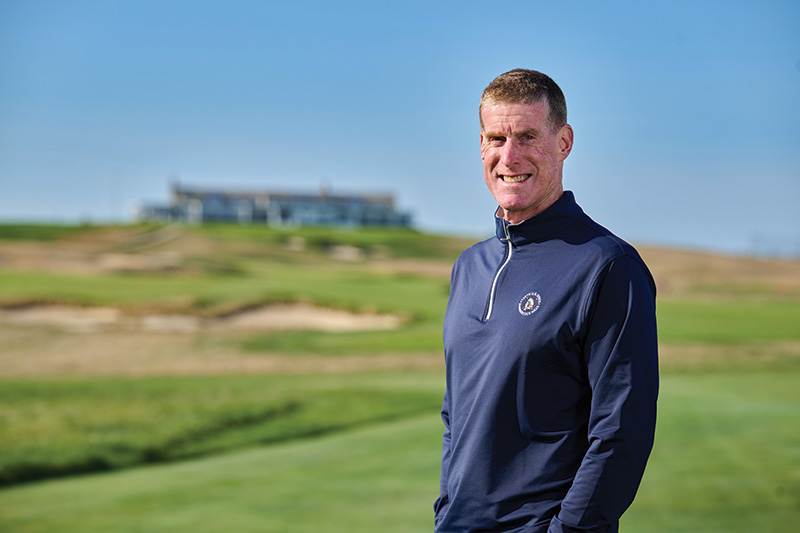
Jon Jennings, CGCS, will lead his team as it welcomes the 126th U.S. Open at Shinnecock Hills Golf Club in Southampton, N.Y. Photos by Benny Migliorino
As he strolled the grounds at his home away from home for the last 14 years, Jon Jennings, CGCS, gazed with delight.
The walk, with Jennings side by side with wife, Susan, and their black English Labrador Retriever, Oslo, on this serene, early spring weekend morning at Shinnecock Hills Golf Club in Southampton, N.Y., confirmed all this wonderland has to offer. “Just the beauty of the place. Osprey flying overhead. The sun came up. It was a crisp morning, but you could feel the spring in the air with just the moisture and the warmth of the sun and smell the earth and the grass,” Jennings says. “I mean, that just never gets old.”
One would think his assessment of this iconic and legendary links-style golf locale between Great Peconic Bay and the Atlantic Ocean on Long Island sounds like a spot one would want to stay forever. For Jennings, though, life at Shinnecock Hills GC has advanced to the sunset stage, more of a time-is-of-the-essence story — and he plans to have the time of his life this month for the remainder of the journey before he retires later this year.
The entire world will witness Jennings presiding over this golf course as his career winds down. The 126th U.S. Open scheduled June 18-21 will be the sixth U.S. Open there and the second with Jennings in charge, the last being 2018. Since that event eight years ago, some things have changed there and, some have not.
His staff, many of whom entered the scene since the beginning of COVID-19, are firmly in place. Jennings’ well-orchestrated plan for them has been significant. Their inclusion is important throughout Shinnecock Hills as it nears another march in its storied history.
Josh Bard, one of Jennings’ team members, is reminded daily of what this historic event is about. He sees it whenever he’s in the maintenance area. “I have been looking at the countdown clock — every day, sometimes 10 times a day,” says Bard, a one-year GCSAA member.
To Jennings, a 41-year GCSAA member, this sweet ride, which concludes at the end of 2026, is more about those who work with him, whom he works for and an opportunity to embrace what it means. There’s too much still to do at the U.S. Open, so the focus is firmly on that. “Keeping my head down and staying focused on what we need to achieve here,” he says.
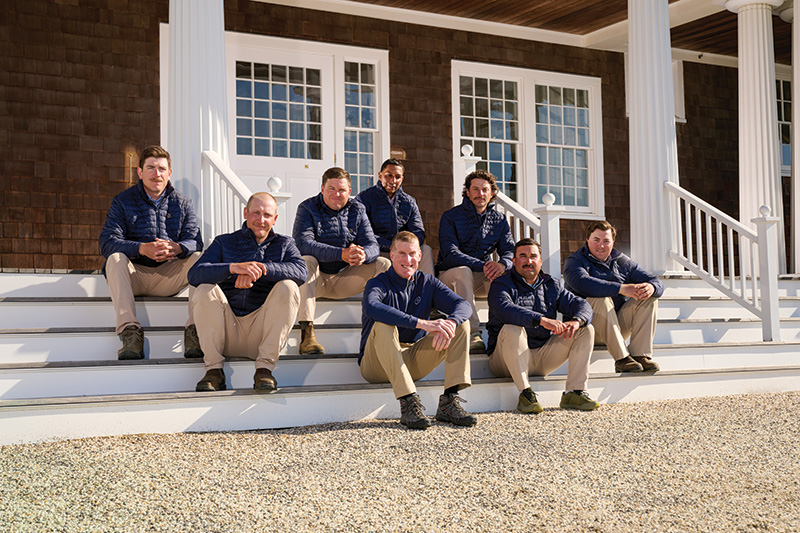
Jennings’ Shinnecock Hills staff includes, front row: Jennings and Josh Bard; second row: Steven Page and Justin Strecker; third row: Peter Barnaby, Mark Goggin and Russ Bolarinho; and, fourth row, Matt Smith.
The road to Shinnecock Hills
Matt Smith is in his sixth year at Shinnecock Hills and is well versed on what this land represents. He has not wasted a moment of it overlooking what Jennings has meant to him now and in the future.
“He’s here sunup to sundown, 40 years of being in this industry including as a superintendent, giving us his knowledge,” says Smith, an assistant and four-year GCSAA member whose relatives worked at Shinnecock Hills for decades. His uncle, Peter Smith, was superintendent for the U.S. Open in 1986 and 1995.
Jennings’ road to Shinnecock Hills was launched 44 years ago. His roots can be traced to his hometown at Madison (Conn.) Country Club. “I enjoyed what I was doing, always enjoyed operating equipment and shoveling snow, the kind of work I did in my neighborhood,” he says. That led to his want for more, including as a turfgrass student at the University of Massachusetts-Amherst, which set the stage for jobs at places such as En-Joie Golf Club in Endicott, N.Y., and Onondaga Golf & Country Club in Fayetteville, N.Y.
In 2000, Jennings’ career took off. One of those who knows him well says it set the stage for a perfect match someday between Jennings and Shinnecock Hills. Twenty-six years ago, Jennings started at famed Chicago Golf Club in Wheaton, Ill.
“It definitely was an exciting time to go to a historic club steeped in history and to manage it and maintain it,” Jennings says of the club founded in 1892. Twelve years later, Shinnecock Hills came calling. Their interest was impossible to ignore, punctuated by a question asked and answered by himself. “It was hard to leave (Chicago GC). Career-wise, you’re only asked once to come to Shinnecock. And if you said no, you weren’t going to be asked again,” he says. “Do I want to be at the U.S. Open (in 2018) managing the golf course, or do I want to be watching it on TV?”
Jennings, who volunteered at Shinnecock Hills for the 2004 U.S. Open, accepted. And he hasn’t looked back.
Veteran golf course superintendent Bob Ranum had a feeling something special was happening as he watched Jennings flourish. Ranum, a 47-year Retired member who was at Atlantic Golf Club in Bridgehampton, N.Y., saw this coming when Jennings made the move to Shinnecock. “He came from Chicago GC, one of the greatest flat courses in the world. He came to Shinnecock with the idea of what great architecture is, and he’s at a very educated membership,” says Ranum. “He’s a hands-on super, still goes out and changes cups.”
At Shinnecock Hills, Ranum witnessed how Jennings took bold steps. “He expanded fairways for the angles and expanded the greens at the same time,” Ranum says.
Otherwise, Ranum says Jennings had the sense to understand the lore of Shinnecock Hills and let it be what it was meant to be. “I told him his course is like a beautiful lady. Don’t put makeup on it. Let it be beautiful,” Ranum says.
Jennings’ presence at both Shinnecock Hills and Chicago Golf GC placed him in some notable history. Jennings is believed to be the only golf course superintendent to have overseen more than one of the five USGA charter-founding clubs. The other courses are The St. Andrews Golf Club in Hastings-On-Hudson, N.Y.; The Country Club in Brookline, Mass.; and Newport Country Club in Newport, R.I.
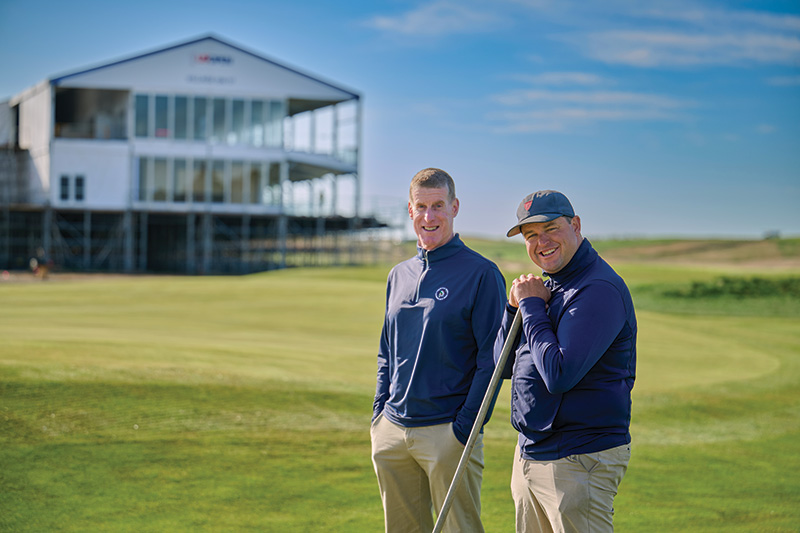
Jennings, left, with assistant superintendent Mark Goggin.
Better than ever
Golfers first teed it up more than 100 years ago at Shinnecock Hills. All these decades later, “stay the course” appears to be an appropriate stance.
“Has anything changed since we hosted the Open in 2018? Not really,” says Jennings. “In my opinion, it (the golf course) is better. The playing surfaces are better. The course overall is firmer. It’s just really good.”
Founded in 1891, Shinnecock Hills originally was a 12-hole course and later was expanded to 18 holes. They were revised and designed by architect William Flynn and opened in 1931. “The course is going to play as it was architecturally set up. There’s just a lot of texture to the place. Instead of trying to set it up a certain way, the course is going to play as it should,” Jennings says. “The elements come into play with the wind, the sun, the grasses.”
USGA Senior Director of Championship Agronomy Darin Bevard says that greens under Jennings and his maintenance team are noticeably improved. “They focused on managing Poa annua on those greens, and they have responded very well. I would’ve called them Poa-bent greens in 2018. I’d call them Poa greens now,” says Bevard. “Not to say there’s not a little bent in some of them, but I’d say we’re playing on Poa annua greens this time around.”
Perhaps the most noticeable difference in this U.S. Open compared to 2018: The fairways were narrower eight years ago than they are now, says Bevard, noting that fairways will average 5 to 6 yards wider this year than they were in 2018, “which is wider than many expect for a U.S. Open,” he says. “It’s going to play at the width Shinnecock Hills membership plays it, which is pretty wide.”
This will be the 14th U.S. Open for Bevard, a 36-year GCSAA member. Some have been at the same venue, but with different superintendents. This will be his first with the same superintendent. “I will say he runs one of the tightest ships in terms of golf course maintenance and his team of any superintendent that I work with,” Bevard says. “It’s details. Everything needs to be done when it’s supposed to, everything needs to be in its place. He’s just very detail oriented, which they all are, but it’s across the board with Jon. It’s not just that he’s detailed on the golf course. It’s from every interaction you have with him and his team. That’s the thing I would probably say he’s exceptional at.
“Jon is a great guy, and I call him a friend. And I want him to go out with a bang.”
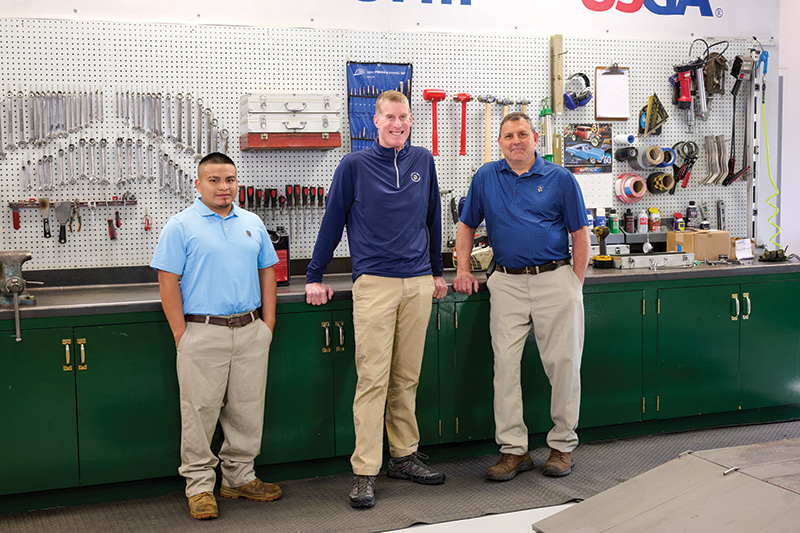
Time in the shop with, from left: Miguel Miguel, Jennings and Larry Arena.
Team effort
Peter Barnaby may know more about Shinnecock Hills than anybody in the maintenance department — including his boss. “I grew up and caddied here in 2008,” says Barnaby, a five-year GCSAA member.
Barnaby is among the numerous assistants under Jennings. Also, the shop is led by equipment manager Larry Arena, a six-year GCSAA member. After the 2018 U.S. Open, Jennings’ staff changed. People moved on, which often happens after majors, for those seeking opportunities elsewhere, including the rise to become superintendents. In the process of change, Jennings altered how his team operates. Now, there is no lead assistant. There are seven of them. They each have a role, specific duties that can be interchangeable on occasion.
“It’s a streamlined system of management. Each assistant carries the same level of management and can step in if needed to help in something,” Jennings says. “The reason I did that is because the majority of them started at the same time with the same skill set. So, to pick one out of that group and move them up ahead, I didn’t feel is fair. I tried something different, and this worked out well. They all have specialties and are able to carry it forward.”
Russ Bolarinho is among them. “Whatever you do, you’ve got to own it. It’s about accountability,” says Bolarinho, a seven-year GCSAA member who’s into water management. “We’ve built a system. There’re processes. You do it over and over and become well-oiled machines.”
How he landed at Shinnecock Hills is interesting, as is like some of the other assistants there. Bolarinho once worked at a country club and spent time on the golf course in maintenance in the morning and was a banquet server and later in the day helped during weddings.
Mark Goggin, 35, was a hockey standout in his youth. A Chicago native, he attended Dartmouth College and blossomed into a stellar forward. He was selected by the Boston Bruins in the NHL’s entry draft in the seventh round in 2009. Injuries detoured his career on the ice before he found the golf industry. He worked at golf clubs in the Boston area, attended turf school through Rutgers University and eventually sought Shinnecock Hills. The reason is simple. “I wanted to work a U.S. Open, to be honest with you,” says Goggin, a five-year association member who attends to the bunkers. “We know what the standard is here, to make Shinnecock as perfect as possible.”
As a hockey player, Goggin understands the team aspect and how it can relate to maintenance. He and assistants Justin Strecker and Steven Page teamed up to watch the Masters. They bought the Taste of The Masters, a global service that delivers concessions from the Masters, even including those pimento cheese sandwiches. Overall, this group has bonded, whether at work, out playing darts or watching a major championship. This month, they’ll be right in the middle of that rather mammoth event. “We all have a common goal, and we really look out for each other,” says Strecker, a seven-year GCSAA member who was raised in Hampton Bays and schooled at UMass.
Page, an eight-year association member who attended Michigan State University (where he posted a lofty 3.75 grade-point average), is unlike any of the other assistants. “I’m a triplet,” he says.
This entire group has added up to a unified, stellar team, says Arena, who is among those darn decent with a golf club in his hands. “In Orlando (at the GCSAA Conference and Trade Show), the whole crew went, and we got to play golf,’’ he says. “It was fun. We’ve got a bunch of good guys.”
Jennings counts his blessings for every one of them. “The team we assembled in the last eight years is phenomenal, and they’re the ones that have made things better,” Jennings says. “We shared our vision with them, and they’ve taken it and run with it. It’s a matter of getting the right people, getting good people who are quality-oriented and work well together. It’s like any good team — you have to have a team that works well together and plays as a team.”
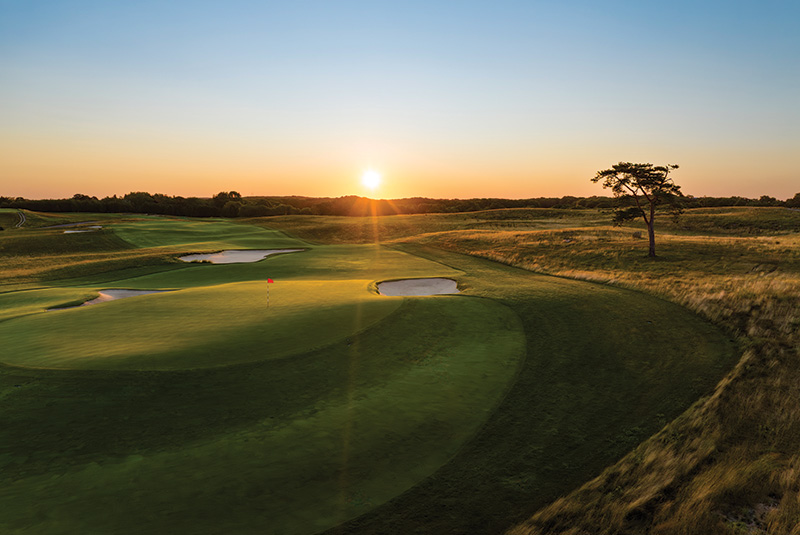
The 13th hole at Shinnecock Hills. Photo courtesy of the USGA
The current and the future
As he was in final prep mode for the U.S. Open, Jennings reflected on the major and the goodbye coming later this year. Why did he decide to retire? It’s not one reason. “Susan and I talked about it for a few years: When is the right time? It’s a big year for Shinnecock, it’s a big year for golf, and it’s a big year for me professionally with the U.S. Open championship,” says Jennings, father of children Samantha and Ted. “Looking ahead to 2036, the men’s and women’s U.S. Open will be contested back-to-back at Shinnecock. Obviously, I won’t be here for that, so it’s time for somebody else to come in and learn the lay of the land. For that, it’s a good inflection point.
“Susan and I both are healthy right now. We enjoy outdoor activities, and, honestly, how many years do you have of that? Do I work till I’m 70 (he’s 63)? What if I have a health issue and never have a chance to do the things I want to do? It’s just a good point for us personally and professionally to do something different, including rekindling friendships.”
Asked if he has had an impact on the golf industry and also Shinnecock Hills, Jennings says, “Anytime I do anything, whether it’s cleaning the garage at home or anything I do at work, it’s just to hopefully have someone say it’s better than before I started,” Jennings says. “I don’t believe I’ve got a big ego, and I’m not looking to leave an imprint on anything, but if someone plays the golf course and says, ‘Boy, this is better than it was five years ago, 10 years ago or 20 years ago,’ that’s when I feel I’ve made a difference.”
As for how he’d want to be remembered, Jennings says, “Leaving the golf course better than I found it. A strong work ethic. Being fair with people. I’m not looking for a legacy to hang my hat,” he says. “I was hired to do a job, and that’s pretty much what I focused on doing.”
Howard Richman (hrichman@gcsaa.org) is GCM’s associate editor.