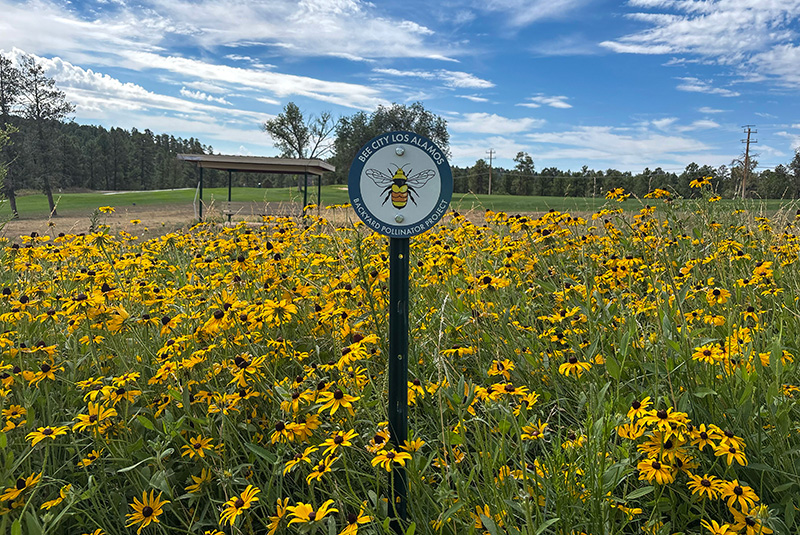
Los Alamos County Golf Course transformed an eyesore of an area formerly referred to as the Bermuda Triangle into a lovely pollinator-friendly meadow thanks to a cooperative venture with nonprofit Bee City Los Alamos. Photo by Jason Tomko
Los Alamos County Golf Course’s Bermuda Triangle has received an impressive glow-up.
Nestled near the southernmost tip of the New Mexico facility, near the point of what appears to be an arrowhead shape between the Nos. 1 and 3 greens and No. 4 tees, the Bermuda Triangle, as local golfers came to refer to it, had been a bit of an eyesore.
“It was just this brown, barren area,” says Jason Tomko, GCSAA Class A golf course and ice rink superintendent at the facility in Los Alamos and 13-year association member. “Then in the rainy season, it was just 3-, 4-foot-tall weeds.”
The tense is important here, because now that section of the course that was built in 1947 by the Atomic Energy Commission is among its most beautiful after a cooperative project between the course and the local nonprofit Bee City Los Alamos. Golf course staff and volunteers from that backyard pollinator project — part of the Pajarito Environmental Education Center in Los Alamos — helped turn the Triangle into a meadow, filled with wildflowers and grasses.
“Bee City started by having a demonstration garden and a few other little areas where they tried to do some pollinator gardens,” Tomko said. “Our director (Community Services Department Director) Cory Styron said, ‘Hey, we have a lot of usable dead space here at the golf course. Maybe we can do something with them.’ That’s when they brought me on board, and I said I’d love to do that.”
The wildflower haven formerly known as the Bermuda Triangle is one of several areas on the recently renovated Los Alamos County GC that sit outside or just on the edge of the irrigation system. It was conspicuous, but also a testing ground for Tomko.
“It’s about a 9,000-square-foot area that turning the irrigation around would hit,” he says. “We started with that 9,000 square feet as kind of a proof of concept. We have another 2 or 3 acres we’re planning to do over the next few years.”
Involvement by the course’s staff was minimal. Because the Bee City folks didn’t want the area touched by herbicides, Tomko tilled it instead. Bee City volunteers turned out in September 2025 to sow the seeds, a mix of native grasses, like blue grama, buffalograss and Indians rice grass, and wildflowers, like blue flax, prairie coneflower, black-eyed Susans and primrose.
“Tilling it just re-tilled the weeds back into it,” Tomko says. “Once they sowed it and let it go, probably about 30% of the area is kind of weedy. They’ve been back to weed it a few times, but they said, ‘Moving forward, let’s treat everything.’”
Despite the weeds, the meadow has proven to be a marked aesthetic upgrade from the barren brown of before. The grasses and flowers were part of seed mixes from a nearby seed supplier — which the course bought for a “couple hundred dollars” — that provide nearly season-long color.
“They all have different seasons, which is nice,” Tomko says. “You have the flax going in June, then the black-eyed Susan in July. Now (in late August) the coneflower and gaillardia are really blooming. We have about 3½ months of actual flowers.”
Golfers’ opinions are mixed.
Though they universally acknowledge the visual upgrade, “Golfers are fickle,” Tomko says with a laugh. “Some of them think it’s pretty cool. Others are mad they lose their golf balls in there.”
Tomko — who, as his title suggests, in the (golf) offseason tends to the Los Alamos County Ice Rink, the only refrigerated, NHL-regulation, outdoor ice rink in New Mexico — says he’s not much of a “bee guy.” But the folks at Bee City know their bees (fun fact: New Mexico is home to nearly 1,000 species of native bees) and other pollinators, and they’re pleased with the outcome.
“They came out and did some checks,” Tomko says, “and there are a lot of bees in there.”
Next spring, Tomko hopes to expand the project more visibly. Five of the course’s 18 holes lie to the north of New Mexico State Road 501, and there’s another Triangle-like area there between holes Nos. 12 and 13 that Tomko would like to give the pollinator-area treatment.
“You can’t really see the Bermuda Triangle from the road,” Tomko says. “But that area between 12 and 13, it’s elevated. If you’re driving by, you can see that. It’s more visible. I want to sow that so people driving through can see it and enjoy it.”
Andrew Hartsock is a GCM staff member.