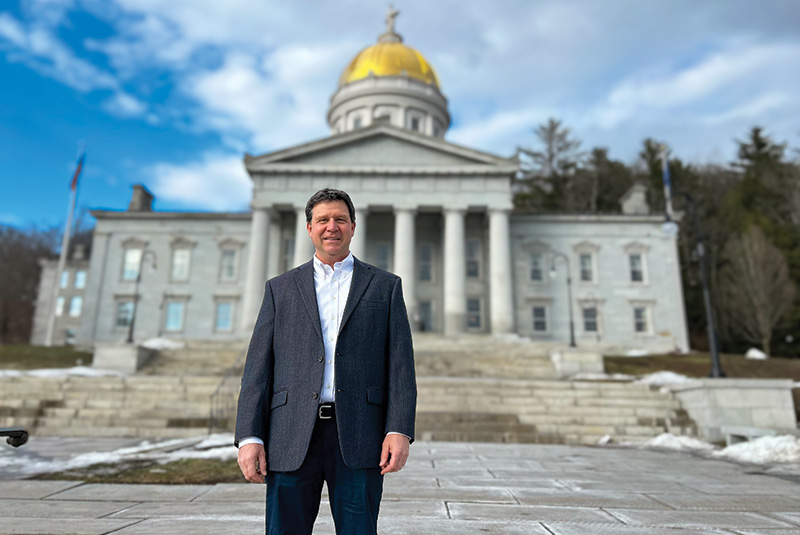
Kevin Komer, CGCS, director of agronomy at The Club at Spruce Peak in Stowe, Vt., in front of the Vermont Statehouse. Photos courtesy of Kevin Komer
Sometimes things happen when you’re in the right place at the right time. And raise your hand when the time comes.
That proved to be the case for Kevin Komer, CGCS, the winner of this year’s GCSAA Excellence in Government Affairs Award.
In 2010, Komer — director of agronomy at The Club at Spruce Peak in Stowe, Vt. — was a freshman member of the Vermont GCSA board of directors and hadn’t yet given much thought to being the active advocate for golf that he has since become.
“There was an unexpected resignation of the current board president. We looked around the room, and no one was raising their hand to be president — so I said I’d jump in,” said Komer, a 34-year GCSAA member.
“What happened right when I became president is, the whole issue of phosphorus pollution blew up in Vermont. There were algae blooms on Lake Champlain. So that really caught a lot of people’s eyes.”
Komer may have been new to his leadership position for golf in the state, but he knew Vermont GCSA had to do something. “With advocacy, you see something come up, and you have to act,” he says. “People were making kind of rash decisions in the legislature as far as what to do with phosphorus. It’s very important for our industry and all of agriculture really. So, we knew we had to go testify.”
Vermont GCSA already had a lobbying firm retained and another superintendent willing to testify on behalf of phosphorus users. Komer said Ken Lallier — golf course maintenance director at Quechee Club in Hartford and 38-year GCSAA member — was ready to testify, and Komer tagged along to observe.
“He did all the talking,” Komer says. “I learned a lot from that process, being there, being in the room.” He said Lallier told the Natural Resource Committee about whom the Vermont GCSA represented and what professional golf course superintendents do — namely, why it was important to preserve the responsible use of fertilizers like phosphorus.
“They were like, ‘That’s great, but you have no plan for phosphorus. You have no guidelines.’ So, we started a whole process of creating a nutrient management plan.”
Komer said that experience advocating in the statehouse led to Vermont GCSA working with the University of Vermont to create nutrient guidelines for the state.
“We needed to show what we were doing so that the legislators would feel comfortable with our industry.
“It was a very long process, but it was a way to — I don’t know if you’d call it a compromise — but it was a way to set some guardrails for use of phosphorus,” Komer says.
“That whole process got me intrigued with advocacy. I’ve been the go-to guy ever since, when something pops up. Our law firm that’s at the statehouse on a day-to-day basis keeps the ear to the ground and lets us know if things are bubbling up. Then we go and learn about what’s going on and testify.”
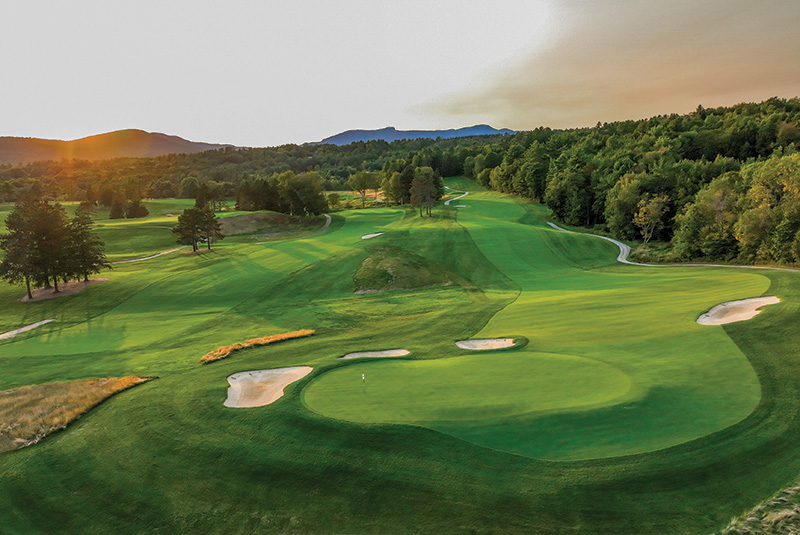
Stowe Country Club, which Komer also oversees.
It’s all about education
Sixteen years and numerous times testifying later, Komer has been awarded GCSAA’s Excellence in Government Affairs Award for his efforts. The award recognizes a chapter, superintendent or coalition for outstanding advocacy or compliance efforts in government affairs. Komer was formally honored in February at the 2026 GCSAA Conference and Trade Show in Orlando.
“GCSAA congratulates Kevin on his extensive advocacy efforts that undoubtedly enhance and sustain the game of golf in the state of Vermont,” GCSAA CEO Rhett Evans said. “We applaud his focus on environmental stewardship on the golf course and for telling his superintendent story that highlights the positive aspects of an often-misunderstood game and industry.”
Komer says testifying in the legislature isn’t hard or all that complicated. In fact, it’s about keeping things as simple as possible for legislators who, in most cases, are new to issues that superintendents deal with every day.
“Basically, it’s all about education,” Komer says. “You walk into a committee room, and the legislators don’t really know about our profession at all. It’s kind of shocking, to be honest. So you just need to educate them about who we are, what we do and that we are environmental stewards at the end of the day. I’ve been asked some crazy questions, like, ‘Can you use sheep again?’ Or they’ve asked me, ‘Why don’t you all just go organic?’ So when you walk in there, you really need to have an open mind because you may get questions that you wouldn’t even think possible. You have to keep a straight face and just educate them.”

A 2006 photo of (from left) Bob Cupp (designer), Kevin Komer, Walter Frame (project manager), Joe Pesci (ownership).
Neonicotinoids in the crosshairs
That was the case recently when some in the Vermont legislature were advocating for a full ban of pesticides containing neonicotinoids. Among other things, advocates of the bill to ban neonics said they were harmful to critical bee populations. Again, Komer said he viewed his role in testifying as simply educating legislators.
“When the neonicotinoids were on the chopping block, like most anything, these are broad-reaching bills that come through,” he said. “So, I just explained to them how we use neonicotinoids. It’s usually in weed-free environments, so bees aren’t even foraging on grasses. We use it once a year. We water it in. It’s very safe. It’s not put on bare soil — just the complete opposite of how it’s used in agriculture. The committee chairs understood that — that it’s really a nonissue on golf courses.” (Read his testimony here: https://bit.ly/40Ns7aF)
Thanks in part to Komer’s testimony, the committee ultimately created an exception for golf courses to enable their use of neonicotinoid pesticides.
Komer said when testifying, it’s important to keep cool and answer questions that may otherwise be irritating.
“I really get fired up when these bills come up that aren’t based on science or fact. It’s all based on emotion and what people think or feel,” Komer says. “So, it’s all just an education effort more than anything. Sometimes it works, and sometimes it doesn’t. This was a victory recently with the neonics, but who knows what’s going to come tomorrow. It’s not too often we get a victory, so we don’t really stand around and celebrate because something could be coming down the road next year.”
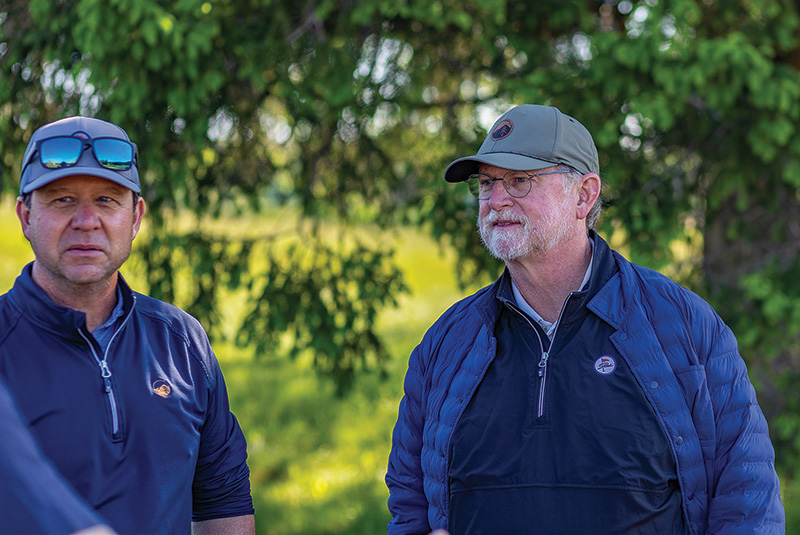
Komer, left, with Beau Welling, the designer of the recent renovation at Stowe Country Club.
Statehouse regulars on working with Komer
Komer is Vermont state Rep. Jed Lipsky’s constituent, and fortuitously Lipsky is also on the House Agriculture committee, where the bill proposing to ban neonicotinoids received its first hearings. Lipsky said the committee heard from many advocates on both sides of the issue — the same as it does with most bills it considers — and Komer stood out for his depth and breadth of knowledge and ability to explain the issue clearly.
“Most importantly, he has a deep understanding of soil science, chemistry and the economic impact of outdoor recreation in the small state of Vermont, how critical our 65 golf clubs are,” Lipsky says. “Kevin Komer was probably the most articulate and best prepared and most thoughtful witness that we heard on that issue.”
Asked what he would tell GCSAA members about how to be an effective advocate for golf, Lipsky was quick to respond: “I think they should have Kevin’s number on speed dial, because he’s an extraordinary example and resource,” he says. “And do your homework like Kevin. Have accurate facts and be as truthful as you can determine. That makes you much more effective.”
The lobbyist that the Vermont GCSA enlists — Matt McMahon, partner at MMR based in Montpelier, Vt. — said what makes Komer invaluable as an advocate is not only his knowledge but also his ready availability.
“Things change so quickly in the legislature,” McMahon says. “So what makes a huge difference is having somebody who’s incredibly responsive and has a deep knowledge of the substance, a real practitioner like Kevin. That is invaluable for somebody like myself, who maintains relationships but doesn’t have the practical knowledge of how legislation would apply to a superintendent.”
McMahon said Komer also knows how to talk with people. “The work that superintendents do, the products they use, the techniques that they use, there can be complicated jargon that’s very technical,” McMahon says. “Kevin has a great ability to put things into layman’s terms so that anybody can understand it. That’s incredibly helpful when you’re talking with a group of legislators who may not have that grounding.”
Growing up with golf
Growing up, Komer spent a lot of time at Wyantenuck Country Club in Great Barrington, Mass., where his father was green chairman for decades. He said he played golf frequently and as a youngster shined shoes and helped out with odd jobs. He started working on the course in high school.
“I learned a lot from Peter Bacon (CGCS and 39-year GCSAA member). He just retired, but he was the longtime superintendent at Wyantenuck. I just liked working outside, and it kind of evolved from there,” he says.
Komer with son Austin on the sixth green at The Club at Spruce Peak in Stowe, Vt. In the background is Mt. Mansfield, Vermont’s highest peak.
When he went to the University of Massachusetts, he worked at The Orchards Golf Club in South Hadley, Mass. “That was where my grandfather was a member. It was a great classic golf course — it’s an old Donald Ross design. They held a women’s Open there one year,” he says.
“From there, I got my first assistant job at Sterling National Country Club in Sterling, Mass., and worked there for a couple of years. But I knew I wanted to move to Vermont. I got my first superintendent job at a little nine-hole course called John P. Larkin Country Club in Windsor, Vt. That was in 1998. That was a great experience. It was a blue-collar golf course, and I had a two-man crew there. It was all quick couplers in the fairways, so I watered at night myself. That was an overall great experience. But I knew I wanted to move on.”
Komer spent a few years at Neshobe Golf Club in Brandon, Vt., before he heard about the opening that would take him to where he is today. “I heard about a new construction job up in Stowe, Vt. — the Mountain Course at Spruce Peak. I was lucky enough to get hired to be the grow-in superintendent. So, I’ve been here since 2004, since the construction. It’s a Bob Cupp design. In doing that, I had the privilege of working with Billy Fuller, Bob Cupp’s agronomist. Billy Bunkers — that’s where that came from,” he said.
“Then in 2012, I got a call to go down and help at our sister course, Stowe Country Club. It’s 7 miles away but still owned by the same company. They were having some agronomic issues, so I went down there to supervise that process. That’s when my whole world changed, and I became the director of two golf courses. Stowe is a beautiful property. It sits right in the historic town of Stowe, rolling fields that used to be a dairy farm. But it got over-planted with pine trees over the years, so we started some tree removal and developing the fescue areas.
“The owners realized it could be more than it was, so they invested in a complete renovation two years ago,” Komer says. “So, a big part of my life for the last two years is that we did a Beau Welling Design renovation. It was an amazing process and pretty intense. Everything’s been redone. It was a ton of work and took a lot of sacrifice and a lot of time. We’re looking at a grand opening in July.”

The Club at Spruce Peak.
Advice for advocates
Looking back, Komer said being an effective advocate can be fairly straightforward.
“You have to start with the people who are favorable to the outdoor industries,” he says. “And then on a personal level getting them to know who you are — so there’s some trust in that. Like (Rep. Jed Lipsky), he knows I’m successful and hardworking and knows that I was in this to be truthful and honest. He knew I didn’t have any ulterior motives, that I was just looking out for our industry. I knew Jed, and he knew me, and he felt comfortable with backing me.
“We also walked through the statehouse, and we got help from our lobbyist. He introduced us to people who are friendly to our cause. You really have to work with a lawyer or lobbyist who knows the statehouse and is following what’s going on. You need some inside help. You have to know the players. Then you go in and just introduce yourself.
“The statehouse can be very intimidating and nerve-wracking and out of my comfort zone, but it’s slightly addicting. It’s a really cool place. It’s a tough place — tough to get things done, but it’s how things work,” Komer says. “You have to realize that there are some groups out there that don’t approve of what we do. You have to educate them on what we do and how we’re a benefit to communities and their neighborhoods, that we use pesticides and fertilizers correctly, safely, and they’re a big part of our business. We have to protect our profession. At the end of the day, there’s just a lot of misperceptions about what we do.”
Note: If you’d like to contact Kevin Komer about advocacy in your own state, his email address is: kevin.komer@destinationhotels.com.
Phil Cauthon (pcauthon@gcsaa.org) is GCM’s managing editor.