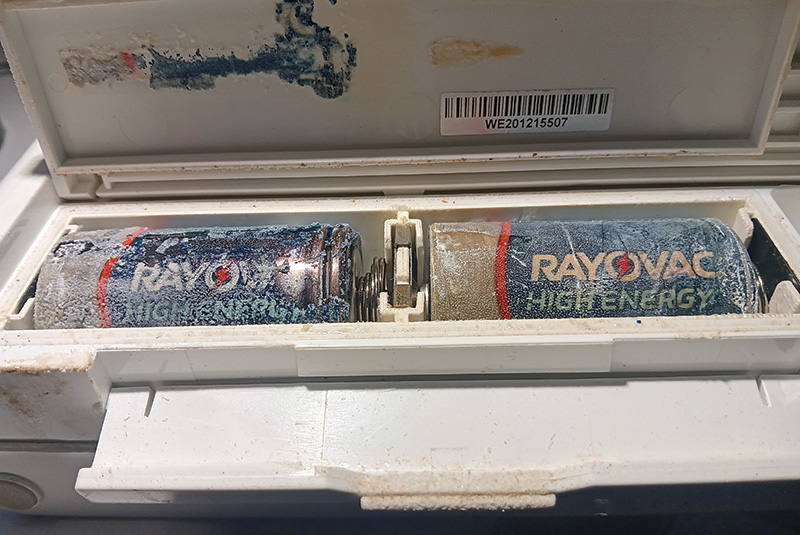
Alkaline battery leakage ate the insides of a portable radio that kept working with those batteries, giving no warning of the destruction. Photos by Scott Nesbitt
Leaking alkaline batteries were destroying my stuff and might be attacking your things.
I’ve started adopting safer lithium single-use batteries for frequently used devices and getting rechargeable batteries for things used only occasionally. For devices used less than once per week, it makes sense to install batteries as needed, removing them after use. You’ll spend more time but less money.
The magnitude of alkaline attack hit me when, after doing annual smoke detector battery replacement, I decided to check other devices while I had the battery storage box at hand.
Of 12 devices — multimeters, flashlights, radios, tachometers and such — three were alkaline victims. An $8 work light had white ooze. A $25 amp clamp/multimeter is gone forever because alkaline slime ate the circuit board. A $113 portable radio suffered damage to the battery box from severely leaking batteries. It still operates on 110-volt current but no longer works with batteries.
The flashlight and radio were working normally when examined. Alkaline batteries can leak and produce power at the same time. Fiendish. Some leakers had familiar brand names; others had odd names.
Blame electrochemistry and government for this problem. Batteries work by placing an electrolyte between two dissimilar materials, usually metals. The electrolyte provides a path for electrons to flow from one metal to the other. This electron flow powers devices, leaving corroded metals behind.
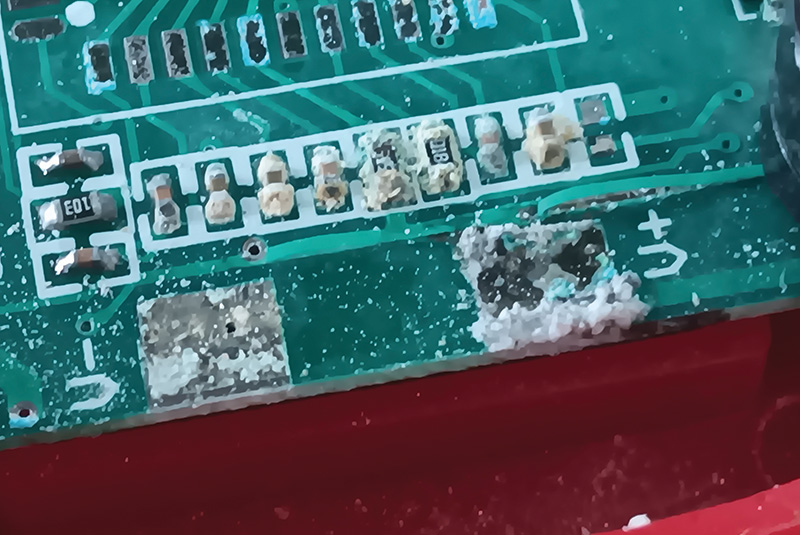
Leakage from two AA alkaline batteries coated the circuit board of an amp-clamp/multimeter with fine drops of corrosive spew. Driven by hydrogen gas escaping the mercury-free batteries, the corrosive electrolyte ate electrical and mechanical components and left fine droplets of caustic soda on the solid-state innards.
Batteries with alkaline electrolytes hit the mass market in 1961. They were a major improvement over the old carbon/zinc dry cells that often leaked their acidic electrolyte. Alkaline batteries produced good power over a longer period. Flashlights no longer got dimmer and dimmer before going dead. Boy Scouts made it back safely from night hikes. That drumming rabbit really kept going and going and going. Unlike the old acid batteries, the new ones rarely leaked.
Leaking became a problem in 1996 with enactment of the federal Mercury-Containing and Rechargeable Battery Management Act. Before it was banned, mercury was included, at 2% or less, to capture hydrogen gas released during breakdown of the alkaline potassium hydroxide (KOH) electrolyte. Thirty years later, battery makers have not found a way to stop hydrogen from spewing corrosive electrolyte.
Lithium batteries can leak from excess load, physical damage, excess heat or cold, or poor design and construction. But their chemistry reduces risk of leaks, and the stuff that oozes out is a messy but non-corrosive organic solvent gel.
Single-use, disposable lithium batteries are a direct replacement for alkaline or zinc/carbon — same physical size, same 1.5-volt output. At this time, it’s easy to find and afford lithium AA, AAA and 9-volt sizes. For independent guidance on what to buy, I found good info on YouTube, searching “AA battery tests,” and looking at videos from Project Farm, Lumencraft and Tools Tested.
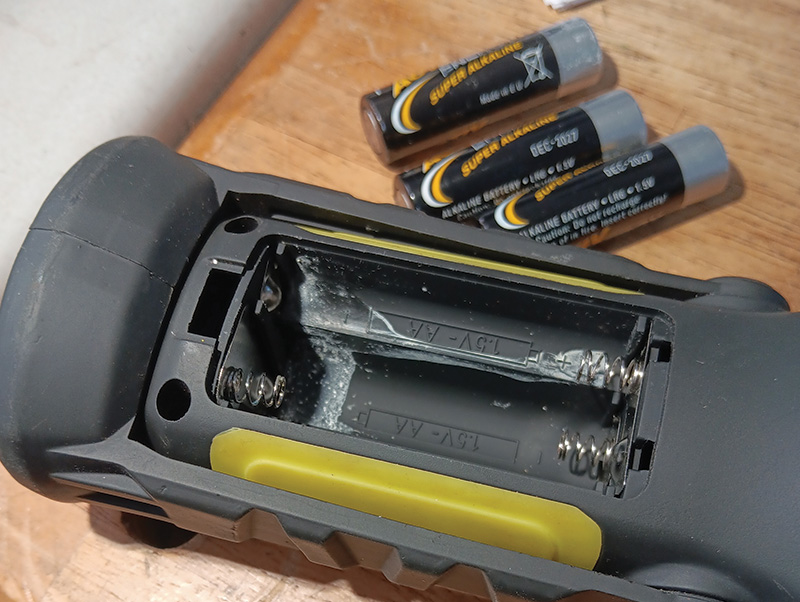
Removed before ruination, the three AA alkaline batteries had started to spread destructive corrosive ooze in the battery box of this work light, which kept working even while the batteries were self-destructing.
Single-use lithium C and D sizes are rare. Affordable rechargeable units are widely available. These are often charged with a USB cable like a cellphone, avoiding the need for a charging station. You might avoid rechargeable nickel-metal hydride (NiMH) or nickel-cadmium (NiCd) chemistry, as these make only 1.2 or 1.3 volts. If a multimeter needs 1.5 volts to give accurate readings, you can find rechargeable lithium units.
Finally, there is always the option of using alkaline batteries and removing them after using your device — or gambling they won’t erupt and ruin things.
Scott R. Nesbitt is a freelance writer and former GCSAA staff member. He lives in Cleveland, Ga.