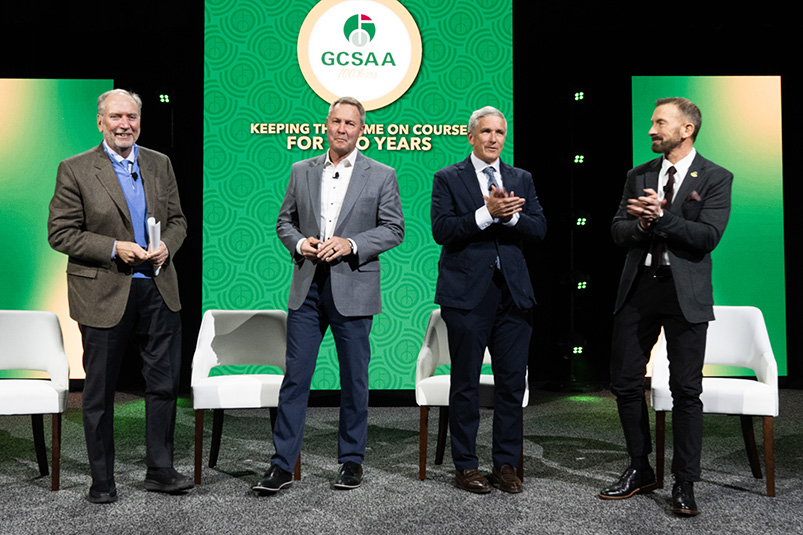
Jerry Tarde, editor-in-chief of Golf Digest; Mike Whan, CEO of the USGA; Jay Monahan, commissioner of the PGA Tour; and Rhett Evans, GCSAA CEO, took part in a discussion on the state and future of the industry during the Opening Session at the 2026 GCSAA Conference and Trade Show in Orlando. Photos by Montana Pritchard
Nearly 2,000 superintendents, assistants, equipment managers and other turfgrass industry professionals from across the country and beyond filled the Opening Session presented in partnership with Syngenta on Monday afternoon at the 2026 GCSAA Conference and Trade Show in Orlando.
The 90-minute welcoming session was filled with references to GCSAA’s Centennial Celebration, including the opening remarks by CEO Rhett Evans. Evans said it was critical to GCSAA founder Col. John Morley 100 years ago that the organization he founded be guided in the right way, the principled way.
“To help keep that front and center for me, I carry with me the very first National Greenkeeper magazine,” Evans said. “Its pages share our history, and it begins with Col. Morley at our very first meeting in 1926, addressing a small congregation. He opened with these words: ‘The association of mankind, for the purpose of advancement and improvement, is a divine arrangement. We are made for companionship. No life is or can be self-existent. We depend upon each other. As we prepare for the Centennial, it is clear that these words are not just part of our history, they are our foundation.”
CEO roundtable
Highlighting the event was a CEO roundtable moderated by Golf Digest Editor-in-Chief Jerry Tarde. The distinguished panel featured Evans; Jay Monahan, PGA TOUR Commissioner; and Mike Whan, USGA CEO.
Tarde led the group in an expansive discussion, starting with three challenges facing golf: Workforce shortages, environmental challenges and affordability. Whan answered first, saying the biggest challenge facing golf is clear to him.
“In a word, it’s water,” Whan said. “In the (USGA) Green Section, I’ve talked about it aggressively for the last six years: We don’t just want to be great research partners, we want to be able to give you the tools to put it into play. So it’s not a shock that we’re spending $20 million a year to try to figure out tools that we can provide, whether that’s (the USGA’s) DEACON apps or moisture meters.”
Evans agreed with Whan, taking it a step further. “When you talk about sustainability, you automatically go to the environment, water, land, energy, air and so on. Even more broadly, when we look at where we’re at and where the game is going, you look and labor and have to ask, ‘Is it sustainable?’ We need to make sure that we are developing the future leaders, the future superintendents. So talent acquisition, I think, is a piece of the puzzle in the sustainability question.”
Looking to the future, Tarde asked the panel to forecast how artificial intelligence would impact their organizations. Whan said he could see the USGA incorporating AI into a rules, questions and answers service.
“What AI really works well on is when you have a significant database of knowledge and correct answers that can only exist in one place,” Whan said. “We get 30,000 questions a year on the rules of golf sent in to the USGA. We’re not too far away from where, if you’re playing a round and your ball is on a root, you can simply pull up our AI on your phone and say, ‘My ball is on a root,’ take a picture of it, and a person will give you a ruling. If you asked ChatGPT that, it might give you an answer from 2004, or might give you a well-publicized wrong answer.”
Evans agreed that AI is going to change all their organizations. “But It’s junk in/junk out, so we’ve got to get this right. GCSAA is doing the same thing that Mike mentioned, like looking at our agronomy plans, whether it’s a nutrient benefit plan or weather and trying to figure out how to plan for the next year. We are developing our own AI bot that will take the right data and the right research from over the years so that when it’s used it’s coming from a reliable source.”
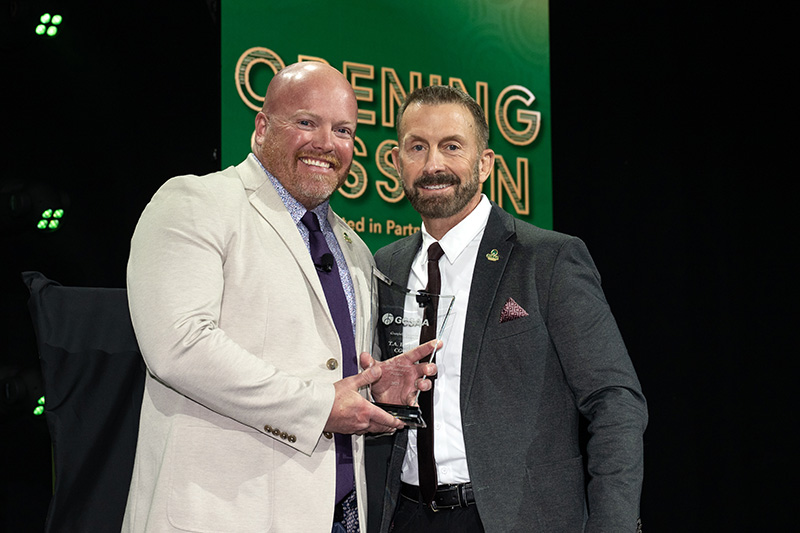
T.A. Barker, CGCS, GCSAA President, was recognized by GCSAA CEO Rhett Evans for his service on GCSAA's Board of Directors.
Award recognition
Among other highlights, the Opening Session also honored GCSAA President T.A. Barker, CGCS, as well several 2025 GCSAA award winners:
- Outstanding Contribution Award: Bert McCarty, Ph. D. — professor emeritus of plant and environmental sciences specializing in turfgrass science and management at Clemson University and 28-year GCSAA member.
- President's Award for Environmental Stewardship: Jim Pavonetti, CGCS, superintendent at Fairview Country Club in Greenwich, Conn., and 30-year GCSAA member.
- Colonel John Morley Award: Joseph Alonzi, CGCS Retired and 50-year GCSAA member and Bob Alonzi, CGCS Retired and 55-year member.