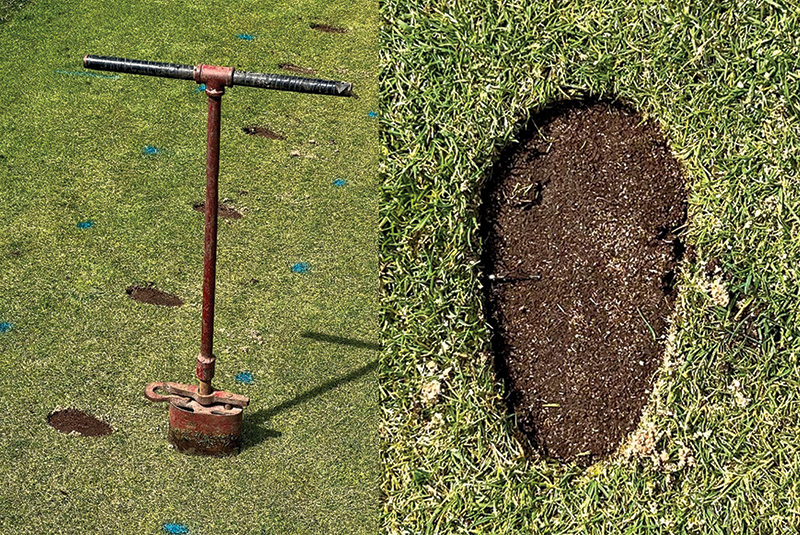
Figure 1. Divot repair tool (left). Example of resultant artificial divot created at 0.5-inch depth (right). Photo by Shehbaz Singh
In Lemont, Ill. (a south Chicago suburb), turfgrass researchers conducted a divot repair study. It was with the encouragement of green committee members who advise the Chicago District Golf Association’s Turfgrass Program. An unrepaired divot takes time to recover, and if not addressed, those divots interrupt playability (i.e., surface smoothness is compromised) and increase the likelihood of weed encroachment (1). Not surprisingly, golfers often mention divot repair as an issue that needs their superintendent’s attention.
The solution
There are several methods to achieve divot recovery on tees and fairways (6). For example, faster turfgrass recovery is achieved by adding turfgrass seed to a divot mix (3). The process of choosing turfgrass seed for a golf course’s divot mix is usually simple — just match the botanical composition of the playing surface. And so, creeping bentgrass (Agrostis stolonifera) seed is most often used in northern regions where it represents the primary playing surface used for golf. However, creeping bentgrass is a tiny seed, roughly 6 to 8 million seeds per pound, and poses a risk of contamination into roughs by wind or surface water runoff (4). Since Chewings fine fescue (Festuca rubra ssp. commutata) seed is larger and heavier, with about 450,000 seeds per pound, it is being considered by some golf course superintendents in divot mixes. We first learned of this divot mix cultural practice from Zach Nicoludis of the USGA Green Section (8).
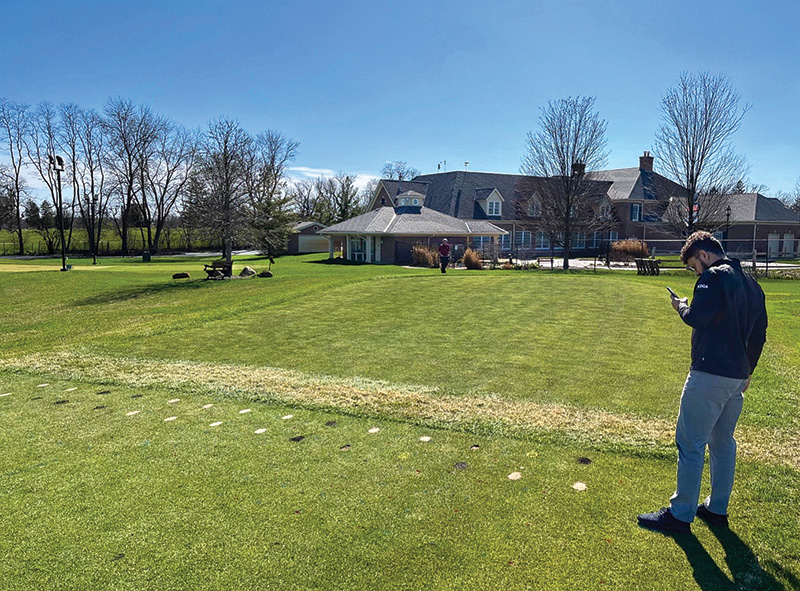
Figure 2. Spring: Divots were created in three areas of the same Kentucky bluegrass tee and corresponded to the initiation of a unique study in the spring (fresh spring divots visible), summer and fall. Each study would provide a data collection period lasting 98 days in Lemont, Ill. Photo taken by Derek Settle April 21, 2022
The advantage
In a divot mix, Chewings fescue seed is advantageous over creeping bentgrass seed because it reduces the risk of contamination in Kentucky bluegrass (Poa pratensis) rough areas and is quick to germinate. Mature Chewings fescue provides a fine-textured, dark green appearance and integrates well into turf mixtures. Chewings fescue is both non-spreading and noncompetitive because of its bunch-type growth habit. Chewings fescue seed represents a perfect choice for divot mixes because it can behave as a “nurse grass” and not interfere with surrounding stoloniferous (creeping bentgrass) or rhizomatous (Kentucky bluegrass) turfgrasses’ ability to recolonize (4).
Research needed
Until this work, no research had been published in a peer-reviewed journal to support the potential use of Chewings fescue seed in divot mixes as a nurse grass (10). Furthermore, few studies have explored divot recovery of Chewings fescue as a monostand or as a mixture with other turfgrass species. In one study, no significant differences for divot recovery were found among 25 mixtures of fine fescue species during a 12-month period (9). This suggests fine fescue species are less likely to persist in established stands of Kentucky bluegrass and creeping bentgrass. Of the fine fescue species, it is known that Chewings fescue can improve divot recovery when subjected to low-maintenance fairway conditions either alone or as a 50:50 mixture with colonial bentgrass (Agrostis capillaris) (2, 5). Therefore, the objectives of this study were to evaluate different divot mixes both with and without Chewings fescue seed for their ability to provide fast recovery of a Kentucky bluegrass tee, and to evaluate their seasonal (i.e., spring, summer and fall) performance. The treatments were considered acceptable only if 50% turf cover was observed within a divot recovery period of ≤56 days (eight weeks).
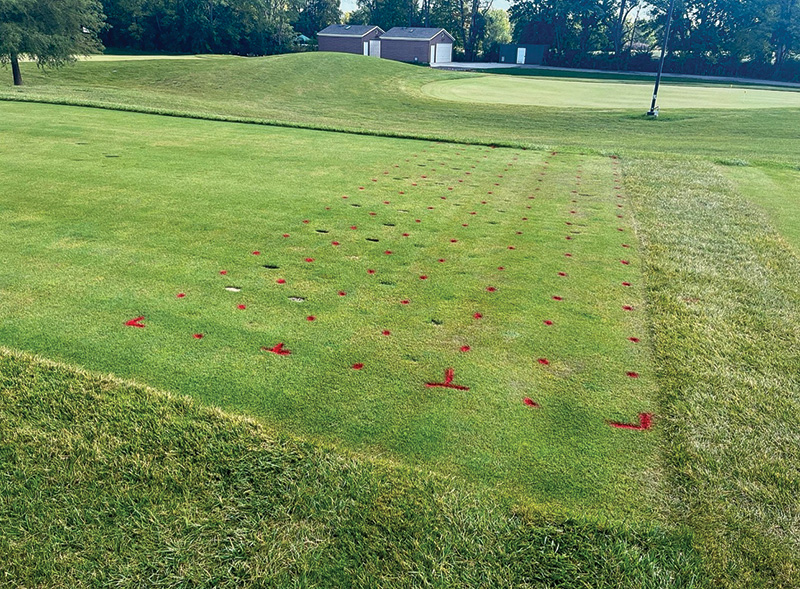
Figure 3. Fall: Divots were created in three areas of the same Kentucky bluegrass tee and corresponded to the initiation of a unique study in the spring, summer and fall (fresh fall divots visible). Each study would provide a data collection period lasting 98 days in Lemont, Ill. Photo taken by Derek Settle Oct. 6, 2022
Materials and methods
Small plot research
A field study was conducted in 2022 on a tee at the Chicago District Golf Association’s three-hole Bob Berry Sunshine Course in Lemont, Ill. The tee was seeded and established with HGT Kentucky bluegrass in the summer of 2020. The experimental design was a randomized complete block design (RCBD) with four replications. Individual plot size was 1.5 feet × 1.5 feet (0.46 meter × 0.46 meter), and a single divot was produced in the center of each plot. The tee was mowed twice per week at a height of 0.5 inch (13 millimeters) during the growing season. Judicious irrigation and fertilizer programs were included as needed to prevent drought stress and promote turfgrass health.
Divot creation
The divots were artificially created by using a divot repair tool obtained from North Shore Country Club in Glenview, Ill. (Figure 1). In each plot, a 3-inch-deep (7.6-centimeter-deep) turf core with an oblong divot-like shape was removed using the tool. To mimic an actual shallow divot made by a golf club, the upper 0.5 inch of the turf core was removed, and the lower remaining portion was carefully returned. Divots were created in three areas of the same tee and corresponded to the initiation of a unique study in the spring, summer and fall, and each would provide a data collection period lasting 98 days (Figures 2, 3). Seven treatments consisted of six divot mixes and one unrepaired divot as an untreated check (Table 1). As required, Leeward Chewings fescue seed was mixed with respective root-zone media just prior to divot filling to prevent any pre-germination. Treatments were filled by hand on the same day as divot creation.
Statistical analysis
Data were subjected to analysis of variance using the MIXED procedure of SAS statistical software 9.4 (SAS Institute). Area under the progress curve (AUPC) analysis is a standard method when quantifying turfgrass plot ratings over time using the trapezoidal integration method (7). Due to a significant Season × Divot mix interaction, most data are presented individually for each season (Table 2). Means were separated using Tukey’s Honestly Significant Difference test (p ≤ 0.05).
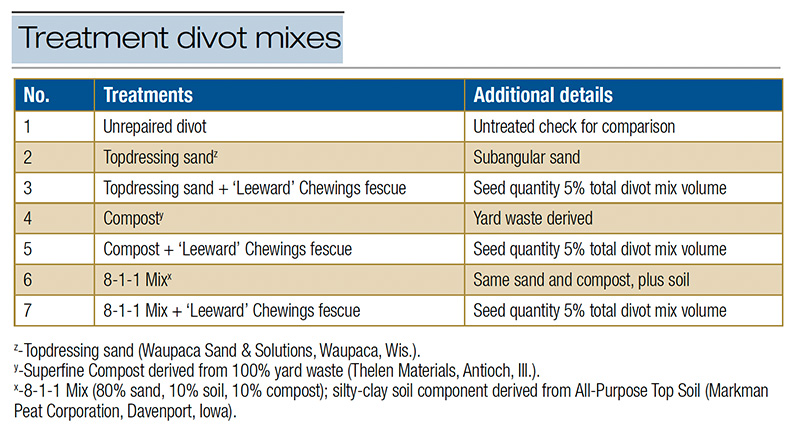
Table 1. Description of treatment divot mixes used in the field study at the Bob Berry Sunshine Course (Lemont, Ill.), 2022.
Results and discussion
Spring divot
By far, the biggest determining factor that allowed faster divot recovery was the presence of seed in a divot mix. Without Chewings fescue seed, divot recovery required long periods to reach the acceptable thresholds of 50% turf cover and ≥ 6.0 turfgrass quality (10). Let’s focus on the turfgrass cover data, because it tells the story best from a practical point of view. Days-to-acceptable turfgrass cover using divot mixes without Chewings fescue seed was 77-98 days (2.5-3 months). Days to acceptable turfgrass cover using divot mixes with Chewings fescue seed was 28-35 days. Results were similar to previous studies where the addition of seed (creeping bentgrass or Kentucky bluegrass) to a divot mix enhanced turf recovery in comparison to a divot mix without seed (3, 11).
The divot mix material matters, too. When looking at which divot mix would be most advantageous with seed, we found sand + Chewings fescue seed was the slowest (35 days) as one might expect (Table 3). In the spring, it turned out that compost + Chewings fescue seed or 8-1-1 mix + Chewings fescue seed were faster by a week (28 days). What’s the value of one week? The ability to have acceptable divot recovery seven days sooner, a 20% shorter time versus 35 days, would be considered important for golf course superintendents who strive for optimum turfgrass surface playability to benefit golfers and their game. Fast divot repair can be achieved in the spring by adding Chewings fescue seed to compost or 8-1-1 mix.
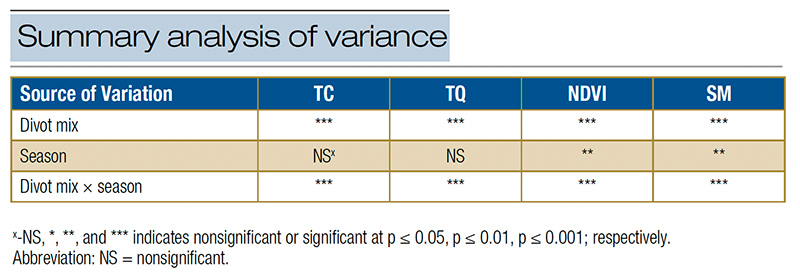
Table 2. Summary analysis of variance for percent turfgrass cover (TC) as an indication of divot recovery, visual turfgrass quality (TQ), normalized difference vegetation index (NDVI) and percent volumetric soil moisture content (SM) of experimental divots measured at 1.5-inch (3.81-centimeter) depth of experimental divots, Lemont, Ill., 2022.
Summer divot
Not all divot mixes with Chewings fescue seed were successful in the summer. Days to acceptable turfgrass cover using divot mixes without Chewings fescue seed was 70-84 days (2.5-2.75 months), which was similar to the long periods observed in the spring. Days to acceptable turfgrass cover using divot mixes with Chewings fescue seed was 21-77 days with 21 days for compost and 35 days for sand, while the 8-1-1 mix was 77 days for unexplained reasons (Table 3). A yellowing or chlorosis of new seedlings in the 8-1-1 mix with Chewings fescue seed was indicated by both turf quality and NDVI data (Figure 4). Temporary yellowing and loss in chlorophyll content of fine fescue species are associated with prolonged heat stress under controlled conditions (12). We also speculated that damping-off seedling disease may have occurred. Without pasteurization, it is known that the soil component of any sand-compost-soil divot mix has disadvantages of potentially harboring pathogenic Pythium and/or Rhizoctonia fungi, as well as weed seeds. Therefore, if fast divot repair is desired in the summer, adding Chewings fescue seed to compost or sand represent the best options.
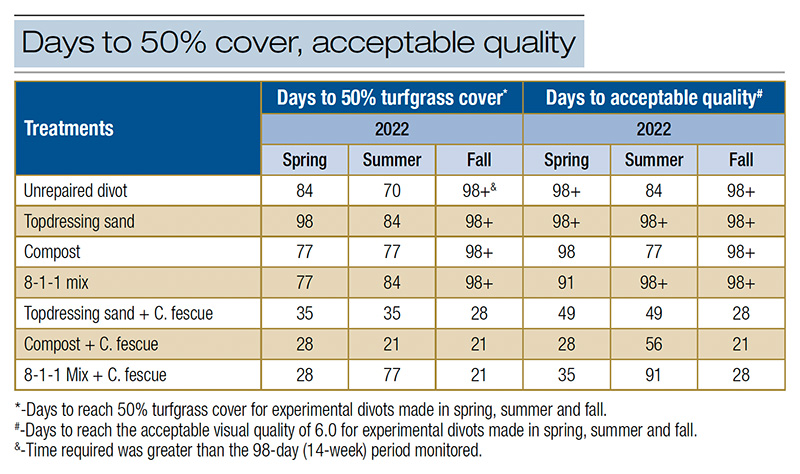
Table 3. Days to reach 50% turfgrass cover as a visual estimate of divot recovery and acceptable visual quality (i.e., rating of ≥ 6.0) for experimental divots made in the spring, summer and fall studies on a Kentucky bluegrass tee, Lemont, Ill., 2022.
Fall divot
Days to acceptable turfgrass cover using divot mixes without Chewings fescue seed was 98+ days (three-plus months). Days to acceptable turfgrass cover using divot mixes with Chewings fescue seed was 21-28 days (three to four weeks) (Table 3). Results in the fall were similar to those of spring, with all divot mixes containing Chewings fescue seed successful in delivering fast and acceptable divot recovery. Overall, no differences were observed between compost + Chewings fescue seed, or sand + Chewings fescue seed for divot recovery in the spring, summer or fall seasons. However, the 8-1-1 mix + Chewings fescue seed failed to deliver fast divot recovery in the summer.
Divot recovery is critical in the fall. Interestingly, divot mix treatments without seed were unable to surpass 25% turf cover during the 98-day evaluation period in the fall (data not shown). This meant every divot mix without Chewings fescue seed experienced unacceptable divot recovery by season’s end (Table 3). The evaluation of the 2022 fall trial continued until the summer of 2023 and revealed that fall-applied divot mix without Chewings fescue seed can require lengthy periods ≥280 days (10 months) to achieve acceptable divot recovery, given that winter dormancy halted divot recovery until spring (data not shown).
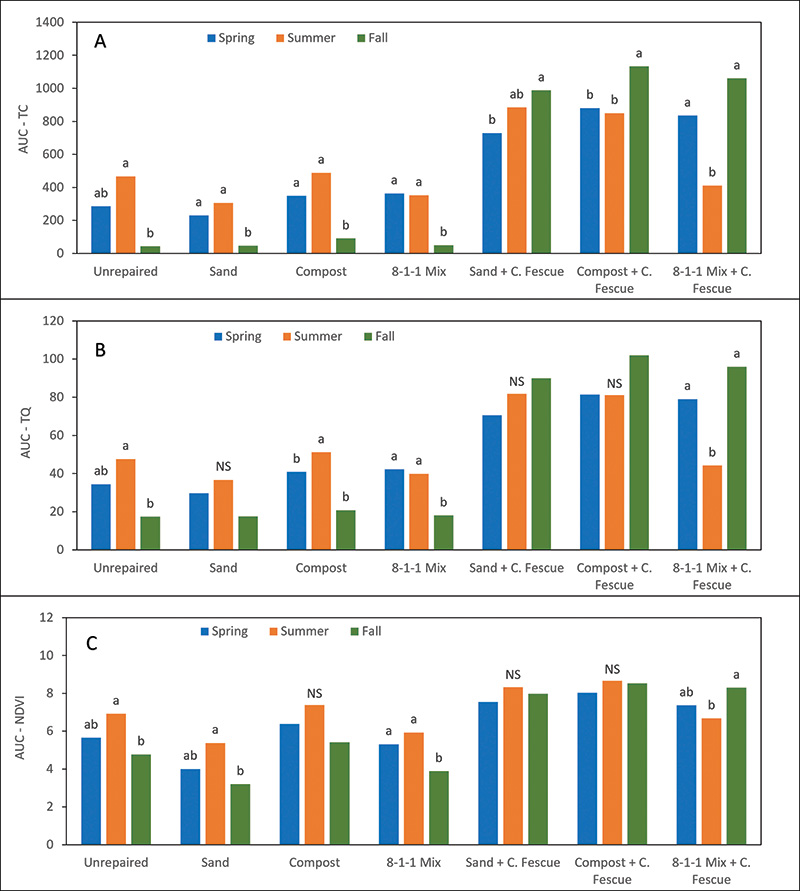
Figure 4. Area under the curve (AUC) for (A) turfgrass cover (AUC-TC), (B) turfgrass quality (AUC-TQ), and (C) normalized difference vegetation index (AUC-NDVI) of the seven divot mix treatments in spring, summer and fall on a Kentucky bluegrass tee, Lemont, Ill., 2022. Different letters indicate significant differences at p ≤ 0.05 among seasons within each divot mix treatment.
Concluding remarks
It has been said that most golfers associate golf course etiquette with the concept of repairing ball marks and divots. An unrepaired divot can recover on its own, but a level playing surface would be lacking for several months. What is the best way to repair a divot? This research challenges the traditional and widely accepted method of filling divots with sand alone. This research showed that turfgrass seed should be added to a divot mix if fast recovery of a tee surface is desired. Further, the addition of Chewings fescue seed to the divot mix was more important than the type of divot mix media used. Chewings fescue seed can be used as a robust “universal donor” in divot mix situations to replace Kentucky bluegrass seed, which is inherently slow to germinate and establish. This suggests Chewings fescue seed could also be used to reduce the risk of seed contamination into Kentucky bluegrass roughs by creeping bentgrass (i.e., adapt Chewings fescue seed use for creeping bentgrass tee situations). The addition of turfgrass seed in divot mixes to achieve fast recovery is most important in the fall because turfgrass growth naturally halts prior to winter dormancy. Future research is needed to determine if Chewings fescue can persist in preestablished tees and fairways that represent currently available Kentucky bluegrass or creeping bentgrass cultivars.
The research says
- This research showed that turfgrass seed should be added to a divot mix if fast recovery of a tee surface is desired. Further, the addition of Chewings fescue seed to the divot mix was more important than the type of divot mix media used.
- Chewings fescue seed can be used as a robust “universal donor” in divot mix situations to replace Kentucky bluegrass seed, which is inherently slow to germinate and establish.
- The addition of turfgrass seed in divot mixes to achieve fast divot recovery is most important in the fall because turfgrass growth naturally halts prior to winter dormancy.
- Future research is needed to determine if Chewings fescue can persist in pre-established tees and fairways that represent currently available Kentucky bluegrass or creeping bentgrass cultivars.
Literature cited
- Beard, J.B. 2002. Turf management for golf courses (second edition). Ann Arbor Press.
- Bonos, S.A., E.N. Weibel, J. Honig, J.A. Murphy, L. Hoffman-Chappell and W.A. Meyer. 2022. Divot recovery of cool-season turfgrass species and mixtures in low maintenance fairways. International Turfgrass Society Research Journal 14:583-596 (https://doi.org/10.1002/its2.27).
- Carey, K., and E. Gunn. 2000. Evaluation of divot repair mixtures. Pages 18-22. In: Guelph Turfgrass Institute (University of Guelph, Guelph, Ontario, Canada) 2000 Research Report. Guelph Turfgrass Institute.
- Dowling, E. 2019. To seed, or not to seed, that is the question. USGA Green Section Record Northeast Regional Update 57(19):2.
- Horgan, B., A. Hollman, E. Koeritz and J. Stier. 2007. Fine fescues and colonial bentgrasses for fairways. Golf Course Management 75(5):112-117.
- Kauffman, S. 2012. Filling the void: Superintendents share their best-kept secrets for divot repair. Golf Course Industry.
- Madden L.V., G. Hughes and F. Van Den Bosch. 2007. The study of plant disease epidemic. The American Phytopathology Society.
- Nicoludis, N. 2023. Better divot recovery with low-mow bluegrass tee. USGA Green Section Record Central Region Update 61(22) (https://www.usga.org/content/usga/home-page/course-care/green-section-record/61/issue-22/better-divot-recovery-with-low-mow-bluegrass-tees.html).
- Reiter, M., N.T. Mihelich, Y. Qiu, B.P. Horgan and E. Watkins. 2022. Assessing fine fescue mixtures and plant growth regulator applications to determine their effect on traffic tolerance and divot recovery. International Turfgrass Society Research Journal 14(1):502-515 (https://doi.org/10.1002/its2.82).
- Singh, S., M. Fidanza, F.D. Dinelli and D. Settle. 2025. Evaluation of Chewings fescue seed in divot repair mixes to achieve fast recovery of a Kentucky bluegrass tee surface. International Turfgrass Society Research Journal 15:905-909 (https://doi.org/10.1002/its2.70099).
- Voigt, T.B., S.J. Schmitz, B.E. Branham and T.W. Fermanian. 2002. Repair mix: Seed ratios for optimizing divot recovery. 2002 Annual Meeting Abstracts (ASA/CSSA/SSSA).
- Wang, J., P. Burgess, S.A. Bonos, W.A. Meyer and B. Huang. 2017. Differential physiological responses and genetic variations in fine fescue species for heat and drought stress. Journal of the American Society for Horticultural Science 42(5):367-375 (https://doi.org/10.21273/JASHS04121-17).
Derek Settle, Ph.D., (dsettle@cdga.org) is senior director of turfgrass programs and 19-year GCSAA member; Shehbaz Singh, M.S., is director of turfgrass programs and two-year GCSAA member, both at the Chicago District Golf Association, Lemont, Ill. Dan Dinelli, CGCS, is the superintendent at North Shore Country Club, Glenview, Ill., and a 43-year GCSAA member. Michael Fidanza, Ph.D., is a professor of plant and soil science, Pennsylvania State University, Reading, and a 25-year association member.