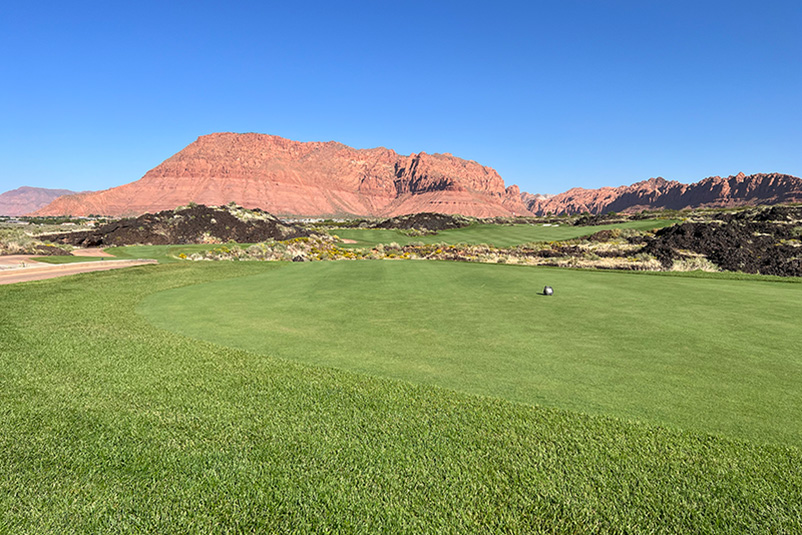
The team at Black Desert Resort in Ivins, Utah, makes use of USGA technologies to inform their agronomic strategy. Photo by Andrew Hartsock
Editor's note: The following article was created in partnership with the USGA. All product claims, research cited and other information are directly from the company.
Ken Yates considers himself, at heart, old school when it comes to maintaining a golf course.
“I’m an old dog,” says Yates, GCSAA Class A superintendent at Black Desert Resort in Ivins, Utah. “I was the guy who’d pull out a core and feel the core. I walked the green barefoot, looking for hotspots. Now I’m an old dog learning a lot of new tricks.”
A 15-year GCSAA member who has been at Black Desert Resort — a 3-year-old facility — since before it opened, Yates is decidedly on the cutting edge now. Through a combination of USGA technologies, including the GS3 ball, Moisture Meter and the DEACON golf course data management system, as well as fairway autonomous mowers and drones, Black Desert has become a prototypical facility for the future of data-driven golf courses. And it has made at least one steadfast convert.
“Jumping on board, I was blown away,” Yates says. “I thought I was old school. I never thought I’d be using my phone to be making decisions on the golf course. We’re saving on fertilizer, water … I’m just blown away.”
A home for championship golf
The golf course was carved into the ancient black-lava-strewn 600-acre Black Desert Resort grounds. Seeding began May 2022, and the first nine holes opened in November of that year. The full 18 opened in May 2023.
Before the course even opened, the LPGA Tour announced it would hold an event there in 2025. Then the PGA Tour paid a visit and accelerated the timeline, announcing it would visit in 2024.
Matt McCarty won the 2024 Black Desert Championship, the first PGA Tour event in Utah since 1963, and last year Black Desert Resort became one of just two facilities to host a PGA Tour (in October 2025) and LPGA Tour event (in May) in the same year.
Though the LPGA no longer stops in Ivins, the PGA Tour will return again this year for the Bank of Utah Championship, which runs Oct. 1-4.
For Yates, though, the day-to-day of maintaining the visually stunning facility nestled among the Greater Zion area’s signature red rocks doesn’t change.
“I try to keep this course the same condition as when the Tour plays on it,” he says. “We might have some different mowing heights, but my green speed is always 12½.”
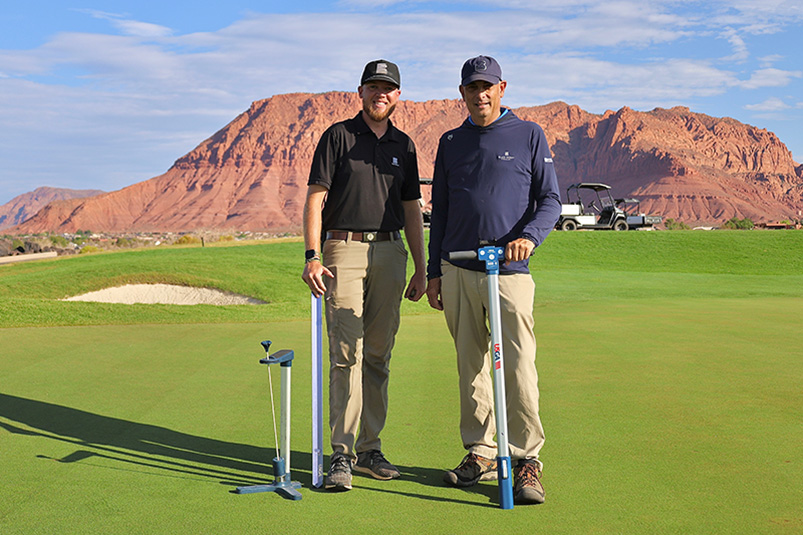
Assistant Superintendent Tyler Jolley, left, and Superintendent Ken Yates, right, show off some of the USGA tools they use on the course. Photos courtesy of Ken Yates
Big on bentgrass
Black Desert Resort is a bit of an outlier in southern Utah: The Tom Weiskopf design sports bentgrass greens, tees and fairways.
“That is unusual,” says Brian Whitlark, West Region director for the USGA Green Section and 27-year GCSAA Educator member. “They’re in a tough spot in that climate, growing cool-season turfgrass year-round. It gets hot there. In June, July, August and September, it’s a warm-season grass environment. Trying to grow a cool-season grass is a real challenge. It requires water, fungicide … you’ve got to be on the top of your game to keep a cool-season grass alive in the summer there.”
Yates confirms the challenge. Though the course has Kentucky bluegrass roughs, the collars, approaches, tees and fairways are all Dominator bentgrass, and the tees are 007XL bentgrass.
“The new Super Bents love it here,” Yates says. “But they are challenging. When its 110 degrees with 40 mph winds, that would dry anybody out. And we don’t have any trees. There are benefits to that, but also drawbacks. I get some purple hotspots, but it bounces back super quick.”
A key for Yates is a precision irrigation system.
“We have our irrigation dialed in right now,” he says. “If somebody looked at my irrigation system, they’d think I’m crazy. I have one head at 350% and another at 25%. It’s not across the board at 100%. It’s up and down. This area needs more water. This one doesn’t.
“To me, the biggest challenge is the irrigation system. I’m from Illinois, by St. Louis. It rains all the time. Here, I’m dialing in sprinkler heads constantly. I think most superintendents in this area are hyper-focused on irrigation. It’s your biggest bloodline out here, so dialing it in is critical.”
Daily use
And that’s where all that data collection pays off.
Yates got his first USGA Moisture Meter a little over a year ago, and, he says, “We kind of went crazy with it at first.”
Unlike other moisture meters he has used in the past, the USGA Moisture Meter works in concert with the DEACON system and much of his other data.
“They were never really connected to anything you could see,” Yates says of other moisture meters.
Yates and his staff have settled into a routine with the USGA meters.
“I look at it every day now. I might see, ‘Hey, that front-right corner of No. 10 is high. Maybe we need to look at the surrounds heads,’” Yates says. “The thing I like about it is, it’s simple and not overly fancy. It’s just what the golf course needs.”
Yates and the crew use the Moisture Meters daily.
“It doesn’t matter if we watered the night before,” he says. “We do the numbers every day. We’ve had problems where greens didn’t get watered. They catch that. I don’t care what the (irrigation) screen tells me. We need to know for sure. I can see the data. We’ve caught three different greens since we’ve had it that weren’t getting watered. We caught it because I saw the data on it.”
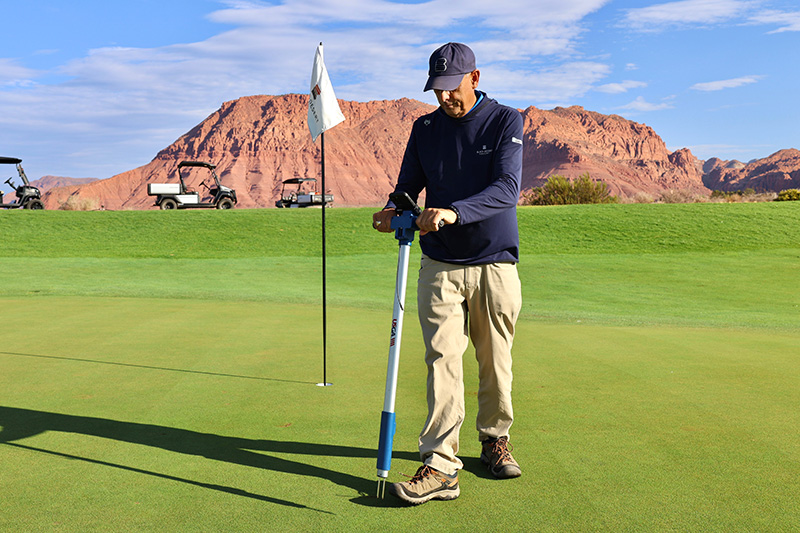
Yates demonstrates a USGA moisture meter.
They’re ballin’
Yates and the crew are similarly wed to use of the GS3 ball — essentially a Stimpmeter measurement device on steroids — which measures not just green speed, but also trueness and firmness and which, of course, adds to the DEACON data trove. Black Desert has been on the GS3 bandwagon since the balls first came out and now rolls two of the devices daily.
They target three greens on the front nine and three on the back, but “sometimes we go random with it,” Yates says.
Yates has been in the business for 35 years and says he has a good “feel” for what cultural practices need to be performed and which can be skipped. But the data from his high-tech devices can confirm his feeling.
“I’m getting away from my old-school thoughts,” he says. “Do I roll today? Do I not roll today? With the GS3 ball, what I look at most is the trueness number. That tells me whether or not I need to roll today. The thing I look at most is the wobble at the end of the roll. If I see that number start to waver, I change some things. That backs up my old-school thoughts. Now I have the data to explain the reason why I can skip some mows this summer and still give the golfer the same conditions every time.”
Yates doesn’t keep all that data to himself. He shares it freely — with staff, the pro shop, even with ownership.
“I send all the numbers out in a bi-weekly report,” Yates says. “It’s great to have all that data. The golf shop has it. When somebody from outside the golf course comes to them and asks, ‘Will you double roll these greens?’ they have no idea. The golf shop and caddy master have all the data, and they can look at it. That helps the caddy, too, when he can talk about green speed as well as that trueness number. That makes the golfer think they’re having a good experience.”
Drones and robots, oh my
Also on the technology front, Yates and the team use drones and robotics.
Their work with the former is still in the early stages, though Yates said unmanned aerial vehicles were particularly useful in the early stages of construction.
“It was a great thing for me during grow-in,” Yates says. “Because of the lava, it was hard to get around. We didn’t have cart paths, so the drones would allow me to keep an eye on things more easily. We still fly the drone four, five times a week. Flying it that often makes it easier to see subtle changes. But to be honest, I’m still trying to learn that data.”
The autonomous mowers, on the other hand, provided an immediate boost. During the 2024 PGA Tour event, Yates’ team sent out four autonomous mowers to stripe the course — at night — and became the first Tour stop ever to showcase autonomous fairway mowers. A team of the robots is still in the rotation at Black Desert Resort.
“They’re wonderful,” Yates says. “They’re solid. I like that they’re electric. There’s no hydraulic leaks. If you use them properly, you get more out of them. You don’t just send them out the door to go mow. We usually send two, three people out with them. While the (autonomous units) are mowing, the people are edging. We’re combining two jobs. Nobody’s losing jobs. We’re just enhancing the work we can do. With these mowers, we get more done in the morning ahead of the golf. My course is unique. I can’t drive hole to hole in the afternoon. Once you’re done, you’re through.”
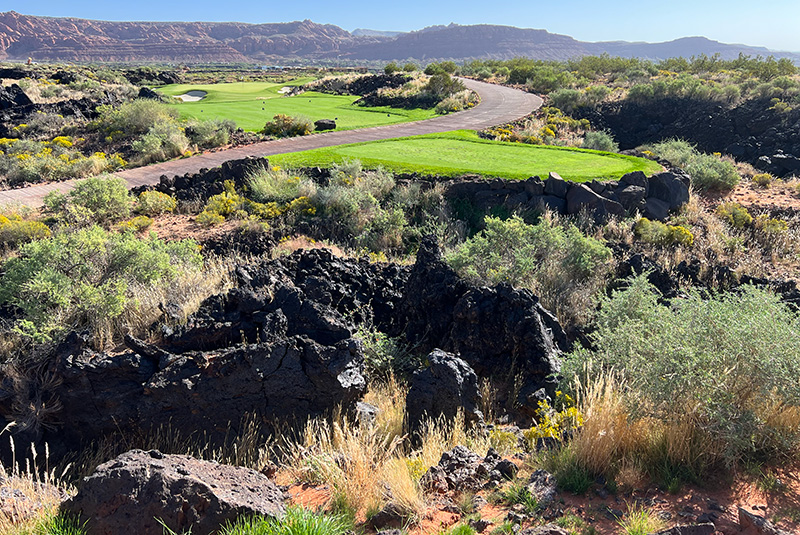
One of Black Desert Resort's many magnificent vistas. Photo by Andrew Hartsock
Beware data overload
While Black Desert Resort might be in the forefront in some ways in the drive toward more data-driven golf course maintenance decisions, it’s not alone.
“The top 10% of courses now, they’re all collecting data, whether it’s moisture, firmness, green speed, clipping yield, topdressing inputs — all those data points are extremely useful to develop an agronomic program specific to your site, as well as one specific green site or fairway site,” the Green Section’s Whitlark says. “They’re not just collecting data from a couple of locations and developing a program for all 18 greens. They’re using this to cater their programs for individual putting greens or fairways.
“We do it all the time for irrigation. That’s where all this data collection comes in, enabling an agronomic team to make better decisions for turf health, as well as playability, but also to avoid wasting resources. It’s easy to put too much water out. Or, if you think you have too much salt in your soil, if you measure salts, you probably don’t have to leach salts as much as you might think. All these data points are useful.
“If you’re making agronomic decisions,” he says, “you really should have the data to make those decisions. I really couldn’t imagine trying to manage putting greens without this data.”
There’s also the worry about analysis paralysis. Yates’ advice? Go slow, and pick what data is most important.
“You can collect as much data as you want — firmness, trueness, green speed, salinity numbers. Stick with that. Stick with what’s important,” he says. “There’s so much coming at you, you can overload yourself with data.”