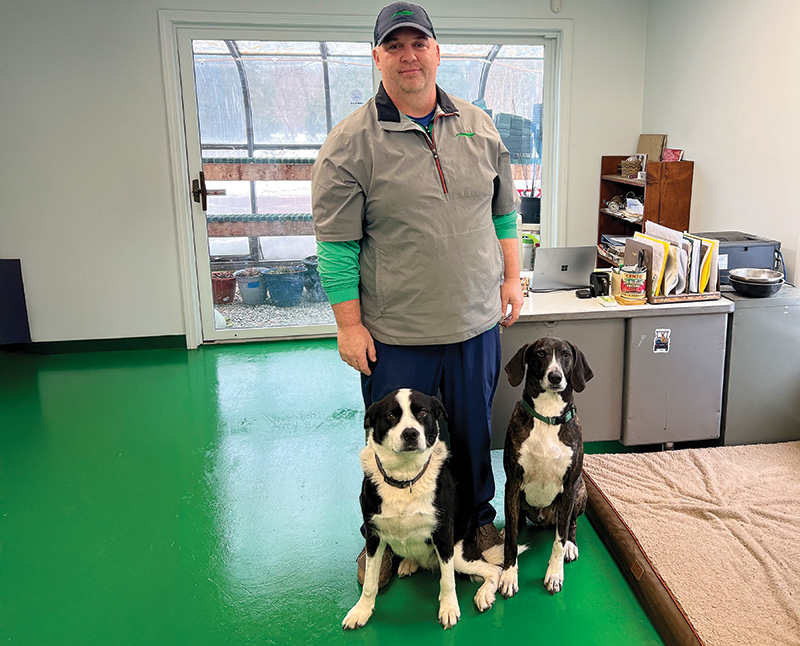
New Hampshire’s Amherst Country Club is overseen by superintendent Chris Knapp, seen here with his dogs, Tucker and Panda. Photo by Evan Butler
In mid-February, Chris Knapp stared into the distance from his office window after answering his cellphone.
Not much to do outside, he tells the caller. “Two-and-a-half feet of snow,” says Knapp. “We wanted to be doing some tree trimming, but we had to shift gears after we got hammered.”
One thing is for sure, though, at Amherst Country Club: Knapp, his team and the club have nailed it, and they’re eager for more. The club located in Amherst, N.H., isn’t holding back when it comes to keeping up with the times. They’re all about sustainability and efficiency at Amherst CC, which features an 18-hole championship golf course, plus a nine-hole executive course.
“We’re trying to change everything here to electric. The golf carts are there, and a bunch of our equipment has been switched over,” Knapp says. Amherst CC is working with Omni Directional Power, which was co-founded by the course’s owner, to produce a line of products to help facilities more efficiently manage energy in their fleets of electric vehicles.
Knapp, a GCSAA Class A superintendent and 10-year association member who in his career has been a superintendent for 15 years overall, praises club owner Jamin Warren for a forward-thinking approach to bringing the latest and greatest to the facility. “Serious resources that make our jobs very efficient. It’s a special property. He (Warren) is smart, doesn’t mind making serious changes if he has calculated out the results,” says Knapp, who, like Warren, is taking a go-for-it mentality. “I love working for him. I have learned a lot at Amherst beyond turf management.”
Amherst CC is, well, extremely busy when a hazard like snow isn’t in the way. The club totals approximately 80,000 rounds of golf from April to mid-November. During the meat of the season, tee times start as early as 5:26 a.m. and last through sundown. “Our cultural practices are mostly done overnight to avoid disrupting play,” Knapp says. “We will aerify greens and spray fairways. Four of us usually are on the first eight-hour shift that starts around 8 at night after play is done. Then, the second eight-hour shift comes in at 4 a.m.”
Knapp, 44, came aboard in 2021. The native of Hinsdale, N.H., originally had alternative career aspirations. He attended Franklin Pierce University in New Hampshire with his sights set on computer science. His admiration for golf, though, ruled the day. “I loved golf, wanted to beat my friends,” he says. This golf thing sure beat a life in the computer world, so he went to college at the University of Massachusetts-Amherst in the turfgrass field. In school, he gained experience by working at the research facility, including as an irrigation tech and as a lab tech for the pathology department.
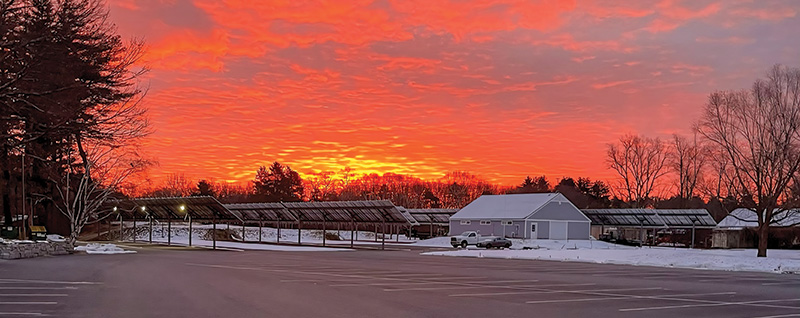
Solar panels have become integral and part of how Amherst CC is driven by technology and sustainability. Photo by Jack Szopa
He has worked at eight golf courses in nearly two and a half decades. One of the most influential mentors he encountered in his journey is 37-year GCSAA member Jeff Scott, who learned from his mentors how to mentor others. Knapp spent three seasons with Scott at Tamarack Country Club in Greenwich, Conn. Scott has been at that spot since 1997. Speaking of mentors, Scott had a couple of legends mentor him: brothers Joe and Bob Alonzi, who received GCSAA’s Col. John Morley Award this year. The knowledge that they passed on to Scott allowed him to share his mentorship tendencies to Knapp. “Chris was a very nice man. Hard worker. Eager to learn. He did well,” Scott says. “What I learned about mentoring from the Alonzis was work ethic.”
Aided by a golf course maintenance team — including assistant superintendent and two-year GCSAA member Evan Butler; assistant superintendent and one-year member Jack Szopa; and equipment manager Dan Leonard — their team gets things done. Knapp reels off the equipment at their disposal and the environmental efforts and how they tie together. A couple of autonomous retrievers that can pick up 24,000 balls daily, along with the autonomous mower, take care of the range. Four state-of-the-art golf simulators — known as The Sims at Amherst CC — are available for players all winter, even during outrageous snow totals earlier this year. “The simulators investment paid off in two to three years,” Knapp says. “The 14 54-foot solar panels in the exterior of the parking lot are massive, and now we want solar canopies at the driving range. We have an eco-friendly wash pad, natural areas that reduce the need for mowing, tracking the EIQ (environmental impact quotient) for sprays at Amherst. Every decision we make is rooted in environmental sustainability.”
Being a friend to the environment has been important at Amherst CC for numerous years. The course has been an Audubon Cooperative Sanctuary Program since the 1990s, and Knapp noted that he spent part of a frosty winter rebuilding the 60 birdhouses on the property. Bluebirds, sparrows, red-bellied woodpeckers and finches are among the species that spend time there. “I’d never been a bird person. Now, I’m more in tune with the birds in our area,” says Knapp, who enjoys keeping an eye on Birdbuddy, an AI-powered bird feeder that captures photos and videos of local birds and sends instant alerts. “Our Birdbuddy captures the seventh green in the backgrounds, and I am excited to install the Insectbuddy that will track pollinators. I knew right away when I got here that we are serious about sustainability and showcasing the wildlife at Amherst.”
A father of two children, Paige and Ethan, and owner of his golf course dogs Tucker and Panda, Knapp has been ready for spring awhile now. His trusty Ventrac snow blower eased part of the winterfest they’ve witnessed at Amherst CC. Back issues, including nerve damage, have curtailed his ability to tee it up as much anymore. Still, he can count on being part of what has become of the club and its ascension. “I got into this job because I love the game,” Knapp says. “This industry has given me a pretty good life.”
Howard Richman is GCM's associate editor