East Coast, West Coast, Midwest and Canada — the winners of the 2025 Environmental Leaders in Golf are as geographically diverse as ever yet their efforts to advocate for environmental stewardship are as unified as their awards attest. The ELGA Awards are presented by GCSAA and Golf Digest in partnership with Syngenta.
The four winners, pictured from left above, and their awards are:
- Justin Brimley, Crystal Springs Golf Course, Burlingame, Calif. — Natural Resource Conservation Award.
- Kevin Goss, Sugar Creek Golf Course, Villa Park, Ill. — Communication and Outreach Award.
- Jim Pavonetti, CGCS, Fairview Country Club, Greenwich, Conn. — Healthy Land Stewardship Award.
- Robin Sadler, MS, AGS, Mickelson National Golf Club, Calgary, Alberta, Canada — Innovative Conservation Award.
In describing his course’s approach to environmental stewardship, Brimley could have been describing most of the ELGAs’ annual winners. “Environmental stewardship is one of our core values. We preach it, and we do it. It’s not just something we say. It’s actually done,” Brimley said.
The awards have recognized superintendents and golf courses around the world for their commitment to environmental stewardship since 1993. In 2018 the ELGAs were updated to recognize more superintendents in more focused areas of environmental sustainability. Instead of offering national awards based on facility type, the current version of the ELGAs is based on environmental best management practices and honor specific areas of focus.
Read on to learn more about the 2025 ELGA winners.
Natural Resource Conservation Award
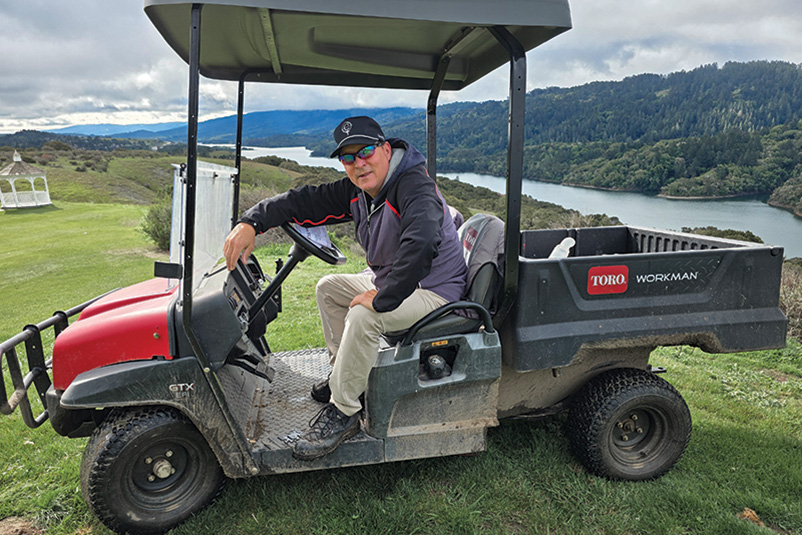
Justin Brimley
Crystal Springs Golf Course
Burlingame, Calif.
Justin Brimley is a Class A superintendent and 15-year GCSAA member. He’s also a two-time runner-up for this award. When asked how it felt to win the award this year, he got right to the point.
“To be quite honest, it felt a lot better to be the national winner than to be the runner-up again,” Brimley said with a laugh.
Winning the award this year comes with the completion (if the work of a superintendent is ever complete) of a project that has been years in the works. The 110-acre golf course is surrounded by native habitat, which supports abundant wildlife living in it. Brimley’s project has been to create about 20 acres of “exclusion zones” — environmental corridors marked off by rope and red stakes with green caps.
“Eventually I want to get it to where it’s more solid, like pillars and mooring rope, so it’s permanent — keep out. Even with the ropes and stakes and signage, once in a while we’ll catch a guy or two trying to go in those areas and it’s just like, ‘C’mon man,’” said Brimley.
“On a day-to-day basis, environmental work is hard,” he said. “When I was the assistant in 2015, I started aerifying a lot of these exclusion areas. And then I planted a California native habitat seed mix. Once I did that, it helped. But without the rope and the stake, it never really had a chance. I staked it when I first started in 2018 as a superintendent.”
Then he communicated about the environmental corridors broadly via the men’s and women’s newsletters, the pro shop, the director of golf and the general manager.
“We got the word out. When I first started this, there was definitely some pushback, nobody likes change. Once they saw the results, with the native coming back and the health of it because it wasn’t getting run over, that helped a lot. And also our wildlife significantly increased. My turkey population doubled, easily. The mule deer is up at least 25%,” Brimley said.
“It’s a daily thing. The guy doing set up in the morning, just fixing the rope and stakes, takes about an hour,” he said. “Doing what I’m doing takes labor, it just does.”
Other conservation efforts overseen by Brimley include using technology to ensure they are not wasting water and creating more sustainable conservation areas under trees that use less water.
“I saved about an acre of turf on our first hole under some huge Monterey pines. When we were irrigating it, it was like ‘Why?’ There’s no real turf stand there because the trees are so big and turf doesn’t really grow under the canopy. I basically saved about a million gallons of water a year by just making them mulch areas,” Brimley said.
“We might start doing it on other areas of the golf course because the way it’s looking, we might start seeing droughts again,” he said. “If that happens, I’m definitely going to be scouring for areas that don’t need water.”
This is Brimley’s second ELGA award — he was also the 2022 Healthy Land Stewardship recipient.
First runner-up: Patrick Parkins, TPC Las Vegas, Las Vegas.
Second runner-up: Robert Esposo, Pacific Grove (Calif.) Golf Links.
Communication and Outreach Award
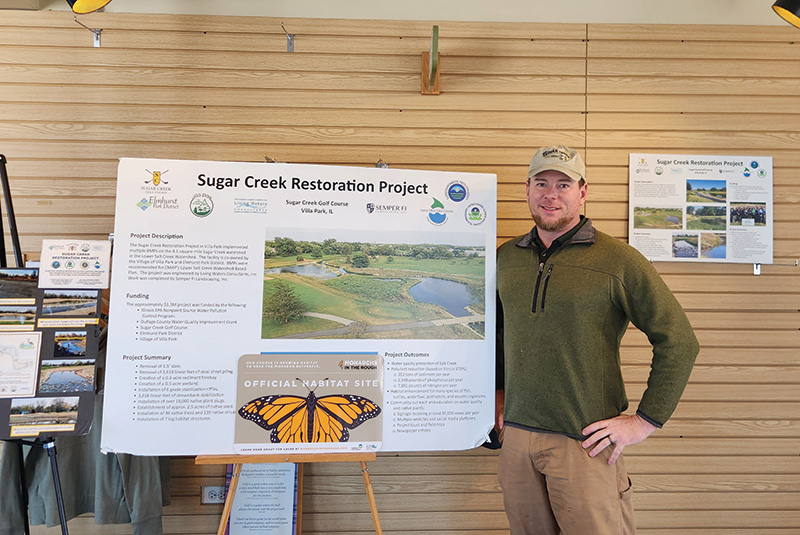
Kevin Goss
Sugar Creek Golf Course
Villa Park, Ill.
At Kevin Goss’ course, they’ve also been in the thick of an environmental project for years, finally getting it mostly done in 2023.
“We’re big into naturalizing whatever areas we can,” said Goss, a Class A superintendent and 16-year GCSAA member. “We reshaped the shorelines — kind of like a suburban creek or stormwater infrastructure in Chicago — and got them to a 4-to-1 slope instead of a 1-to-1 slope and then planted them with native plants. So now we have 20- to 25-foot natural buffer zones. We used to have basically zero and we were getting a lot of erosion.”
He said they also dug out a pond that had all but completely filled with silt.
“If this land wasn’t a flood plain it would have been developed — so because it floods that’s the only reason it is a golf course. It’s the lowest spot in the town so all the silt and all the water comes here, so managing it is a long-term project — it’s always going to be an issue,” Goss said.
Since the course has been in a state of repair for some time, communicating with golfers has been key. Making posters for the clubhouse has been a consistent way to do so.
“The frontline staff in the clubhouse gets so many questions, so making posters at different points in the project lets people know what’s going on and why. It really helps the people behind the counter and gets accurate information out,” Goss said.
Goss has also prioritized reaching out to the community in various ways about how the course serves important environmental functions. He starts with the local college students. “I want them to know what we actually do versus what they think we do, so the next generation of horticulturalists is informed.”
He said he also proactively reaches out to garden clubs and other community groups to create lines of communication with the golf course.
“I’ve done a lot of speaking and field trips over the last 15 years. I think my first one was the Elmhurst Garden Club here in town. I gave a speech to them about golf courses and the environment. I took that speech and have been riffing on it for a long time,” Goss said.
“Occasionally more sensitive topics will come up like glyphosate or pesticides, but in general once they see wildlife and a diversity of plants, they start getting more into that. Then you get more people in the community who see golf courses as more than just a haven for golfers — that there is a benefit to the whole community,” Goss said.
He also tries to reach the general public with social media posts. “People love to see the wildlife, the baby turtles, the native plants,” Goss said. “I try to put that kind of stuff on there to keep people informed of the value of golf courses beyond golf.”
First runner-up: Christopher Hayman, The Crossings at Carlsbad, Carlsbad, Calif.
Second runner-up: Carl Thompson, CGCS, Columbia Point Golf Course, Richland, Wash.
Healthy Land Stewardship Award

Jim Pavonetti, CGCS
Fairview Country Club
Greenwich, Conn.
Jim Pavonetti, CGCS, is proof persistence pays when it comes to the ELGAs.
Pavonetti, golf and grounds superintendent at Fairview Country Club in Greenwich, Conn., started entering the annual competition in 2006. Though he collected a couple of runner-up finishes along the way, it wasn’t until 2023 that he won his first ELGA.
Now that he has added the Healthy Land Stewardship Award to his haul — joining titles in Natural Resource Conservation (2024) and Innovative Conservation (2023) — Pavonetti, who also is the winner of the 2026 President’s Award for Environmental Stewardship, is on a three-year winning streak with just one ELGA to go to complete the Grand Slam.
“I feel I’m obligated to try for the fourth one now,” he says. “I’m going to try. I don’t know if I have a lot of work ahead of me or not, but I feel that last one is the toughest.”
Healthy Land Stewardship is a, uh, natural for Pavonetti, a 30-year association member who has been at Fairview CC just outside the New York City metropolitan area the past 18 years. A vocal proponent of data-driven decision-making, Pavonetti has added to Fairview CC’s environmental cred steadily over his nearly two decades there. Responsible water use has been key there.
Because the course uses only water from the sky for irrigation, maintaining its volume and health has been a priority from the start. Pavonetti and the team there use air diffusers in their ponds and barley straw in cages at every inlet to all but eliminate algae; fastidiously use infrared cameras, moisture meters and sensors to determine optimal water use; and have converted turfgrasses to more drought-resistant varieties or to natives.
“Because of our Audubon International certification, we test our water regularly,” says Pavonetti, who serves as that organization’s treasurer. “We have to test the water coming into our property and the water going out, and in every case, there’s less nitrates and less phosphorus leaving than coming in.
“I think this category is perfect for us. Our property is a huge watershed. Well, most golf courses are. Ultimately, all our stormwater runoff runs down to the Byram River, which is a big stream or small river that’s stocked with trout and empties into Long Island Sound. There used to be so many negative articles written about Long Island Sound and problems with lobsters, which they blamed on runoff of fertilizer. So I always had a sensitivity to that since I came to Fairview. I was always an avid fisherman, so that’s why water quality is a sensitive subject for me.”
For more on Pavonetti and the work he and the crew are doing at Fairview CC, please see “Second nature” on Page 36 of this issue of GCM.
First runner-up: Jorge Mendoza, Green River Golf Club, Corona, Calif.
Second runner-up: Michael Bednar, Palouse Ridge Golf Club, Pullman, Wash.
Innovative Conservation Award
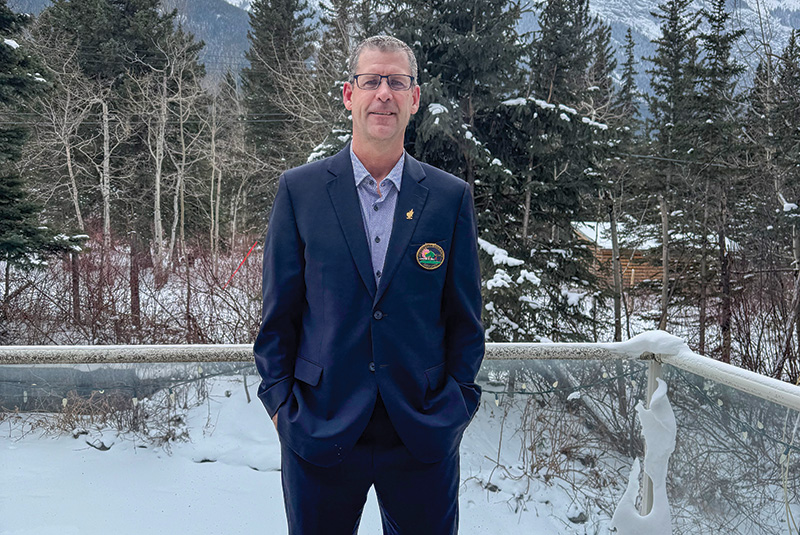
Robin Sadler
Mickelson National Golf Club
Calgary, Alberta
Robin Sadler hardly expected to win a conservation award but said it’s a welcome surprise.
“We’re kind of doing our thing on a daily basis, trying to make the club a better, a more sustainable place — and to all of a sudden get recognized on a global level for our efforts, it’s just unbelievable,” said Sadler, a GCSAA Class A superintendent and 23-year association member.
All decisions that are made at the club consider environmental stewardship, Sadler said.
“Environmental stewardship is absolutely something we focus on — it goes hand-in-hand with our daily job. In my mind, it’s part of our responsibility to focus on it on a daily basis. It’s an opportunity to protect natural resources, enhance biodiversity and set a precedent for our kids and future generations.”
Sadler readily lists off many conservation efforts he’s proud of.
“We irrigate with reclaimed water to improve turf health and lower environmental impact,” Sadler said. “Part of what we’re charged with is recycling the treated sewage effluent water from the town of Harmony,” which is just west of Calgary. “It’s a great opportunity to reclaim that water and gain the benefit of the nutrients in that water and have a full 360 system.”
He said by fine tuning his irrigation system and increasing precision of the system’s coverage, he’s been able to reduce water usage by 13%.
Next on his list of conservation efforts: participating in a pollinator program provided by Syngenta. “So now we have a bee club and we harvest the honey and sell it out of the pro shop,” Sadler said. “We also do nature walks and tours that the bee club gets involved with and helps reach out to the community.”
Sadler is also proud of his club’s ongoing switch to battery-powered vehicles. “We’ve reduced carbon and noise pollution by shifting to lithium-powered carts. A couple years ago we switched entirely from gas to a lithium-powered cart fleet, which has saved 18,000 liters of fuel and is more than $20,000 in savings as a side benefit,” he said. “We’re also up to 11 utility vehicles on our course and we’ve got one lithium greens triplex and some hybrid triplexes.”
Two years ago, Sadler also secured the course certification by the GEO Foundation for Sustainable Golf.
“We were the first golf course in Canada to be certified by GEO,” he said. “That’s really helped us to continue best practices and be at the cutting edge of sustainability.
“In one year, all the good sustainable practices we do are equivalent to the capacity of 420 acres of Canadian forest sequestering carbon. In 2024, we sequestered 353 metric tons of carbon. That’s real data. That’s a very positive story for golf courses and golf in general. That’s a number we can try to build upon.”
First runner-up: James Sua, CGCS, Pei Tou Kuo Hua Golf and Country Club, Taipei, Taiwan.
Phil Cauthon (pcauthon@gcsaa.org) is GCM’s managing editor. Andrew Hartsock (ahartsock@gcsaa.org) is GCM’s editor-in-chief.