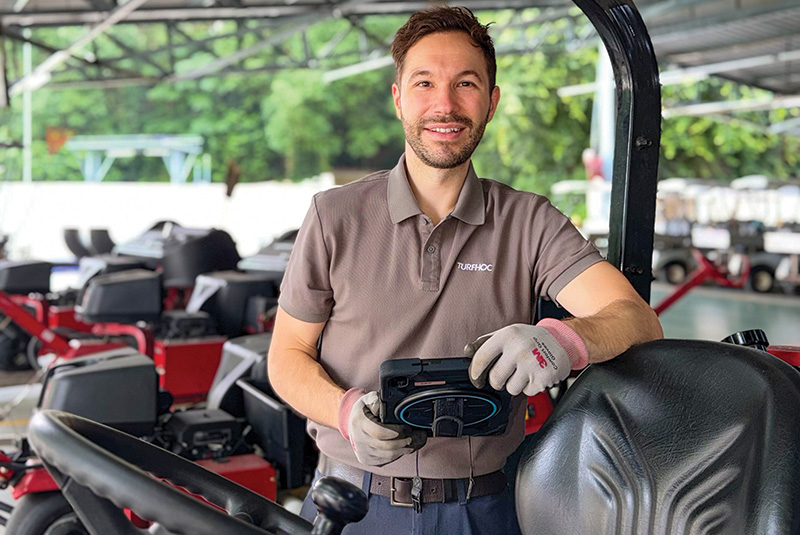
American Alex Grengs, CTEM, has settled in nicely in China at Xili Golf & Country Club. Photos by Anastasiia Grengs
Alex Grengs wasn’t born with a wrench in his hand. But he has a firm grip on his industry, which requires a hands-on approach for success.
Grengs is the first Certified Turf Equipment Manager in GCSAA history employed in China and the association’s third international CTEM. Based at Xili Golf & Country Club in Shenzhen in Guangdong Province, Grengs, a nine-year GCSAA member, says he’s honored to be recognized for what he has accomplished, and he’s chasing even more.
“Being recognized as a CTEM is especially meaningful because it represents years of hard work, learning and growth in this profession,” Grengs says. “I have spent most of my career outside the U.S., so it also enforces to me that equipment is a global profession with shared standards, challenges and opportunities.”
A born fixer
Long before China entered the picture, Grengs got his start 6,700 miles away — born in Oakland, Calif., and raised in Vancouver, Wash. Growing up, he liked using his hands, but a wrench usually wasn’t involved.
“In our house, the wrench was probably too expensive. But I was drawn to fixing things,” he says. “I wanted to understand how things work, find solutions and solve problems.”
That curiosity became practical early. His closest relatives depended on it. “Our family had a revolving door of broken cars; taking them to the shop was not always an option,” Grengs says. “If my mom needed a car to get to work, we had to figure it out with the few tools we had. Later, when I finally saved enough money, I started making payments on a car. It was a 1977 Mercury Comet that cost a whopping $800.
“Of course, it always needed something, too. At the time, I was trying to keep things running. Looking back, that was where I started learning how to troubleshoot, think creatively and stay patient when a solution was not obvious. Those lessons became the foundation of the way I approach equipment management today.”
His high school years proved to be critical, and a major turning point was qualifying for a two-year diesel technology program. During his junior and senior years, he spent half of each school day in a career and technical education program studying diesel technology. “That program gave me college credits, helped earn scholarships and gave me a real direction,” says Grengs, who went to Clark College in Vancouver, Wash., earning an associate degree in diesel technology. He later completed a basic certificate in turfgrass management through Penn State.
“It showed me that a hands-on technical career could be more than just a job,” Grengs says. “It could be a long-term path where I could keep learning, keep improving and build a future of practical skills.”
Not bad for someone whose first job in high school was at a roller rink.
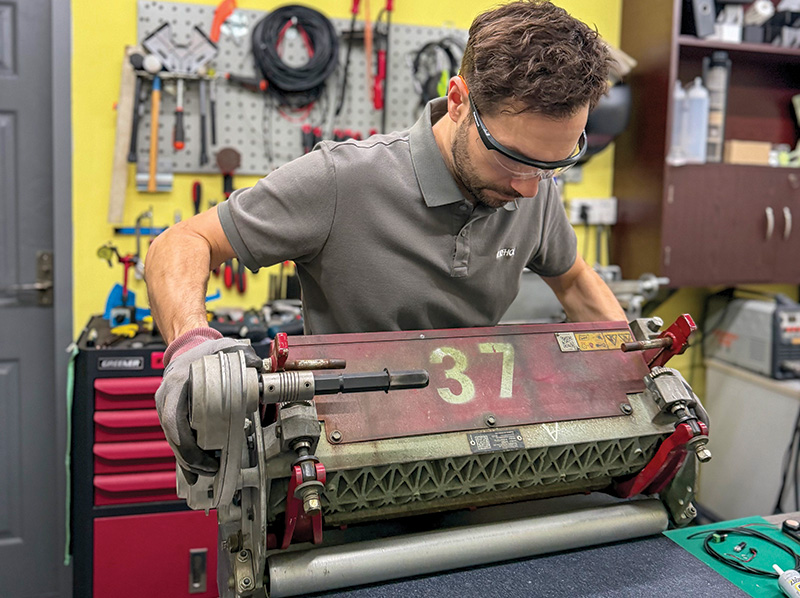
Turning a diesel technology degree into learning what it takes to excel in the golf course maintenance shop has resulted in excellence for Grengs.
Golf over forklifts
It wasn’t a given that Grengs was bound for the golf world.
After college, he landed a job at Williams Form Engineering in Portland, Ore., where he supported production operations and maintenance. He later departed for the East Coast, working a series of positions in New York: vehicle maintenance, industrial and facilities maintenance. As for golf … “I was looking at jobs at the time,” he says, “and it came down to either servicing industrial forklifts or working at a golf course.”
Golf won. He was hired for his first golf course maintenance position at Ardsley Country Club in Dobbs Ferry, N.Y., where he oversaw an 18-hole club. He gained critical knowledge by connecting with Steve Jordan, who previously had been equipment manager at iconic Winged Foot Golf Club in Mamaroneck, N.Y. “He helped train me in reel grinding and helped me understand quality of cut, which was something I had no experience with before entering the industry,” Grengs says.
His passion for golf course maintenance grew because equipment brought together several interests he enjoyed. “Mechanics, precision, problem-solving and the connection between equipment condition and course quality,” Grengs says.
When he decided to move on, Grengs crossed oceans. Hello, China. Why? It was a combination of curiosity and timing.
“I had been learning some Mandarin Chinese, had traveled to China and Japan a few times, and then saw an international job posting on TurfNet,” Grengs says. “I applied, flew out for an interview, and, to my surprise, especially since I was still fairly new to the golf industry, they hired me.”
He wasn’t the most experienced candidate, “But I could speak some Mandarin and was willing to take the leap and make that kind of move,” Grengs says. “It was a risk, but it was a decision I have never regretted.”
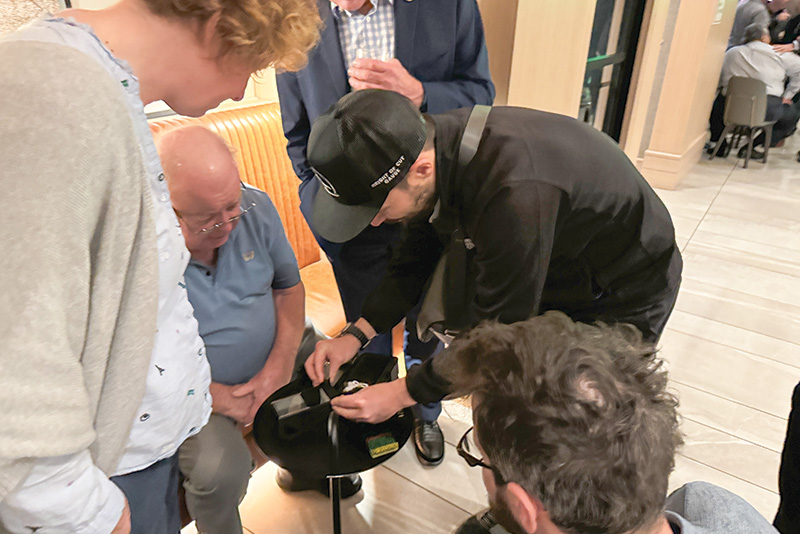
Friend John Mascaro from Turf-Tec International snapped this image of Grengs showing off his original laser prism gauge. Photo by John Mascaro
A strong network
Grengs started at Xili Golf & CC in 2016, and at first, it was an international opportunity that seemed interesting and challenging. But over time, it has become much more than that.
“Xili has given me the chance to grow professionally, take on responsibility and work in areas that go beyond traditional equipment management. That is a big reason I have stayed as long as I have,” he says.
Because he’s spent much of his career overseas, Grengs hasn’t always had the same day-to-day industry network that many U.S. equipment managers enjoy, so mentorship and networking have helped him thrive.
“The GCSAA Conference and Trade Show has been one of the few places where I have been able to connect with people in person, and I have been fortunate to attend several times,” he says.
While working in China, Grengs has relied on people in the industry.
“John Patterson, Mike Rollins, Trent Manning and Hector Velazquez have helped keep me engaged and invested in the industry from a distance,” he says. “Chris Menno of CMF Global has also become one of my biggest mentors. We worked together during a 36-hole irrigation renovation at Xili, and he helped us source equipment for the project.”
His baby: TurfHOC
A visit to the Philippines in 2023 to do some drone-mapping sparked a new and exciting venture.
Before his trip, a local consultant there asked whether Grengs could bring his prism gauge. “I did, but it was awkward to pack in my carry-on, so I started thinking about making something more compact for my own use,” he says.
At first, his idea was to make a gauge that was easier to travel with or leave on a cart. But like many equipment managers, “I was also often taking photos to document readings, which led me to develop a phone attachment for the gauge,” Grengs says. “That idea pushed the idea further.
“Because it could slide up and down instead of being fixed in one position, I noticed that the point where the grass appeared to meet the scale changed depending on the viewing angle. That made the parallax issue very clear to me. With a traditional prism gauge, the person taking the measurement still has to visually interpret where the turf aligns on the scale, so two people can look at the same gauge and get slightly different readings.”
That led Grengs to the laser idea and the creation of TurfHOC, a method of measuring effective height of cut using a laser and prism. “I wanted to create a more consistent and standardized way to measure effective height of cut by using a line laser as a clear reference point of the scale, reducing the need for visual estimation,” he says.
After visiting the South China Turf Managers Association seminar and then the GCSAA Conference and Trade Show in 2024, feedback on TurfHOC from the industry was positive. Grengs was optimistic but not arrogant. “I was reluctant at first to make a big deal of it,” he says, and he credits Joseph Check for introducing the traditional prism gauge concept in the 1970s.
“I never imagined starting my own business. That was never part of the plan,” Grengs says, and he lauds his wife, Anastasiia, for encouraging and supporting his pursuit.
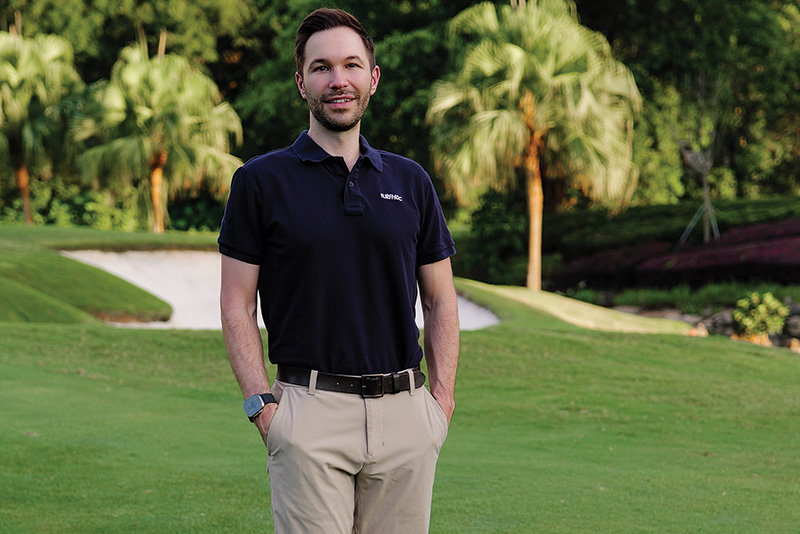
There’s a lot going on at the shop for Grengs, who besides his TurfHOC creation has implemented an equipment manager platform. Photo by Shane Gower
Gauging the future
TurfHOC really hit the market in early 2024, and John Mascaro, who runs TurfTec International — a leading manufacturer of diagnostic turfgrass tools and environmental tech equipment — was among those impressed by Grengs’ creation. Mascaro met him at the GCSAA Conference and Trade Show, where he checked out the prism gauges.
“He was looking to sell one he came up with,” Mascaro, who does the Photo Quiz for GCM, says. “We started working together on redesigning one of his products for a sports and golf market. He had a laser on it, which was pretty cool.”
They worked together on a wide 150 mm version of the TurfHOC gauge and have a partnership on that model. The wide version is sold exclusively through Turf-Tec.
“He kind of reminds me of me at an early age,” Mascaro says of Grengs, who is 37. “He looks at designs to make them better. He’s a go-getter, has a lot of ideas, making things more usable for the golf industry.”
Grengs says his business is going well, still small and manageable between him and his wife. “Considering how niche our industry is, I’m happy with how it has grown,” he says. “We’ve sold gauges internationally, established distribution in parts of Europe, and I’ve since expanded the product line with a bench height-of-cut gauge.”
What’s next?
Grengs is currently focused on software, and over the last few years, he’s developed and implemented a comprehensive equipment management platform for his club. “The main focus is equipment and asset management, preventive maintenance and repairs, parts and inventory, fuel management and equipment and golf cart fleet GPS tracking and golf course mapping,” he says. “One of the key modules is dedicated to tracking reel cutting units, including their service, setup, grinding and history.”
There’s more: He has also added several agronomy workflows that his course superintendent needs for daily operations, such as streamlined clipping-yield entry and connecting weather data.
“The whole idea behind the platform is making data entry as easy as possible,” Grengs says. “If we make it simple to record information, complete a work order, request a repair or enter an agronomic measurement, people are much more likely to actually use the system. Once the data is being captured consistently, we can trust what we’re seeing on the screen and use it to make better decisions.”
One of his goals is moving toward a paperless operation without making the system complicated for those who use it. Equipment, cutting units and parts are QR coded so staff can quickly get to the right record and workflow.
As for TurfHOC, he wants to take it up a notch. “That experience has led me to begin developing the next generation of the platform under TurfHOC, with the possibility of eventually offering it commercially,” Grengs says. “It’s still something I’m actively developing, but I believe it could become a significant part of TurfHOC going forward.”
Looking ahead, what else is on Grengs’ agenda? Quite a bit.
“I would like to keep combining equipment management, facilities management and technology to solve practical problems for golf course operations,” he says.
Howard Richman (hrichman@gcsaa.org) is GCM’s associate editor.