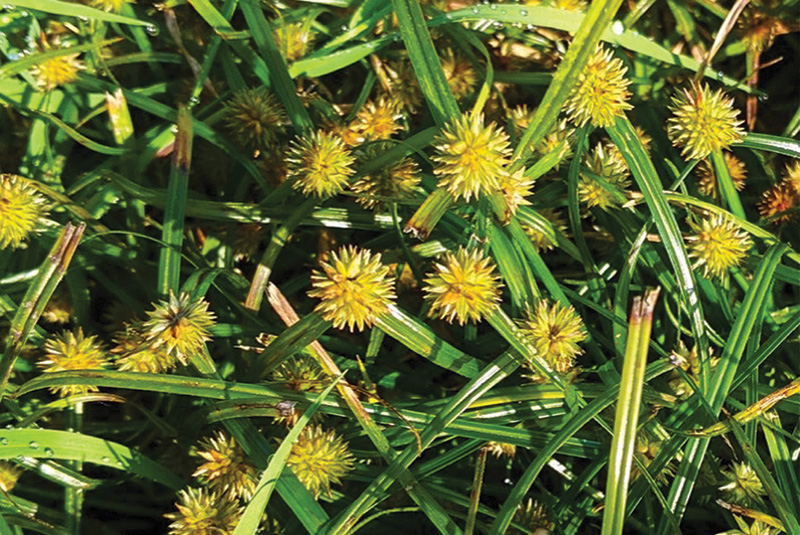
Figure 1. False-green kyllinga seedheads. These are typically produced in late summer. Photos by Trevor Watson
False-green kyllinga (Kyllinga gracillima; FGK) is an increasingly problematic weed in cool-season turfgrass systems. It is a C4 warm-season perennial that spreads aggressively through rhizomes and can form dense patches that disrupt turf uniformity and play quality. Once established, infestations can be difficult to manage and often require multiple herbicide applications (2). Its dense mat-like growth resembles turfgrass, but it is most noticeable when it produces seedheads in late summer (Figure 1) or when it turns brown in winter dormancy (Figure 2).
FGK is commonly associated with irrigated turf and moist soils, and it can produce seed at mowing heights as low as 0.5 inch (1.3 centimeters). It is especially competitive under low mowing and is commonly found in fairways and putting green collars, and occasionally in putting greens (Figure 3). Management programs in cool-season turf focus on controlling established plants with postemergence herbicides such as sulfentrazone, halosulfuron-methyl, pyrimisulfan and imazosulfuron (3). These herbicides target rhizomes and existing plants, and sequential applications are usually required for acceptable control (3, 5). Questions from superintendents who observed resurgence of false-green kyllinga a year or two after aggressive postemergence control programs led us to evaluate the potential of false-green kyllinga to establish from seed. While we know that yellow nutsedge spread from seed is not a concern, relatively little research has examined the ability of Kyllinga species to establish from seed in turfgrass. One study found green kyllinga (Kyllinga brevifolia) can establish from seed in bermudagrass (4), but no research has examined false-green kyllinga. If FGK seed establishes from seed easily, infestations could spread through contaminated equipment, foot traffic or water movement. Seed production within existing patches could lead to reestablishment even if rhizomes are completely controlled with postemergence herbicides.
The objective of this research was to evaluate FGK establishment from seed compared to smooth crabgrass under turf management programs designed to produce turfgrass stands of varying densities. We hypothesized that FGK will establish less readily in high density turfgrass and will not establish as readily as smooth crabgrass. Smooth crabgrass (Digitaria ischaemum) was used as a comparison species in this study because its seedlings are highly competitive in turfgrass systems. Like FGK, crabgrass is a warm-season species that grows rapidly under summer temperatures. Comparing the establishment of these species provides useful context for understanding the competitiveness of FGK seedlings.
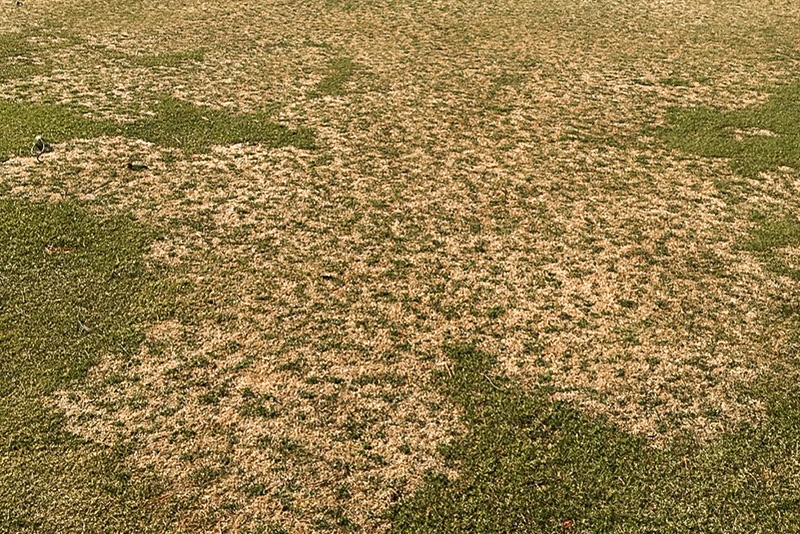
Figure 2. Dormant false-green kyllinga in a perennial ryegrass fairway.
The experiment
Field experiments were conducted at Rutgers University Hort Farm No. 2 in North Brunswick, N.J., in two experimental runs from 2021-2022 and 2022-2023. The site was established in the autumn prior and consisted of Kentucky bluegrass (Poa pratensis L.) maintained at a mowing height of 2.5 inches (6.35 centimeters).
The high-density program received 2.5 pounds nitrogen per 1,000 square feet (122 kilograms per hectare) and preventative fungicide applications targeting common diseases such as summer patch, brown patch and dollar spot. The low-density program received 0.5 pounds nitrogen per 1,000 square feet (24 kilograms per hectare) and no fungicide applications. These programs were designed to represent dense, intensively managed turf and lower-density turf with reduced canopy density (Figure 4).
Within each turf program, three weed seeding treatments were applied: FGK seeded at 0.1 pounds and 10 pounds per 1,000 square feet (5 and 490 kilograms per hectare) and smooth crabgrass seeded at 10 pounds per 1,000 square feet. The higher seeding rates were designed to simulate seed produced in a heavy infestation and the lower seeding rate to simulate seed movement from equipment or surface water.
Figure 3. False-green kyllinga in a creeping bentgrass putting green collar.
Plots were lightly scarified in winter at weed seeding to expose soil and improve seed-to-soil contact. Turf was irrigated as needed and mowed weekly with clippings removed. To prevent crabgrass interference in plots seeded with FGK, fenoxaprop-p-ethyl (Acclaim EXTRA, Bayer Environmental Science) was applied when crabgrass seedlings emerged.
Weed cover was evaluated visually throughout the growing season and measured using grid-intersect counts within a 3-foot-by-3-foot (0.9-meter-by-0.9-meter) sampling frame. Turf density early in the season was assessed using digital image analysis.
Data and analysis
Weed cover was evaluated in July, August and September each year using visual estimates on a 0%-100% scale and a grid-intersect method containing 135 intersect points. Percent weed cover was calculated based on the presence of weeds at each intersect.
Turfgrass canopy density at the time of weed emergence was measured using digital image analysis to determine percent green cover. Turfgrass quality was evaluated monthly from May through September using a scale of 1 (poor) to 9 (excellent), where 6 represents acceptable turf.
GK seedlings were counted using two 8-inch (20-centimeter) soil cores collected from each plot in July of each year.
All data were analyzed using analysis of variance, and treatment means were separated (α = 0.05).
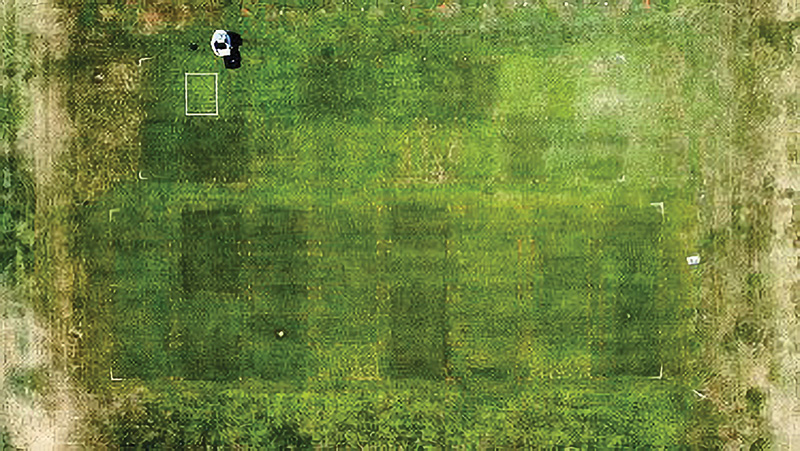
Figure 4. Overhead view of plots showing color differences from nitrogen programs.
Results
Weed cover and turfgrass canopy density varied among treatments in each year, so data from each year are presented separately. Turf quality data were combined across years.
Turfgrass green cover
Turf density programs produced noticeable differences in turf density. Early season green cover averaged 97%-98% in high-density plots and 87%-94% in low-density plots. These differences created turf stands with distinct canopy density, allowing us to evaluate how turf competition affected weed establishment. Dense turf can reduce weed establishment by limiting light and space available at the soil surface.
False-green kyllinga seedling count
FGK seedlings were observed in both turf density programs, demonstrating that the species can establish from seed in cool-season turfgrass. However, seedling establishment was strongly influenced by turfgrass density. At the higher seeding rate (10 pounds per 1,000 square feet), FGK produced 31 seedlings per core sample in low-density turf and eight seedlings in high-density turf. At the lower seeding rate (0.1 pound per 1,000 square feet), few seedlings emerged regardless of turf density.
These results suggest that dense turfgrass can suppress early establishments of FGK seedlings by limiting light penetration and reducing open space within the canopy.
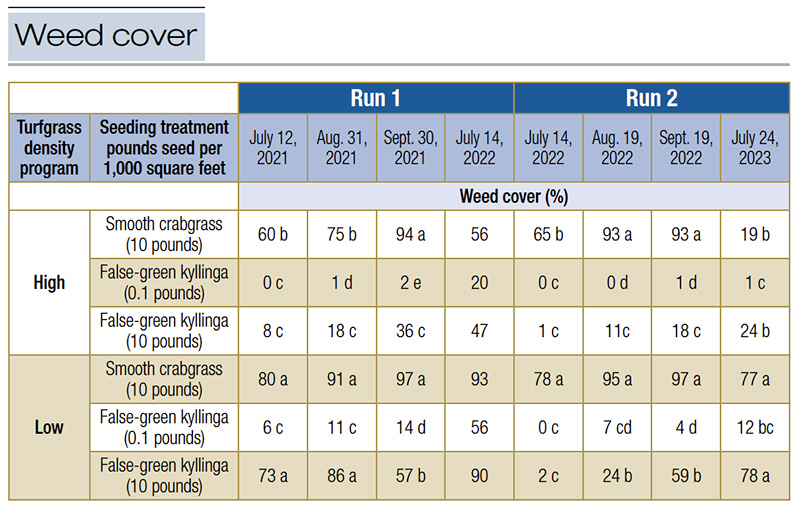
Table 1. Effects of weed seeding rate and turfgrass density program on weed cover estimated visually in 2021 to 2022 (Run 1) and 2022 to 2023 (Run 2) in Kentucky bluegrass. Means followed by the same letter are not significantly different according to Fisher's Protected LSD test (α = 0.05).
Weed cover in the year of establishment
Establishment of FGK was more strongly influenced by turfgrass density than smooth crabgrass in both experimental runs (Table 1). When FGK was seeded at 10 pounds per 1,000 square feet, the high-density program reduced FGK cover compared with the low-density program at most rating dates (Figure 5). In September of Run 1, FGK cover in high-density plots was 2% and 36% when seeded at 0.1 and 10 pounds per 1,000 square feet, respectively, compared with 14% and 57% in low-density plots. Smooth crabgrass establishment was hardly affected by turfgrass density, as crabgrass cover was only slightly affected by management program in July and August and did not differ between turf density programs by September in either run.
Not surprisingly, seeding rate also influenced establishment, as FGK seeded at 0.1 pound per 1,000 square feet consistently produced less weed cover than when seeded at 10 pounds per 1,000 square feet. For example, in September of Run 2, FGK cover reached 18% and 59% in high- and low-density plots seeded at 10 pounds per 1,000 square feet compared with 1% and 4% when seeded at 0.1 pound per 1,000 square feet.
Overall FGK cover was lower in Run 2 than Run 1, likely due to greater turfgrass density early in the season in Run 2. In the low-density program of Run 1, FGK seeded at 10 pounds per 1,000 square feet reached 73% cover in July compared to 2% in Run 2. However, these differences dissipated by September.
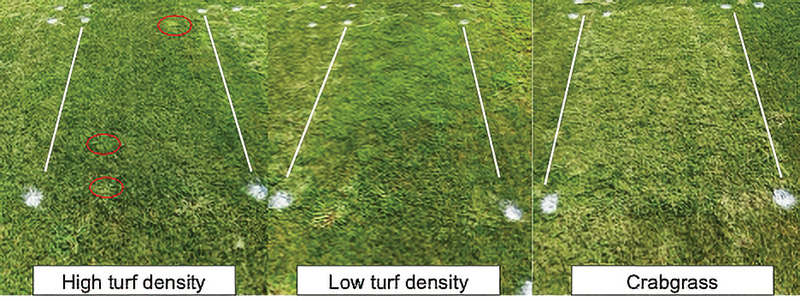
Figure 5. Kyllinga and crabgrass infestation in September during the year of establishment. The red circles indicate the kyllinga infestation in the high-density plot. The light green kyllinga is visible throughout the low-density plot. The crabgrass plot is nearly completely covered with crabgrass.
Year after establishment
FGK successfully established by seed and increased within the sward as a perennial after overwintering from the initial establishment year (Figure 6). During the establishment year, FGK cover was generally lower than smooth crabgrass when both species were seeded the same rate. However, by the year after establishment, FGK and smooth crabgrass cover were similar, presumably because FGK cover increased substantially from rhizome growth. In plots seeded at 0.1 pound per 1,000 square feet in low density turfgrass, FGK cover was 17% in September 2021 but increased to 58% the next summer after overwintering. Similarly, a relatively benign infestation of 6% FGK in high-density turfgrass increased to 20% cover the following summer. Similar patterns have been observed in other kyllinga species where infestations expand rapidly after overwintering due to vegetative spread (4).
Turfgrass quality
Turfgrass density programs influenced turfgrass quality at every rating date (Table 2). The high-density program improved turfgrass quality on every rating date compared to the low-density program. When FGK and crabgrass seedlings first emerged in May, the turfgrass quality in the high-density plots was 6.9, whereas in the low-density plots, it was 4.6. As the growing season progressed from July onward, weed cover began to increase and is attributed to reduced turfgrass quality.
Smooth crabgrass established faster than FGK and contributed to reductions in turfgrass quality from July onward. In July of the establishment year, turfgrass quality in smooth crabgrass plots (3.8) was lower than in FGK plots (>6). Smooth crabgrass resulted in a turfgrass quality rating of 3.2 in August, whereas the 0.1 and 10 pounds per 1,000 square feet of FGK produced quality of 6.7 and 5.8, respectively. Following September ratings, turf quality declined more rapidly in FGK plots seeded at 10 pounds per 1,000 square feet compared to 0.1 pound per 1,000 square feet in October and November as the higher proportion of the C4 FGK entered winter dormancy following frost events and the C3 Kentucky bluegrass quality remained high into November.
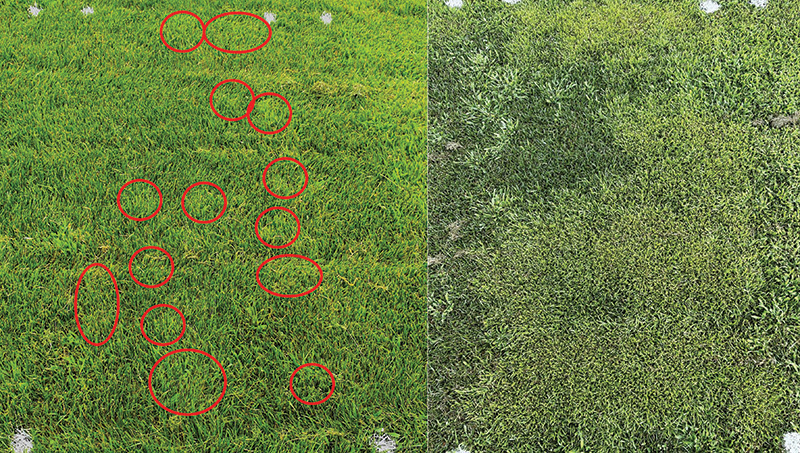
Figure 6. A kyllinga infestation following seeding at 10 pounds per 1,000 square feet in August of the year of establishment (left) and the same plot the following July (right). These images illustrate the rapid expansion of kyllinga from rhizome growth after overwintering.
Conclusions
FGK can establish from seed in cool-season turfgrass, although seedlings are less competitive and slower to establish than smooth crabgrass. Increasing turfgrass density was more effective at reducing FGK establishment from seed than smooth crabgrass. However, once FGK becomes established, spread from rhizomes is not mitigated by higher N fertilization.
It is well understood that using preemergence to control crabgrass is critical because crabgrass matures rapidly, and postemergence control is difficult. But these results suggest using preemergence herbicides should not be a primary strategy to control FGK. This is for two reasons. First, we do not know which preemergence herbicides are most effective against FGK seedlings. Our preliminary research suggests dithiopyr, prodiamine and pendimethalin are less effective at controlling false-green kyllinga seed than crabgrass (6). We also do not fully understand seasonal emergence of false-green kyllinga seed, although preliminary results indicate its temperature requirements are similar to other warm-season weeds (1).
While modifying preemergence herbicide programs is not necessary, early detection and control of small infestations and controlling them with postemergence herbicides remains important for long-term management. In our experiments, these minor infestations expanded rapidly after overwintering, likely through rhizome spread. This suggests that minor infestations may become much more problematic in subsequent seasons if they are not controlled early. Future research should evaluate preemergence herbicides in field environments.
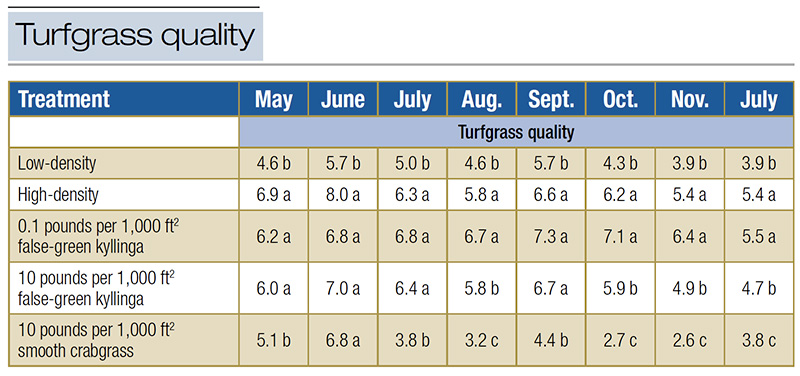
Table 2. Effects of weed seeding treatment and turfgrass density program on turfgrass quality. Turfgrass quality was assessed on uniformity, color and weed establishment. Data presented are pooled across two experimental runs. Means followed by the same letter are not significantly different according to Fisher’s Protected LSD (α = 0.05).
The research says
- False-green kyllinga can establish from seed in mature cool-season turfgrass but is not as competitive from seed as smooth crabgrass.
- False-green kyllinga establishment from seed was reduced by input that increase turf density but smooth crabgrass establishment was not affected.
- In our experiments, minor infestations expanded rapidly after overwintering, likely through rhizome spread. This suggests that minor infestations may become much more problematic in subsequent seasons if they are not controlled early.
- Using preemergence to control crabgrass is critical because crabgrass matures rapidly and postemergence control is difficult. But these results suggest using preemergence herbicides should not be a primary strategy to control false-green kyllinga.
- While modifying preemergence herbicide programs is not necessary, early detection and control of small infestations and controlling them with postemergence herbicides remains important for long-term management.
Note: This article was adapted from Watson, T.S., M.T. Elmore, A.J. Patton and D.P. Tuck. 2025. False-green kyllinga competitiveness from seed in turfgrass. Crop Science 65, e70178 (https://doi.org/10.1002/csc2.70178).
Literature cited
- Amgain, N.R., A.J. Patton and M.T. Elmore. 2024. Effects of temperature, light, and water stress on false-green kyllinga germination. ASA, CSSA, SSA International Annual Meeting Abstracts (https://scisoc.confex.com/scisoc/2024am/meetingapp.cgi/Paper/157573).
- Bryson, C.T., R. Carter, L.B. McCarty and F.H. Yelverton. 1997. Kyllinga, a genus of neglected weeds in the continental United States. Weed Technology 11:838-842 (https://doi.org/10.1017/S0890037X00043530).
- Elmore, M.T., A.J. Patton, D.P. Tuck, J.A. Murphy and J. Carleo. 2019. False-green kyllinga (Kyllinga gracillima) control in cool-season turfgrass. Weed Technology 33:329-334 (https://doi.org/10.1017/wet.2019.16).
- Lowe, D.B., T. Whitwell, L.B. McCarty and W.C. Bridges. 2000. Mowing and nitrogen influence green kyllinga (Kyllinga brevifolia) infestation in Tifway bermudagrass (Cynodon dactylon× C. transvaalensis) Turf. Weed Technology 14(3):471-475.
- McElroy, J.S., F.H. Yelverton and L.S. Warren. 2005. Control of green and false green kyllinga (Kyllinga brevifolia and K. gracillima) in golf course fairways and roughs. Weed Technology 19:824-829 (https://doi.org/10.1614/WT-03-241R1.1).
- Watson, T.S. 2024. False-green kyllinga (Kyllinga gracillima Miq.) ecology and integrated management strategies in cool-season turfgrass. Publication No. 31333371. [Master’s thesis, Rutgers University].
Trevor S. Watson (trevorswatson1@outlook.com) is a regional technical manager with expertise in turfgrass science, weed management, plant health care, and agronomic program development; Matthew T. Elmore, Ph.D., is an associate Extension specialist, and Daniel P. Tuck is a field researcher, all at Rutgers University, New Brunswick, N.J.; and Aaron J. Patton, Ph.D., is interim department head and professor of horticulture and landscape architecture at Purdue University, West Lafayette, Ind.