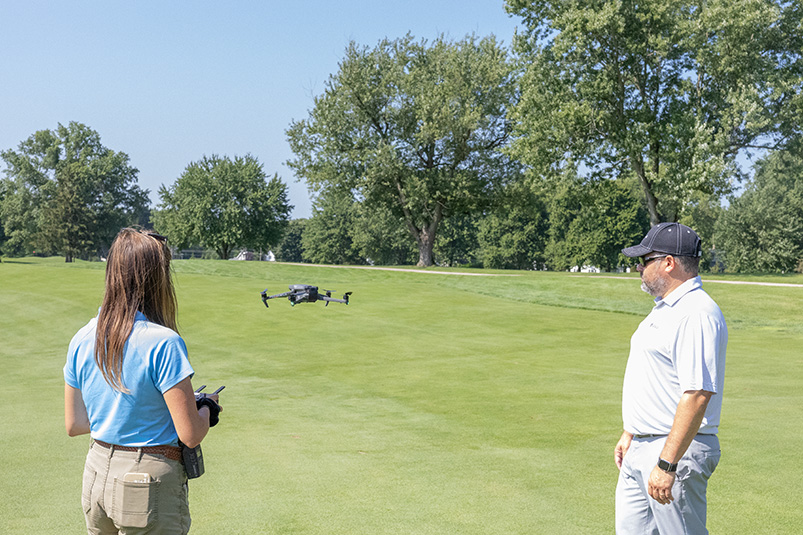
Let’s talk about spray drones. To be specific, let’s talk about multi-rotor unmanned aerial vehicles, or UAVs, used as agrichemical sprayers or spreaders. I will refer to them as spray drones because that is what they are called colloquially.
Drone spraying really should be defined as aerial autonomous spraying. Geodefined zones are created via the accompanying software, and applications are made within those zones. Drone sprayers are loaded with spray or granular materials and tasked to a work area. The drone lifts off, travels to that area, treats that area and geo tracks where it has sprayed. Sprayers return to the loading location, can have tanks quickly changed and can return to spraying at the exact location it left off.
Spray drones spray 10 to 20 feet above the ground. They also spray at low volumes (2 to 5 gallons per acre) because they can carry limited amounts of spray solution. Because of this, they produce smaller droplets that are more prone to drift. The downwash from the propellers can also create vortices in the wake, which further exacerbates drift.
Research on UAV spray systems has begun to quantify these droplet dynamics and deposition patterns. Studies have consistently shown that UAV sprayers produce fine to very fine droplets, which increases the risk of off-target movement compared to conventional ground-based sprayers. Droplet drift potential increases with flight height and wind speed, but rotor downwash can enhance vertical deposition directly beneath the aircraft (3). Similarly, the downward airflow generated by multi-rotor UAVs improves canopy penetration but also creates turbulent air patterns that can reduce uniformity at the edges of the spray swath (2). Deposition uniformity has also been shown to be sensitive to operational parameters such as flight speed, altitude and spray volume (1).
While much of this work has been conducted in agronomic crops or noncrop areas, the findings translate well to turfgrass environments. The shorter, more uniform canopy of turfgrass potentially reduces barriers to droplet interception, meaning effective coverage could achieved at lower carrier volumes. In some cases, rotor downwash may enhance droplet movement into dense turf canopies or thatch layers. However, increased drift potential associated with fine droplets requires careful management, particularly on golf courses, where sensitive areas such as greens, ornamentals and water bodies are in close proximity.
One way I evaluate new technology is to just ask the question, “Does it solve a problem?” Marketing of technology can try to convince you there is a problem that it solves, but really the technology was created first, and then a problem was added later. It should derive from the person with a problem.
On golf courses, there are areas that are tough to spray with traditional equipment. Applications to slopes and natural areas can be difficult due to steep, undulating and uneven terrain. Drone applications could easily cover these areas.
Ponds and lakes are also problematic to spray, and drones could help solve this issue. A spray drone could be launched from the shoreline, allowing precise application across the entire surface without the need for direct physical access, improving both efficiency and operator safety.
But what about on the course? This is where it gets more complicated, largely due to trees. Trees can reduce GPS-RTK signal, which reduces precision of the geodefined zones, potentially reducing the ability of the spray drone to function. Newer technology and good practices can mitigate this issue. Trees can also be a danger to the equipment.
Like lots of technology, spray drones have pros and cons. There are great use cases, but probably not in all situations.
Flagstick in or out? Player’s choice.
Literature cited
- Manjunatha et al. 2026. Effects of flight height, flight speed and spray volume of a UAV based spraying system on droplet deposition in cashew trees. Results in Engineering 29(3) (https://doi.org/10.1016/j.rineng.2026.109786).
- Qin et al. 2016. Optimization and test for spraying parameters of cotton defoliant sprayer. International Journal of Agricultural and Biological Engineering 9(4):63-72 (https://doi.org/10.3965/j.ijabe.20160904.2125).
- Wang et al. 2018. Testing method and distribution characteristics of spatial pesticide spraying deposition quality balance for unmanned aerial vehicle. International Journal of Agricultural and Biological Engineering 11(2):18-26 (https://doi.org/10.25165/j.ijabe.20181102.3187).
Scott McElroy, Ph.D., is a professor of turfgrass management and weed science in the Department of Crop, Soil & Environmental Sciences at Auburn University, Auburn, Ala. He is a 19-year member of GCSAA.