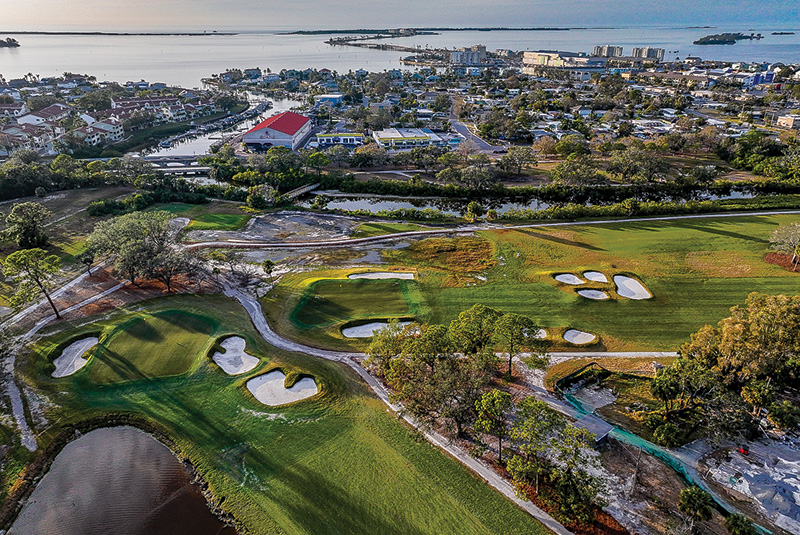
An aerial view of parts of holes Nos. 14-17 at Dunedin Golf Club just outside Tampa, Fla. Photos courtesy of Scott Griffin
In the final days of 2024, Dunedin Golf Club — located just north of Tampa, Fla. — reopened following a $6 million restoration to its historic Donald Ross design. When it was announced in the fall of 2023 that the city of Dunedin, which owns the golf course, would embark on this significant project, I was excited and full of anticipation to see the final product.
Having spent many years as a superintendent at various courses in Naples and Tampa, I was familiar with Dunedin Golf Club. This iconic gem was one of Donald Ross’ favorite courses when it opened in 1927. Ross referred to it as his “masterpiece” and attributed that label to its ideal combination of rolling hills, waterways and other natural hazards that made it possible to achieve his idea of course perfection.
Dunedin was also the PGA of America’s home from 1945 to 1962 and site of the first PGA Merchandise Show in 1954.
Over the years, the course became tired, underwent various renovations and lost much of Ross’ strategic shot values that he was known for. This included the original green complexes shrinking by 35-50%, the irrigation system being in constant disrepair, the fairways featuring a combination of various bermuda varieties and the greens being a mix of MiniVerde and numerous other species. Additionally, there were severe drainage issues. The course was ripe for restoration.
When the city decided to move forward with the restoration, it secured grants from the Donald Ross Society and the State of Florida, thanks to the course being on the National Register of Historic Places. Combined with funds from the American Recovery Plan, the grants helped secure the loan funding for restoration.
The city hired course architect and Ross specialist Kris Spence — 17-year GCSAA member — to bring the course back to its original Ross vision, in collaboration with the engineering firm Stantec and contractor TDI Golf. The city also hired Blair Kline as general manager of golf operations. Completing the team to execute the project was Dennis Swander of the maintenance provider Down to Earth.
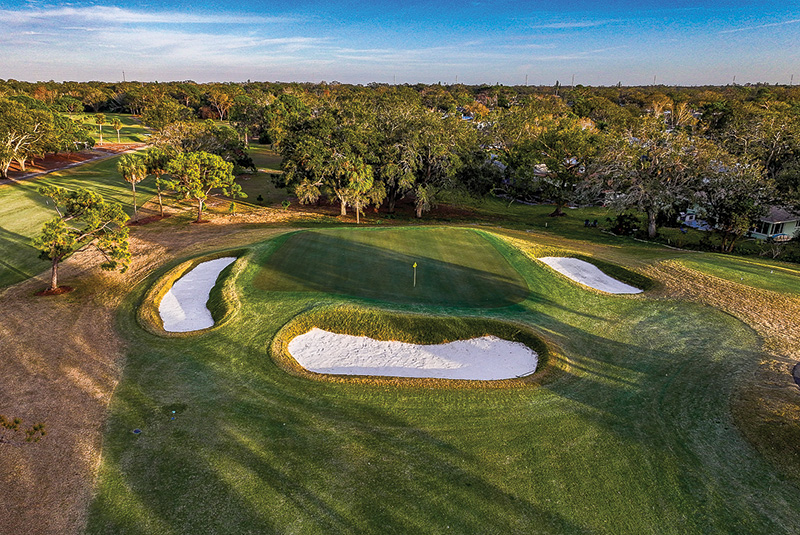
No. 6 after the renovation. Part of the restoration included returning greens to their original sizes and shapes.
Old is new again
Perhaps the most interesting construction detail was the greens restoration. During previous renovations, the PGA of America relocated one green and flattened the others, which were situated on their original fill pads but buried under 11⁄2 to 2 feet of soil resulting from sand shots and topdressing. Utilizing old photos, drawings and Ross’ field notes, Spence located the original greens.
He and his shaper pushed off the soil, carefully dug and followed the black layer in the green (cinders from Ross) to the green edges to uncover the original size and shape. Once he approved the green, it was mapped and cored out, drainage was installed, and a new green mix was applied. Then the contours were recreated, leading to sprigging. The “new” greens are truly on their 1926-1927 fill pad, and the one green that had been moved was returned to its original location.
Spence says the greens’ original contours and elevation changes are back for today’s golfers to experience firsthand.
“They’re as good as any out there with great variety,” Spence says. “There are some subtle greens on some of the longer holes and some with a lot more movement, tilt and complexity to them on some of the shorter holes. It’s what we’re used to seeing out of Ross when he was really on point. In hindsight, it was a blessing that they just buried the greens. It was sort of an archaeological dig to go down and find the surface of the old greens and peel off the newer material — like we’re peeling the rind off an orange — to reveal that original green. Once we did, we could see the original greens that had been buried for 75 years.”
As the course superintendent responsible for overseeing the historic course following the award-winning restoration, I considered it crucial to have Swander be an integral part of the project. He was alongside Spence during the entire process. He was a part of all the construction meetings, helped to select the bunker sand (G Angle), fairway grass (TifTuf or paspalum) and greens mix (TifEagle) and oversaw the Toro irrigation system.

A look down the fairway on No. 16. The course reopened for play late in 2024.
Rain, rain, go away
The restoration wasn’t without obstacles. Rain issues, heat and wind created challenges early on, followed by a tropical storm. Then Hurricane Helena hit with a storm surge that flooded five holes, followed by Milton, which dropped more than 15 inches of rain and brought high winds that knocked down 96 trees.
The severe weather provided the opportunity to learn more about the grass strains being used. The Platinum paspalum held strong at the intrusion of brackish water, while the TifTuf withered under the water. This helped identify which areas were affected by which strain of grass. Despite all the weather considerations, the team still worked hard to have the course ready. Finally, on Dec. 27, 2024, the course opened for play.
With the course being closed for 10 months, there was built-up demand to experience the genius of Ross more than a century after it opened.
“If Ross crawled out of his grave today and saw how far the ball goes and how fast the greens are compared to his era, I do not believe he would design the same course today that he designed in 1926,” says Kline. “Now we have the course that we believe he would design. The routing remains the same. Some bunkers have changed locations to account for driving distance, and the greens are exceptional. We recaptured all the pin placements, too.”
Dunedin is now one of Florida’s top municipal courses, visited by many golfers and course architecture aficionados. The course also won an award for Best Public Renovation by Golf Inc. The tribute goes to Ross. There are several Ross designs in the Tampa area, but few are open to the public.
Although I was not involved in the restoration, I am thankful that a GCSAA member was such an integral part. Now as its new superintendent, I am truly honored to become the caretaker of such a historic and renowned course.
Scott Griffin is the GCSAA Class A golf course superintendent at The Dunedin Golf Club in Dunedin, Fla., and a 17-year GCSAA member.