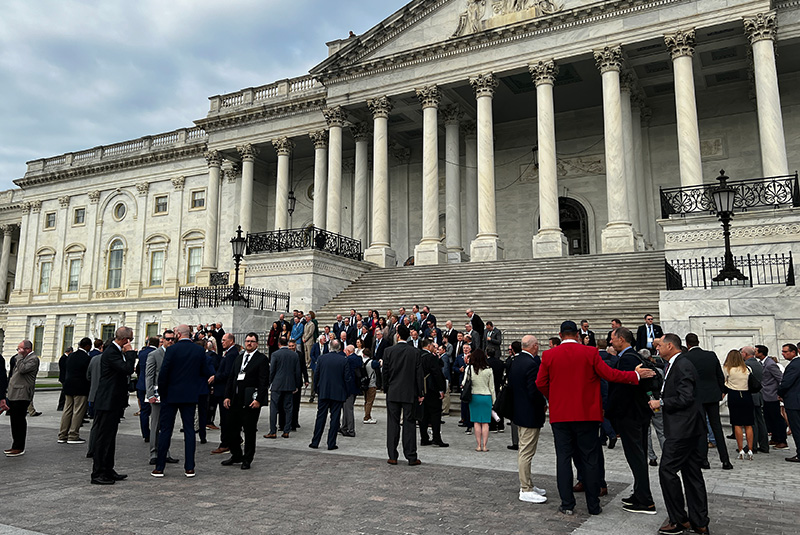
GCSAA is heading to Capitol Hill for the 2026 National Golf Day May 4-6, in Washington, D.C., to discuss key issues affecting the golf industry. The issues up for discussion are determined annually by American Golf Industry Coalition (AGIC) lobbyists and approved by the core group of golf industry chief executive officers.
National Golf Day attendees are trained on talking points ahead of meeting with members of Congress and their staff to ensure they are knowledgeable and prepared to share golf’s positive story during more than 250 meetings, representing 41 states, on Lobby Day on May 6.
For 2026, National Golf Day participants will again focus on the issues of modernizing the tax code in the PAR Act and passage of the PHIT Act, as well as H-2B visa program improvements and a new request for funding for the National Agriculture Statistics Survey.
Tax Code Modernization
Since 1973, the language in the U.S. tax code has been discriminatory against the golf industry, lumping it in with industries such as betting establishments, dog tracks and tattoo parlors. When this tax code was written, the golf industry was mainly comprised of private clubs, but that landscape and accessibility has greatly changed over the last 53. It’s important to modernize this section of the tax code to ensure golf facilities are included in supplement disaster tax relief when faced with significant natural disasters.
In its second year of a two-year congressional session is the H.R. 1583 Parity for Athletic Recreation (PAR Act), which was co-sponsored by Reps. Claudia Tenney (R-NY) and Jimmy Panetta (D-CA) in 2025. This bill would amend the tax code to remove existing restrictions on the use of tax-exempt bond proceeds for golf facilities. National Golf Day advocates will encourage support of H.R. 1583 so that golf is no longer unfairly penalized.
PHIT Act
GCSAA is also advocating for the Personal Health Investment Today (PHIT) Act that would allow Americans to use pre-tax money from flexible spending accounts (FSA) and health savings accounts (HSA) for qualified fitness-related expenses, including golf-related activities. The intent is to encourage healthy lifestyles and prevent chronic health issues.
The PHIT Act was reintroduced in March 2025 with H.R. 2369, co-sponsored by Panetta and Reps Mike Kelly (R-PA), and S. 1144, co-sponsored by Sens. John Thune (R-SD) and Chris Murphy (D-CT). GCSAA and AGIC support the PHIT Act because it offers 100 million Americans the opportunity to lower the cost of life-long health and to achieve and maintain a healthier lifestyle.
H-2B Visa Program
The H-2B visa program allows U.S. employers to hire foreign nationals for temporary, non-agricultural jobs, typically in seasonal industries like landscaping, construction, golf and more. The demand for the program has increased in the golf industry by 73% since fiscal year 2019. The number of H-2B visas available each fiscal year is capped at 66,000, unless Congress acts to increase this number. While Congress has acted to increase that cap through supplemental visas through the Appropriations process, GCSAA will advocate that the program have a more permanent fix and provide more visas and in a timelier fashion for GCSAA superintendents.
GCSAA supports two options for such improvements:
- Increasing the total cap of visas available each fiscal year.
- Changing the law to exempt long-term employers who have been using the program annually for at least five years and doing so in a legal way. Additionally, any facility that qualifies as a certified seasonal employer (CSE) would not be subject to the H-2B visas cap and would receive the highest number of visas received in the last five years.
Funding for the National Agriculture Statistics Survey
Turf comprises 60 million acres and is the fourth largest crop in the United States. Its benefits are enormous to public health, landscaping, recreation, environmental sustainability and impeding contaminant runoff into waterways. It’s also vital to the golf industry, which contributes $102 billion to the economy annually.
GCSAA supports a request for $3 million in funding for the Department of Agriculture National Agriculture Statistics Survey (NASS) to collect data on acreage, production and economic impact of the turf industry, including employment, input costs and retail value.
Turfgrass research is vital to the future of the industry and its environmental stewardship. If GCSAA can show that turfgrass is a significant commodity, it could translate into looking at the golf industry through a different lens and, in turn, secure more appreciation for it.
Kelsey Underwood is a communications manager at GCSAA.