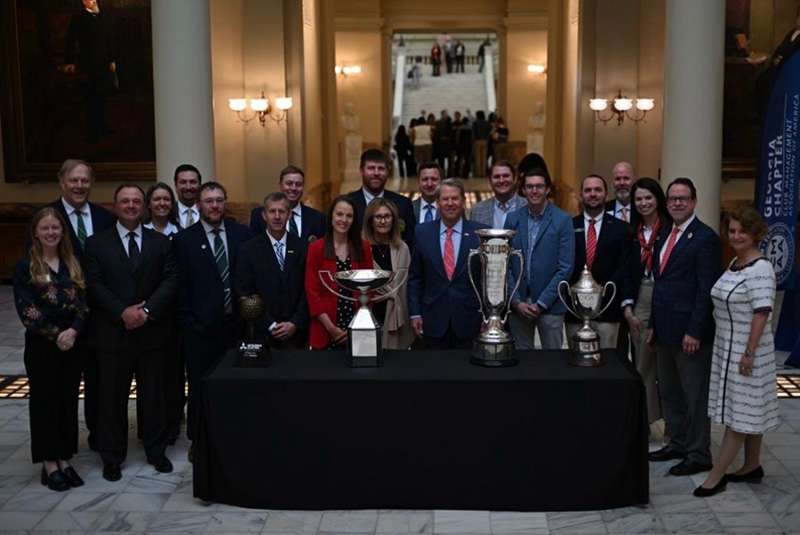
Georgia GCSA members with Georgia governor Brian Kemp during an advocacy event at the Georgia state capitol. Photos courtesy of Tim Busek
Every GCSAA chapter wants to be heard when environmental policy is developed. Few have earned the credibility and influence that the Georgia Golf Course Superintendents Association (Georgia GCSA) has achieved over the past two decades.
Georgia's story is not simply about Best Management Practices (BMPs). It is about how a chapter, working in partnership with GCSAA, university researchers, allied golf organizations, legislators, regulators and golf course superintendents, built lasting relationships that transformed golf from a regulated industry into a trusted environmental partner. Theirs is a story every GCSAA chapter can learn from.
Building Trust Before the Crisis
Nearly 20 years ago, Georgia experienced one of the most severe droughts in its history. As water supplies dwindled, golf courses became targeted for water-use restrictions. Policymakers were searching for ways to conserve water, and mandatory irrigation restrictions for golf courses appeared increasingly likely.
Rather than waiting for regulations to be imposed, the Georgia GCSA chose to lead. Working alongside golf facilities, state agencies and allied golf organizations, the chapter united the industry around responsible water management and environmental stewardship. Turfgrass professionals didn’t argue that golf deserved special treatment. Instead, they demonstrated how golf courses could be trusted partners in protecting Georgia's natural resources.
The development and implementation of Best Management Practices became the foundation of that effort. Georgia’s BMPs documented how golf courses conserved water, protected water quality, managed wildlife habitat and operated under science-based management principles. More importantly, they gave regulators confidence that golf facilities were committed to measurable environmental stewardship.
That proactive approach earned Georgia GCSA members meaningful input during the development of Georgia's drought management policies. Instead of simply reacting to regulations, the golf industry became part of the conversation, with representatives helping secure regulatory consideration and flexibility that might otherwise have been unavailable.
A Commitment That Never Ended
This organization effort’s greatest achievement wasn't regulatory relief. It was trust. Unlike many advocacy efforts that end when a crisis passes, Georgia's commitment continued long after drought conditions improved.
For more than 20 years, successive Georgia GCSA boards of directors remained committed to educating policymakers and strengthening relationships with regulators. Working alongside the chapter's longtime legislative advocacy team — GeorgiaLink Public Affairs and consultant Skin Edge — the association consistently communicated golf's environmental value, economic impact, and commitment to conservation.
Just as important was the continued partnership of the Allied Golf Council — an alliance of the Georgia GCSA, Georgia State Golf Association, Georgia PGA, and the Georgia Chapter of the Club Management Association of America. Together, these organizations presented a unified voice for golf that strengthened the industry's credibility throughout Georgia.
Those relationships would prove invaluable when history repeated itself.
Reviving a Successful Strategy
Nearly two decades after Georgia's original drought crisis, drought conditions and water-resource restrictions once again emerged as significant public policy issues. This time, however, golf was better prepared.
Recognizing that the relationships built years earlier provided an extraordinary foundation (but not a permanent solution) Georgia GCSA executive director Tim Busek understood maintaining golf's credibility required more than relying on past accomplishments. It required demonstrating that today's golf industry continues to embrace the highest standards of environmental stewardship.
Rather than allowing Georgia's earlier success to remain part of the chapter's history, Busek transformed it into a strategy for the future. His vision centered on a simple principle: documented stewardship creates credibility, and credibility creates influence.
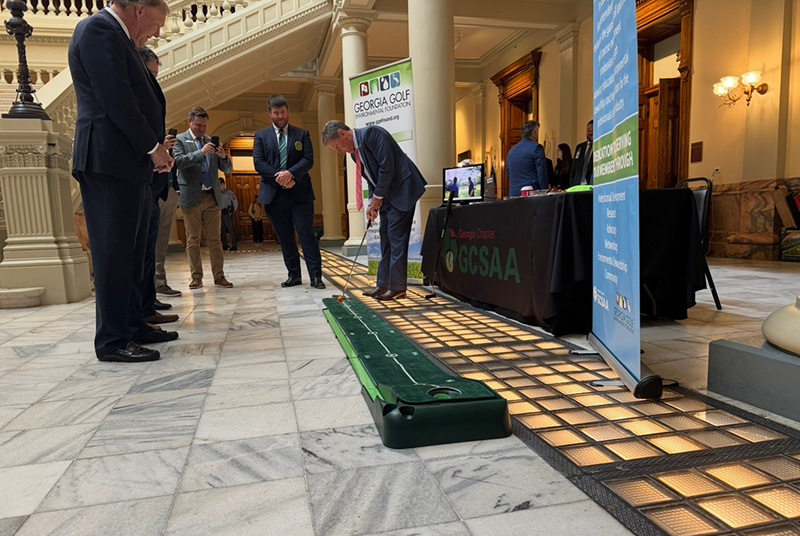
Georgia governor Brian Kemp tries out a putting green at the Georgia State Capitol Building.
The Power of a Chapter–National Partnership
One of Busek's most important strategic decisions was strengthening Georgia's partnership with GCSAA's National Best Management Practices Program. Busek recognized GCSAA had developed far more than a BMP manual. The association had created a nationally recognized framework, implementation platform and scientific foundation to help chapters strengthen relationships with regulators at every level of government.
The partnership combined the strengths of both organizations. GCSAA provided the national BMP platform, implementation tools, technical resources and scientific credibility establishing consistent environmental standards throughout the golf industry. Georgia GCSA contributed local leadership, trusted relationships, legislative engagement and an understanding of Georgia's unique regulatory environment.
Together, they created an advocacy model that neither organization could have accomplished independently. It also created a blueprint any GCSAA chapter can adapt to its own state.
Turning BMPs Into Action
Recognizing implementation matters as much as publication, Busek secured funding through the Georgia Golf Environmental Foundation to accelerate BMP adoption across Georgia. That investment enabled the chapter to engage Dr. Gary Hawkins, Associate Professor at the University of Georgia and one of the state's leading experts in water resource management, to work directly with golf facilities.
Rather than asking superintendents simply to adopt a manual, Hawkins and his team work alongside facilities to customize BMPs using GCSAA's implementation platform. Each plan reflects the unique design, infrastructure, environmental conditions, and operational practices of the individual golf course.
The result is not another document sitting on a shelf. It is a living management plan that guides daily decisions while documenting measurable environmental stewardship.
Expanding the Model Beyond Georgia
Busek also recognized environmental stewardship does not stop at state lines. Working closely with Tim Hiers, Director of Golf Course Operations at White Oak Conservation, and in collaboration with the Florida GCSA, the effort expanded into a regional conversation with regulators and elected officials throughout Georgia and Florida.
Supporting those efforts is Dr. Bryan Unruh, Professor of Environmental Horticulture and Associate Center Director of the UF/IFAS West Florida Research and Education Center, whose research and expertise continue to reinforce the scientific foundation behind golf course BMPs.
Together, these leaders have demonstrated that golf courses are not simply consumers of water. They are managers of watersheds, wildlife habitat, stormwater systems, forests, and natural landscapes that contribute to the responsible stewardship of public resources. That message carries far greater weight because it is supported by documented BMP implementation rather than opinion alone.
Trust Earned Again
When drought concerns resurfaced, Georgia's golf industry entered discussions with regulators from a position of strength rather than uncertainty.
While the credibility earned during the droughts of the early 2000s created the original foundation, it was Busek's leadership — and the collaboration between the Georgia GCSA and GCSAA's National BMP Program — that positioned golf courses to once again receive meaningful regulatory consideration.
By expanding BMP adoption, investing in scientific expertise, documenting environmental stewardship, and strengthening relationships with policymakers before new restrictions were proposed, Georgia regained—and in many respects strengthened—the trust and flexibility it had earned more than two decades earlier.

From left: Senator Matt Brass and Lieutenant Governor Burt Jones, Jamey Jackson of Modern Turf and Tim Busek, GCSAA Class A executive director of Georgia GCSA.
A Blueprint for Every Chapter
Perhaps the greatest lesson from Georgia is that successful advocacy is never built during a crisis. It is built over decades through leadership, science, collaboration, and trust.
Georgia's success is the product of multiple generations of leadership. Early chapter leaders like former executive director and Georgia GCSAA Hall of Fame inductee Tenia Workman and long-time Georgia Golf Course Superintendent, Georgia GCSA Hall of Fame inductee and Georgia Golf Hall of Fame inductee Mark Esoda helped establish the relationships and credibility that first earned golf a place at the table. Successive Georgia GCSA boards of directors sustained those relationships through continuous engagement.
Today, Busek has elevated that legacy by partnering with GCSAA's National BMP Program, engaging leading researchers like Hawkins and Unruh, collaborating with Tim Hiers, the Florida GCSA, GeorgiaLink Public Affairs, Skin Edge and the Allied Golf Council, and focusing on implementation rather than simply publication.
That continuity of leadership is what distinguishes Georgia's story. For GCSAA chapters across the country, this is more than a Georgia success story. It is a roadmap.
Every state faces different environmental challenges, political landscapes, and regulatory priorities. Yet every chapter has the opportunity to combine local leadership with GCSAA's national BMP resources, partner with universities and allied organizations, build lasting relationships with local, state, and federal decision-makers and document environmental stewardship through BMP implementation.
Georgia has demonstrated that BMPs are far more than environmental manuals. They are strategic advocacy tools. When local chapters collaborate with GCSAA, invest in implementation, engage credible scientific partners and cultivate relationships long before regulations are written, they earn something that cannot be legislated or purchased. They earn trust that secures golf's seat at the table when the next environmental challenge inevitably arrives.
Acknowledgments
The Georgia GCSA's success reflects the dedication of many individuals over more than two decades. Special appreciation is extended to Tenia Workman, former executive director of the Georgia GCSA, whose leadership helped establish many of the relationships and initiatives that continue to benefit the industry today. Special thanks also to Mark Esoda, whose leadership during the formative years helped build lasting relationships with policymakers, regulators, and allied organizations that became the foundation for Georgia's long-term success.
Thanks are also due to the many past and present members of the Georgia GCSA board of directors, whose sustained commitment to advocacy, environmental stewardship, and industry collaboration carried this vision across generations. The chapter also recognizes the invaluable partnership of GCSAA, GeorgiaLink Public Affairs, Skin Edge, the Allied Golf Council, the Georgia Golf Environmental Foundation, Dr. Gary Hawkins, Dr. Bryan Unruh, Tim Hiers, the Florida GCSA and the many Georgia golf course superintendents whose commitment to Best Management Practices has made Georgia a national model for environmental leadership.
Josh Tapp is GCSAA's director of environmental programs.