
Golfers have wide-ranging expectations for course conditions, especially when it comes to everyday play. Photo by Robert Beck/USGA
There are many steadfast, universal truths in golf. For example, everyone knows that you “drive for show, but putt for dough.” The average player really should just “grip it and rip it.” And who can forget the omnipresent words of Bobby Jones: “Golf is a game that is played on a 5-inch course — the distance between your ears.” The universal truths of golf course maintenance are less mainstream, but no less fundamental to the success of the game. Perhaps the most important is that golf course management is expensive. Equally pervasive is the apparent arms race toward better playing conditions, and the perception that golfers will accept nothing less than what they’ve become accustomed to.
In the U.S., the average maintenance expenditure for an 18-hole golf course was nearly $1 million in 2023, representing 23% of facility revenue (2). A good portion of maintenance budgets go to labor, water (for those who purchase water), equipment maintenance, fuel and product applications. The wide range of maintenance budgets across facilities is also important to note. About 20% of facilities spent $1.5 million or more to maintain 18 holes in 2023 (50% more than the average cost), but 15% spent less than $400,000 (less than half of the average cost). Some facilities might not be looking for cost savings or might even be looking to increase expenditures, but many are interested in ways to spend less and still meet golfer expectations. For those interested in cost reduction, establishing well-adapted and resource-efficient turfgrass cultivars on their various playing surfaces has great potential to bring savings. Understanding, and even changing, golfer expectations may hold even more potential. While decades of work and millions of dollars have been spent developing improved grasses, less has been done to understand what golfers actually expect out of those grasses and what, if anything, can be done to adjust those expectations.
To learn more, we conducted a survey to explore whether golfer perceptions of visual quality and playability are influenced by receiving information on maintenance costs. How would higher- and lower-input options be viewed once golfers had more information about what it cost to provide those conditions? This research was conducted by showing golfers fairway plots with various input levels that were composed of creeping bentgrass, Kentucky bluegrass and buffalograss. Buffalograss is a warm-season turfgrass option that offers exceptional drought and heat tolerance but has not been widely adopted because of seed availability and establishment challenges, along with concerns about how golfers might perceive its appearance and playing quality. We expected that participants would most often prefer highly managed creeping bentgrass but may be more willing to accept less-intensively managed Kentucky bluegrass or buffalograss fairways when management costs were known.
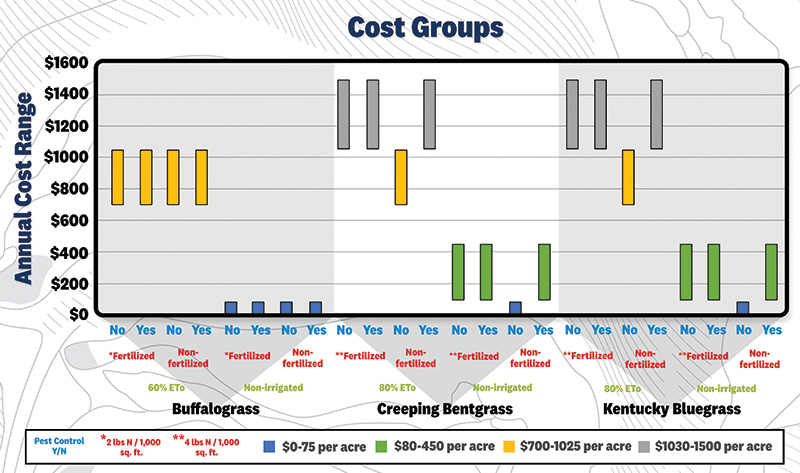
Figure 1. Price groups were created based on the per-acre cost for 24 treatment combinations — eight each for management of buffalograss, creeping bentgrass and Kentucky bluegrass.
Determining management costs for fairway plots
Our experiment occurred from May 2017 through summer 2019 at the East Campus Turf Research Center at the University of Nebraska-Lincoln. Replicated plots of Prestige buffalograss, Pure Select creeping bentgrass and Barvette Kentucky bluegrass were maintained at 0.5 inches (1.27 centimeters) and subjected to eight combinations of irrigation, fertilizer and pest control regimens. Irrigation levels were 1) no supplemental irrigation beyond precipitation or 2) irrigation based on replacement of standard reference evapotranspiration (ETo), which was 80% ETo for cool-season grasses and 60% ETo for buffalograss. Fertilizer levels were 1) untreated or 2) standard, which was total annual nitrogen applications of 4 pounds per 1,000 square feet (19.53 grams per square meter) for cool-season grasses or 2 pounds per 1,000 square feet (9.76 grams per square meter) for buffalograss. Pest control levels were 1) untreated or 2) standard scheduling of products and rates to control weeds and diseases. The principal contribution to costs from pest management was chlorothalonil, which was applied at the first sign of dollar spot in cool-season grasses.
Management costs for each of our 24 treatment combinations were estimated based on the average amount of water, fertilizer and pesticides used over three plots of each treatment combination. To summarize costs for our survey (discussed below), four cost groups ($0-$75, $80-$450, $700-$1,025 and $1,030-$1,500 per acre annually) were then created by equally dividing the range of per-acre costs over all 24 treatment combinations (Figure 1). Water was the main component of costs — calculated based on nonresidential municipal rates for high-volume users in Lincoln, Neb., in 2017 ($1.91 per 748 gallons). Turf performance and complete cost information is available in our full research article (https://doi.org/10.1002/its2.160)(1).
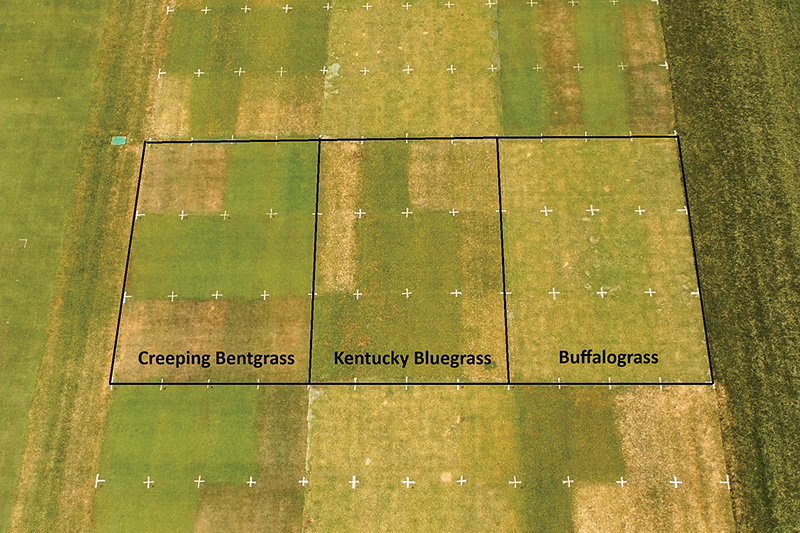
Figure 2. This aerial image shows the variation in turfgrass performance between creeping bentgrass (left), Kentucky bluegrass (middle) and buffalograss (right) maintained under different management regimes. Poor quality in some of the cool-season plots was driven mostly by drought stress and residual dollar spot injury, which were less of an issue in the buffalograss plots.
Golfer survey
Survey participants included University of Nebraska Turfgrass Research Field Day attendees and undergraduate students. Each indicated their golfing frequency and ability. Golfing frequency categories were defined as “annual” (one to three rounds per year), “monthly” (four to seven rounds per year), “bimonthly” (eight to 15 rounds per year) and “regular golfer” (more than 15 rounds per year). Ability categories included “scratch” (an average score of less than 76 on an 18-hole golf course), “skillful” (an average score of 76-85), “bogey” (an average score of 86-95), “recreational” (an average score of 96-105) and “casual” (an average score of greater than 105). The 62 participants were asked to visually evaluate the turfgrass in each research plot (Figure 2) by assigning a score of 1 for acceptable or 0 for unacceptable visual quality and playability. Participants were then told estimated management costs and asked to reevaluate each plot. Results were compared for differences in acceptable ratings before and after being informed of management costs. Because participants were golfers associated with the turf industry, results might not perfectly translate to golfers without industry training or knowledge.
Survey results
When study participants rated plots after being informed of management costs, only the cost group for managing each plot was provided, not the specific breakdown of those costs. Treatment information about the use of supplemental fertilizer, water and pesticides would likely also influence golfer perceptions, but our study focused on how educating golfers on management costs generally would influence their perception of turf quality and playability.
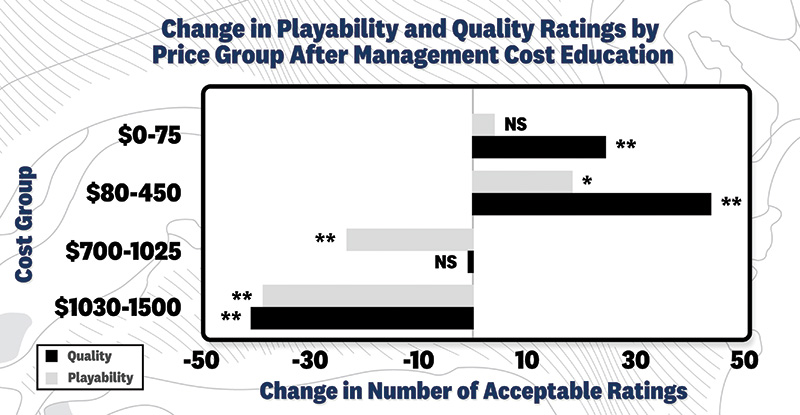
Figure 3. Overall, study participants were more accepting of the quality and playability in the two lowest cost groups after learning about maintenance costs. Interestingly, the highest two cost groups received lower scores after participants were told how much it costs to maintain them. This suggests golfers are more accepting of lower-input fairway options when educated about the cost savings.
Note: * and ** indicate statistical significance for the change in participant perceptions after being informed of management costs at the 0.05 and 0.01 probability levels, respectively, according to McNemar’s chi-squared test. NS is not significant. (n=1,488 total ratings)
Playability
The second-lowest maintenance cost group and the non-irrigated plots had increased ratings for playability after golfers were informed of the management costs. These results indicate that golfers may find lower-input options more acceptable if they understand the cost reductions, but that there are limits. Further, the two highest cost groups (Figure 3) and irrigated plots had the largest decrease in playability ratings after information about maintenance costs was shared. Essentially, golfers felt that the results were less desirable once they understood the costs involved. This further supports the notion that golfer perception of playability is influenced by knowledge of maintenance costs. Importantly, there were generally no significant changes in playability ratings among golfer ability and frequency levels.
“No pest control” and “irrigation” were the only management-practice categories that statistically influenced playability perceptions, and both received lower ratings after study participants were informed about management costs. Increased occurrence of dollar spot in the “no pest control” plots reduced perceptions of playability, and the negative change after explaining management costs suggests that golfers are willing to accept higher costs to treat destructive diseases. The relatively low playability perceptions for the “irrigated” plots after finding out about the cost to maintain those conditions is initially surprising, but it is consistent with decreased perceptions for the highest-management price group (of which irrigation costs were the largest contributor) once golfers had information about the relative costs. Fertilizer applications had no significant impact on playability ratings.
Quality
Similar to playability, Figure 3 shows that the lower two cost groups both significantly increased in acceptable quality ratings after management costs were shared. Again, this suggests that golfers are willing to accept fairways maintained with fewer inputs if it means lower costs. There were more changes in golfer ability and frequency levels regarding perceptions of quality, but all were increases in acceptability following cost-management education (for scratch, bogey and regular-frequency golfers). The “no irrigation” and “no pest control” treatments had more acceptable quality ratings than their corresponding treated counterparts after study participants were informed of costs. The most notable difference was between the non-irrigated and irrigated plots, where there were statistically fewer acceptable quality ratings in the irrigated plots after study participants were informed of costs and statistically more acceptable quality ratings in the non-irrigated plots after informing study participants about management costs. If a course pays for irrigation water and spends a significant amount on pest control annually, educating golfers about those costs and demonstrating lower-input options may build willingness to adjust expectations.
Another important observation was the significant increase in acceptable quality ratings for buffalograss plots after participants were informed about management costs. This corresponds to the increased acceptable quality ratings for the lower cost groups. Since turf-type buffalograss development for golf course use initiated nearly three decades ago, adoption of buffalograss has been slow (3). Results from this study suggest that educating golfers on the lower management costs of buffalograss may encourage its use, especially in situations where budgets are not able to afford the higher inputs necessary to maintain other grasses successfully.
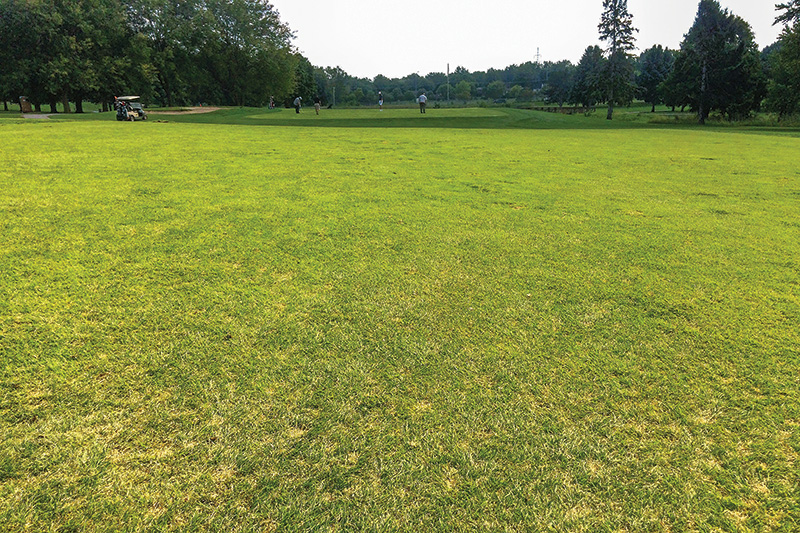
Golfers rated the quality and playability of buffalograss fairway plots higher after learning of its lower management costs. Buffalograss fairways like the one pictured above can be a lower-input alternative for courses in suitable climates.
Practical considerations
These results demonstrate the value of educating golfers about management costs. Doing so may cause them to reevaluate higher-input approaches and increase their acceptance of lower-input options. It’s important to note that in this study, survey participants only made visual assessments, and they only evaluated plots a single time during the season. In future research, it would be useful to assess playability based on actual play and to assess both playability and quality throughout a growing season when turf is subject to traffic and other wear. It would also be valuable to revisit management costs and survey assessments after several years. We experienced timely rainfall during our study, and our plots were not trafficked. It’s likely that our lower-input, specifically non-fertilized and/or non-irrigated treatments, would have lower quality and potentially extensive turf loss over several dry seasons, which may change golfer assessments of these programs.
The research says
- This study investigated whether providing golfers with information about the maintenance costs for various fairway grassing options and management programs influenced their perception of turf quality and playability.
- Golfers had greater acceptance of lower-input options following management cost education, especially regarding decreased irrigation.
- Quality and playability ratings for the highest-cost options decreased after golfers were educated about costs.
- Among other turfgrasses in this study, only the perceived quality of buffalograss fairway turf increased after management cost education.
- Golfer ability and playing frequency did not heavily influence the results, suggesting that all types of golfers are potentially willing to adjust their expectations based on maintenance cost information.
Literature cited
- Amundsen, K., C. Thompson, W. Kreuser and R. Gaussoin. 2024. Management costs influence golfer perceptions of turfgrass quality and playability. International Turfgrass Society Research Journal 15(1):135-147 (https://doi.org/10.1002/its2.160).
- Golf Course Superintendents Association of America. 2024. 2024 Maintenance budget survey (https://www.gcsaa.org/facility/operations-surveys-reports).
- Shearman, R.C., T.P. Riordan, B.G. Abeyo, T.M. Heng-Moss, D.J. Lee, R.E. Gaussoin, O. Gulsen, H. Budak and D.D. Serba. 2006. Buffalograss: Tough native turfgrass. USGA Turfgrass and Environmental Research Online 5(21) (https://usgatero.msu.edu/v05/n21.pdf).
Keenan Amundsen, Ph.D., is a professor and Roch Gaussoin, Ph.D., is a professor emeritus, both at the University of Nebraska-Lincoln; Cole Thompson, Ph.D., is director of research for the USGA Green Section, Pinehurst, N.C.; and Bill Kreuser, Ph.D., is president of TurfGrade LLC, Lincoln, Neb.