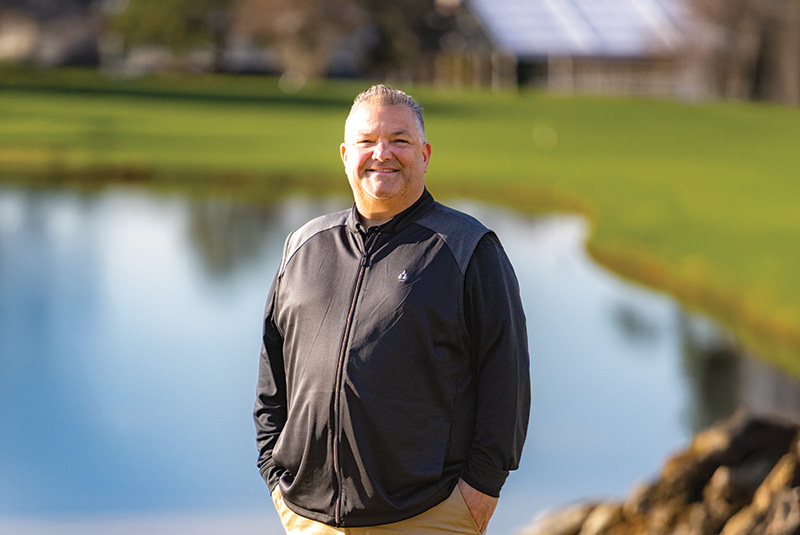
Jim Pavonetti, CGCS, is the winner of the 2026 President’s Award for Environmental Stewardship. Photo by Tyler Stover
Jim Pavonetti, CGCS, is a veteran superintendent at an exclusive, high-end, big-budget golf course in an extremely competitive area of the United States.
He’d be the first to dispute that any of those preceding descriptors is a prerequisite for any superintendent, anywhere, to make a difference environmentally.
“I stress all the time that you don’t have to increase your budget by a million dollars. You can do stuff that will wow your membership without spending a nickel,” Pavonetti says. “Don’t try to do everything in a year. Do baby steps. When it comes to these environmental programs, you don’t have to try to change the world in a day. Start small. Start with a few nesting boxes. Try to figure out a way to make buffer areas better. There’s a lot of low-hanging fruit you can do that costs nothing. Then you can gain the confidence and trust of the players or who you’re working for and build from there.”
Following that formula, Pavonetti has built something of an environmental showcase at Fairview Country Club in Greenwich, Conn., where he has served as golf and grounds superintendent the past 18 years. Along the way, he has collected more than a few tributes as proof of the fact those baby steps can cover a lot of ground over time.
In addition to a couple of runner-up finishes, Pavonetti has won three of the four Environmental Leaders in Golf Awards, all in the last three years (See “Environmental advocates,” Page 44). He helped Fairview CC — just a short hour’s drive away from New York City yet worlds away in terms of seclusion — become an Audubon International Certified Audubon Cooperative Sanctuary and is active in Audubon International’s Monarchs in the Rough program, and he has served as treasurer of that environmental-powerhouse organization since 2024.
Pavonetti’s club, Fairview CC, was presented the Arthur P. Weber Environmental Leader in Golf Award from the Metropolitan Golf Association in 2019, and, earlier this year at the 2026 GCSAA Conference and Trade Show in Orlando, Pavonetti added to his hardware haul when he collected the 2026 President’s Award for Environmental Stewardship, which is “based on exceptional environmental contributions to the game of golf — contributions that exemplify the superintendent's image as a steward of the land.”
Pavonetti just shrugs.
“Really, some of the environmental things I’m doing,” Pavonetti says, “just seem … normal.”
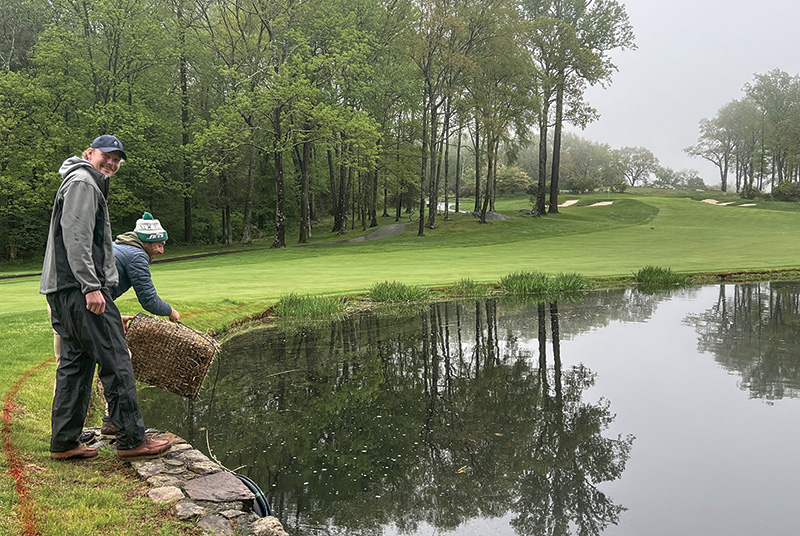
Assistant superintendents Ty Leahy (left) and Matt Deluca add barley straw bales to the pond inflow on the fourth hole. This is part of Fairview CC's aquatic chemical reduction program. Photos courtesy of Jim Pavonetti
BOGO at Lake Isle CC
Jim Pavonetti — born Vincent Anthony Pavonetti, though nobody called him by that first name except his first-grade teacher — was something of a buy-one-get-one hire at Lake Isle Country Club in Eastchester, N.Y.
His father, Les, was an “off-the-boat Italian, a custom tailor,” Pavonetti says. “He had a custom tailor shop that wasn’t working out, so he wanted to get a job with the town. Somebody said, ‘Go work at the golf course. They’ll take anybody. You can always transfer to the highway department.’”
So Les applied at the town-owned Lake Isle CC and landed the job. Young Jim, then 16, went to visit on his dad’s first day.
“I’d never been on a golf course before,” Pavonetti says. “The superintendent saw me and said to my dad, ‘Is your son looking for a summer job?’ So I got a job working there. It was a summer job no one would lay you off from. By the end of my first summer, in 10th grade, I learned every aspect of golf course maintenance. I learned the equipment side — grinding, assisting the mechanic — and assisted spraying greens and fairways, fertilizing, topdressing. I loved it. Everybody said, ‘You have a great future in this.’ By 11th grade, I knew I wanted to be a golf course superintendent.”
He even has the yearbook to prove it.
“Yeah, it actually says that in my yearbook,” Pavonetti says with a laugh. “You know, like it might say, ‘Most likely to become a lawyer.’ Mine says, ‘Most likely to become a superintendent.’”
Les Pavonetti never did transfer over to the highway department. He spent the rest of his career there as a kind of assistant superintendent/foreman until retirement. “He loved the projects,” Jim Pavonetti says. “That was his forte. Now he comes here and busts my chops.”
The younger Pavonetti stuck around, too, working summers and even on weekends in the winter. Pavonetti studied agronomy and earned his turf-management certificate through Rutgers’ winter program and then kicked around a bit as an assistant superintendent before landing his first head superintendent job at West Point Golf Course in West Point, N.Y. After two years there, he headed to the Edison Club in Rexford, N.Y., for another five before returning close to home at Fairview CC.
Never did he consider changing professions.
“Not for a second,” he says.
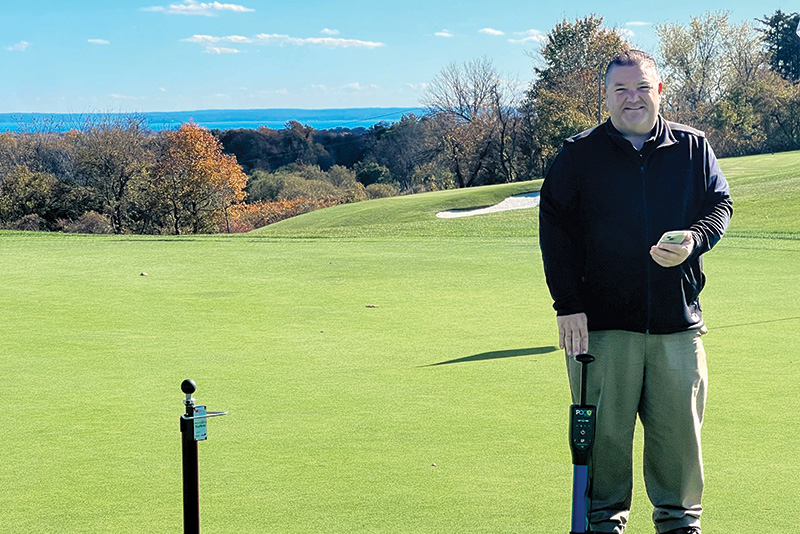
Pavonetti collecting data on the 18th green. Fairview CC's data collection has helped the agronomy team make more precise decisions on day-to-day maintenance procedures.
At home at Fairview CC
Before that enlightening first trip to visit his dad on the golf course set his path, Pavonetti, an avid fisherman since childhood, considered a more aquatic career. “Maybe marine biology,” he says.
Once he realized his future was not ocean blue but turfgrass green, Pavonetti often drew on his early (and ongoing) love of fishing and nature.
He recalls, during his six years as an assistant superintendent, first crossing paths with Audubon International.
“When Audubon came on the scene, I was still an assistant,” Pavonetti says. “I went to a couple of seminars they gave to promote the program, and I was just like, ‘Wow. This is right up my alley.’ I love birds. I love nature. Why wouldn’t golf courses want to enhance that? If it makes the golf course more enjoyable or better, so be it.”
At every stop of his career journey, Pavonetti did both, but by far his biggest impact was made at Fairview CC, which, Pavonetti says, started life as a Donald Ross-designed country club in Elmsford, N.Y.
“It’s got a really interesting background,” he says. “Not that long ago, it moved locations. They were having land taken by eminent domain because of an expanding highway. To this day, more than half the membership is from Manhattan. Back then, they were all from Manhattan. They found this property in Greenwich, Conn., six or seven miles away and got Robert Trent Jones to build this in 1966. It opened in ’68 and moved the entire membership. Only 60 years ago, to be able to move a whole country club … it would be impossible to do this today.”
At Fairview CC, Pavonetti honed his patient, baby-steps approach to boosting the club’s environmental bona fides. It started with nesting boxes. And grew. And grew.
“You start by doing stuff that doesn’t affect playability to start,” he says. “You don’t want something to become a negative, like growing some crazy buffer strips. You don’t want a member saying, ‘Oh, I landed in the Audubon.’ Start with something easy, like nesting boxes. The members love it. We have dozens of eastern bluebirds flying around our tees, and they love it, and they start to buy in on that.”
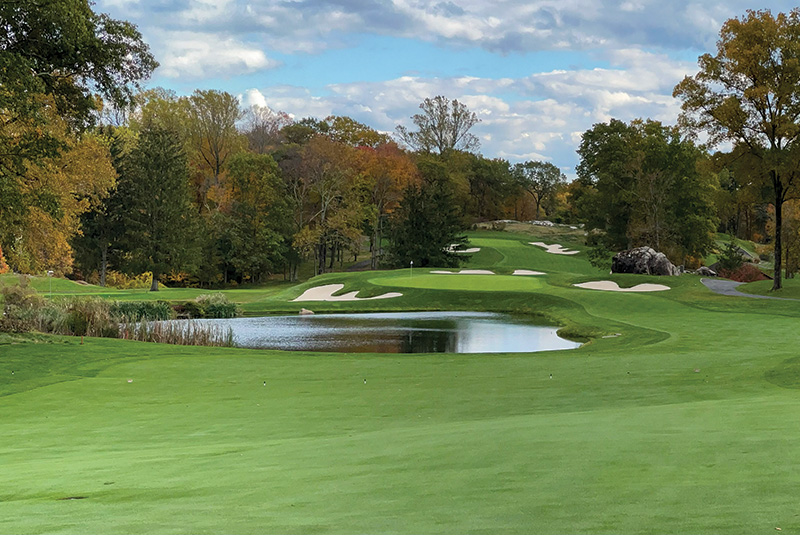
Fairview CC's second hole. Aquatic chemical use has been reduced dramatically by using an integrated pest management plan that includes a combination of air diffusers, black pond dye, and barley straw.
Many of Fairview CC’s environmental programs focus on water — preserving its volume and health. All of the club’s irrigation water falls as rain and is stored in on-property ponds, so Pavonetti and his team strive to keep it as pristine as possible and not waste a drop. Buffers filter runoff. Barley straw and aerators reduce, or eliminate, algae. Replacing managed turfgrass with natives and transitioning to more drought-resistant varieties save water.
As Pavonetti preaches, it’s the right thing to do, morally, aesthetically and fiscally.
“If we go a long stretch without rain, the ponds get low. Those feature ponds are on beautiful holes, and the last thing members want to see is low ponds,” Pavonetti says. “Sometimes the idea of conserving water so the ponds look better may be the way members look at it, but we’re also saving water and energy and saving money and helping the environment. We’re saving water, using less chemistry and making us more resilient. When other golf courses around us are having a bad year, we’re still having a good year.”
Pavonetti says he hasn’t had any true “failures” in any of his environmental initiatives.
“The only thing I’d say, in some newer native areas, I might have a member come to me and say, ‘Can you mow 10 feet of that? A lot of balls collect there,’” Pavonetti says. “They’re not failures. They’re adjustments.
“I’ve been real careful where we’re putting native grass and things like that, trying to keep as much stuff out of play as possible. I’ve had colleagues over the years who’ve gone a little nuts with native grasses, and they end up being a negative. I’m careful with that. We do have native areas here, but most of them are around tees or behind tees, places balls aren’t going to land. They’re maintainable. But if you go crazy with buffer areas, that’s just going to annoy people.”
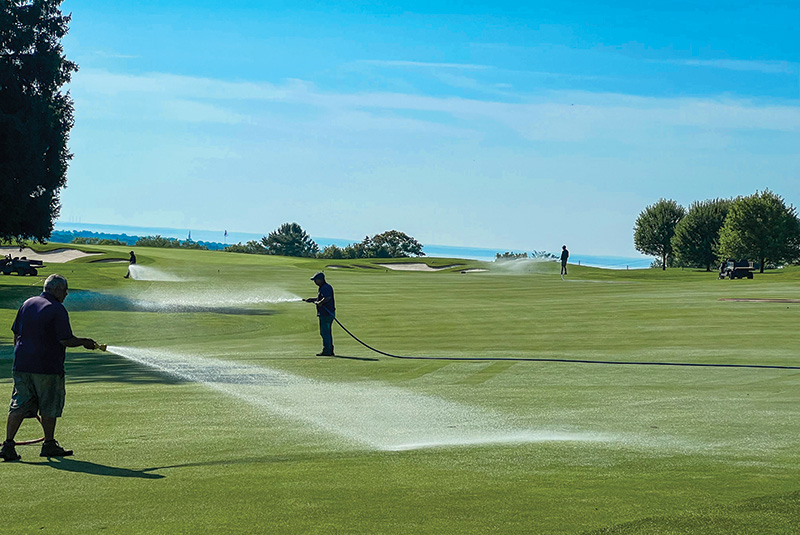
By using the latest moisture sensor technology, Fairview is able to pinpoint irrigation needs, which has led to firmer and faster conditions, while also saving millions of gallons of water in the process.
Targeted efforts
Pavonetti tries to be deliberate when expanding environmental efforts.
“Usually, the natives are coming in after we remove trees. Getting them to remove the trees is the harder part,” he says. “One thing we did that was really neat, in 2019-2020, we redid all our bunkers, and we put turf-type tall fescue in the areas going into the bunkers. Replacing one species of grass with a more drought-tolerant one saves water, and it still looks good as new. But you don’t get much chance to do something like that unless you’re doing a project.”
Pavonetti religiously records the elements that go into both his agronomic and environmental programs.
“You have to, as a superintendent in general, assess what you did with greens this year. Was it worth it? What worked? What didn’t? Then you mirror that with all your environmental achievements,” Pavonetti says. “Are there any opportunities to add pollinator areas this year? A storm knocked down three trees. Maybe we can add some natives. There’s always more you can do. Our clientele, especially in this area, they expect things to get better every year. It’s like being a Yankee fan. OK, you won the World Series this year. What are you going to do with the team to win the World Series next year?”
Pavonetti keeps knocking it out of the park thanks, in part, to his slavish devotion to compiling data about every aspect of his programs. Coupled with that is a robust set of maintenance standards, which were the subject of his Feser Award-winning article “Gold standards” in the November 2022 issue of GCM.
“I think everybody should have maintenance standards — this is what we’re doing, what we should be doing,” he says. “You have to keep a good log of everything you do all year, then all Thanksgiving and over the holiday season, I spend time evaluating that.”
Pavonetti says it’s interesting how, not that long ago, golf course superintendents used the best data they had available, but, really, he says, “It was all estimates and guestimates and experience.”
Now that the technology has evolved and superintendents have access to actual real-world data, “When you see the actual numbers, you see how wrong you were,” Pavonetti says. “But when you have the data, it becomes obvious, combined with your intuition, what you should do.”
Pavonetti’s involvement with best management practices (BMPs) has evolved along with his devotion to data. He was a member of the New York State Best Management Practices Project Committee and the Connecticut Best Management Practices Planning and Steering Committee.
In other words, he helped write the book on BMPs.
“Helping other people with BMPs has been nice,” Pavonetti says. “I was on the New York planning and steering committee working with Frank Rossi and Cornell. When Connecticut worked on theirs, I was asked to be on their committee. Then each state branched off, and I helped with that. I wrote a couple of chapters, on irrigation and construction and landscaping. That was an interesting experience. All it did was make me a better superintendent.”
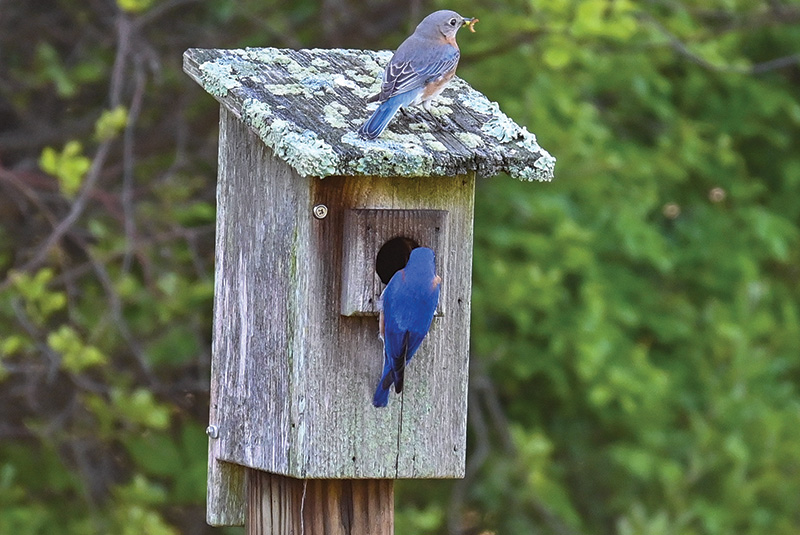
Nesting boxes, like this one with a pair of resident bluebirds, are part of the wildlife-friendly amenities at Fairview CC.
What’s next?
There’s no telling what’s next for Pavonetti and his environmental efforts, but he knows he wants to stay put.
“I love it here,” he says. “If I could grow grass in Florida, I might go there. I love fishing. But the membership is so nice here, just really great people. They treat you with respect. When I see a member on the course, they always ask how my wife and family are before they ask you about the golf course. Everyone is smiling and laughing and having a good time. That’s just the culture here.”
A big part of that culture, at least where Pavonetti is involved, entails never settling. It would be easy, after all, for Pavonetti to coast, to not keep pushing for the next big thing, not because there’s an award or a plaque attached to it, but because it seems the right thing to do.
Rest on his laurels? No chance.
“I couldn’t do that. Not my personality,” he says. “You have to keep learning, keep reinventing yourself. If you don’t, you’re not going to last long. I always have to be figuring out what we’re going to do next, and that’s half the fun of it. That’s always been my intent, every year, to take it to the next level.
“You know, we lost a lot of snow over the weekend. We cover our greens here. We were going to uncover greens, mow, then cover them again. This is the point in the season you start missing your crew. I couldn’t wait to jump out of bed this morning. I love what I do.”
Andrew Hartsock (ahartsock@gcsaa.org) is GCM’s editor-in-chief.