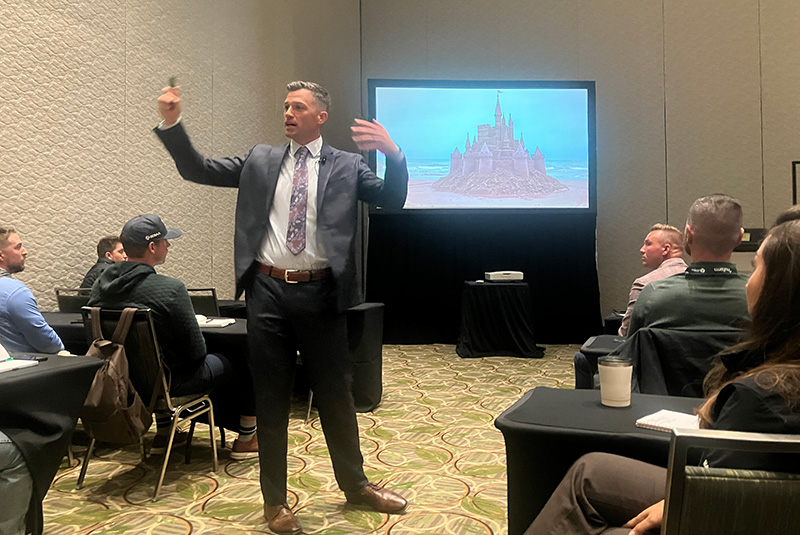
Jason Tharp, CGCS, lead a group of assistant superintendents in a leadership training session on Tuesday at the GCSAA Conference and Trade Show. Photo by Phil Cauthon
About 70 assistant superintendents joined a session Tuesday on the principals, methods and mindsets for becoming a successful golf course superintendent. The session was led by Jason Tharp, CGCS, superintendent at Gulf Stream (Fla.) Golf Club, and 13-year GCSAA member.
Tharp said his main message for the day was that leadership starts today, before achieving the title.
“If you go about your professional life with the mindset that you’ll get ready when the time comes, whenever the opportunity comes, you’ll be ready, you won’t be ready,” Tharp said. “You don’t know when that job is going to open up, you can’t just all of a sudden get ready, because you can’t fake it. Whether it be leadership or agronomics, prepare now. You need to be the person now so that when the opportunity comes, it doesn’t pass you by.”
He said the most important thing for preparing for whatever the next step is starts with your mindset.
“Good leadership is simple, it’s just not easy,” Tharp said. “Good leadership is the opposite of what we want to do by human nature. In hard times, it’s human nature to go into the background, to not want to be in the spotlight. But you’ve got to step up.”
Among the traits of good leadership, he said, are ownership, accountability, sharing credit, seeking feedback, staying steady and being adaptable.
“Do you take ownership of things that go wrong on your course? Leadership is taking on ownership of the bad and passing on credit for the good,” Tharp said. “You’ve also got to stay steady. If things are going wrong, people are looking to you. That’s so much of leadership. If you’re calm, things will be ok. If you lose your head, you just lost credibility, whether that be with your crew, your superintendent, your general manager, members.”
Accountability is also key to credibility, he said. “Don’t ask your people to do anything that you’re not willing to do yourself. It is rare that anyone lower down in the organization than you will have higher standards. So if the person at the top has low expectations and low standards for the quality of work, there’s a trickle-down effect from there. How can you hold anyone to a standard that you don’t hold yourself to.”
Seeking feedback also builds credibility in good leaders. “You’ve got to be comfortable enough in your own skin to admit that you’re not perfect,” Tharp said. “So many times, people just want to be heard. Whether it’s a member or a staff member. If you just let them talk and listen and look them in the eyes and make them feel heard, that’s more than half the battle. Just let them get it off their chest.”
Also among the traits of good leaders is learning how to balance authority and influence. He said authority is needed for expressing clarity and urgency, for enforcing standards, and for assigning duties and correcting. Influence is needed for building culture and building trust, and is often achieved by leading by example.
“It’s pretty straightforward and simple. Influence is living by the standard and willfully bringing others along with you. But there’s a balance. You have to be able to operate with authority, too. If you’re all influence — if you’re all fun guy or fun girl — people are going to get loose. When there’s no authority and they just like you, standards can deteriorate.”
He said authority means not always being the likeable boss. “Your standards are not what you say they are. They are what you do and what you allow.”