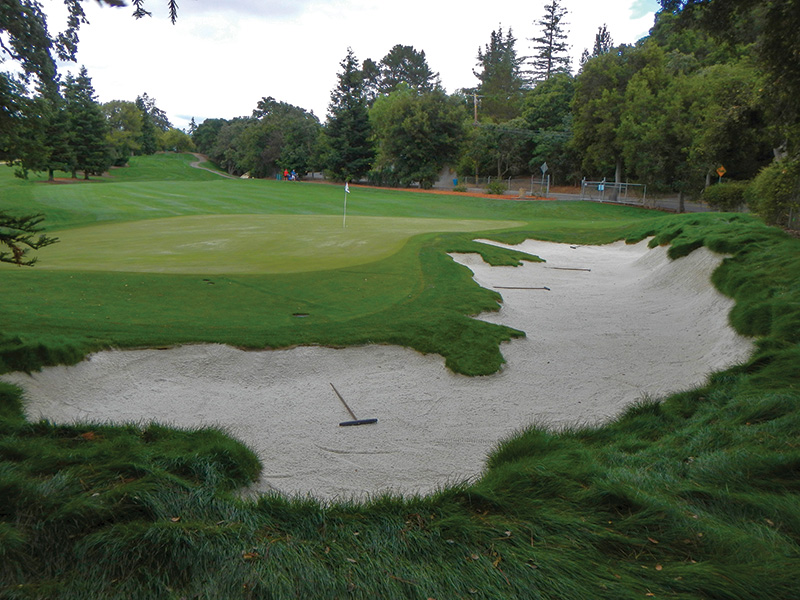
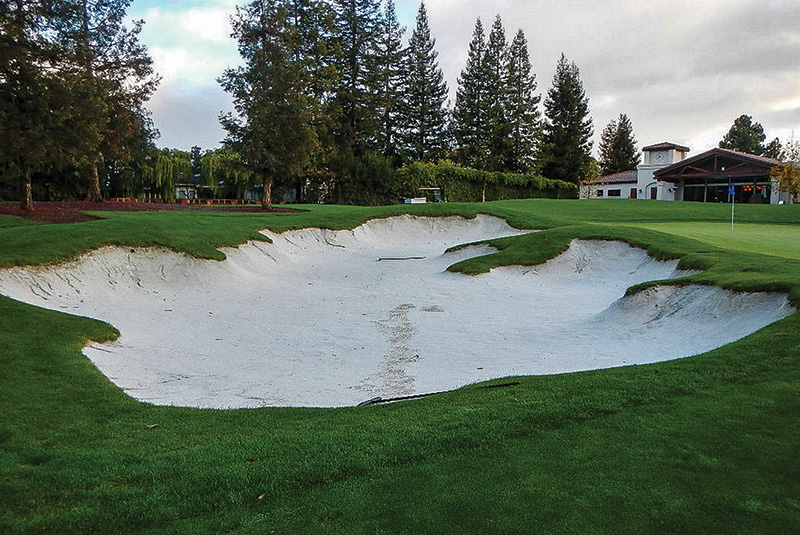
The No. 3 greenside bunker after reconstruction at Los Altos (Calif.) Golf & Country Club. Photos by Michael Simpson
In 2013, Los Altos (Calif.) Golf & Country Club completed a comprehensive bunker renovation to address long-standing inconsistencies in playability and escalating maintenance demands. More than a decade later, the hybrid construction integration — now referred to as the Los Altos Hybrid System — continues to demonstrate stable performance under daily play and variable weather conditions.
This article documents the design rationale, construction methodology, engineered sand depth strategy, moisture management systems, selective bunker liner integration and long-term operational observations gathered through more than 10 years of in-house evaluation.
Bunkers are intended to challenge golfers. However, modern expectations increasingly emphasize fairness, predictability and consistency. Prior to reconstruction, LAGCC experienced continual unfavorable player feedback, including:
- “The bunkers are too soft.”
- “The bunkers are too hard.”
- “The bunkers are too wet.”
- “My ball plugged in the face of the bunker.”
- “My ball fried-egged in the middle of the bunker.”
LAGCC initiated a course-wide bunker renovation with a clear objective: to improve player bunker experience while reducing overall labor demands — and to sustain those results over time.
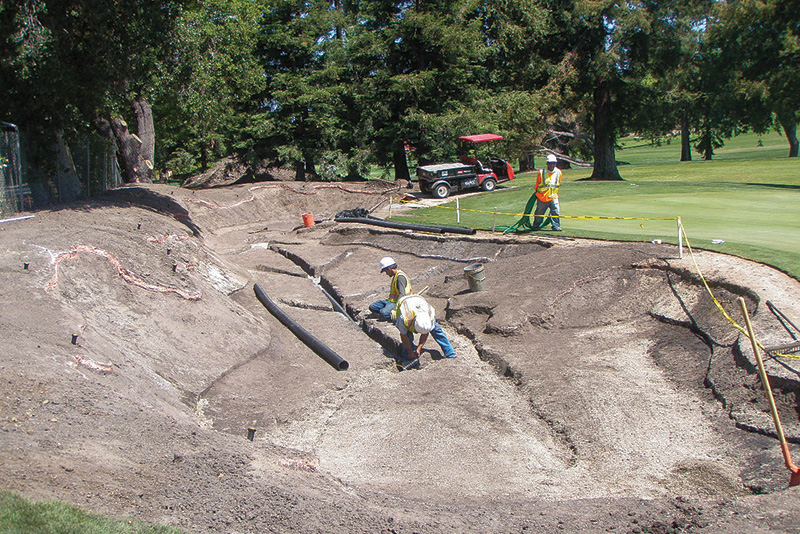
The No. 3 bunker engineered subgrade illustrating herringbone subsurface drainage.
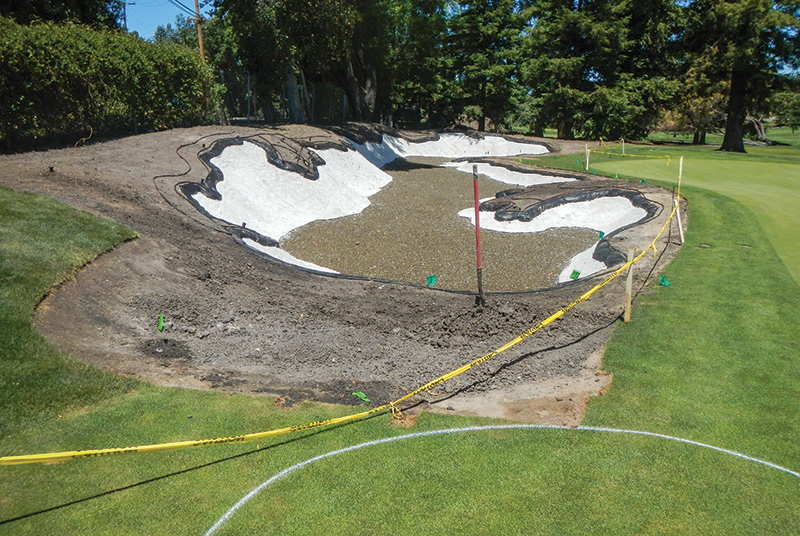
That same bunker showing Better Billy Bunker shell, with Bunker Solutions mat on bunker face, bunker surrounds and turf fingers subsurface drip, and pop-ups prior to installing a sand that met USGA bunker sand recommendations.
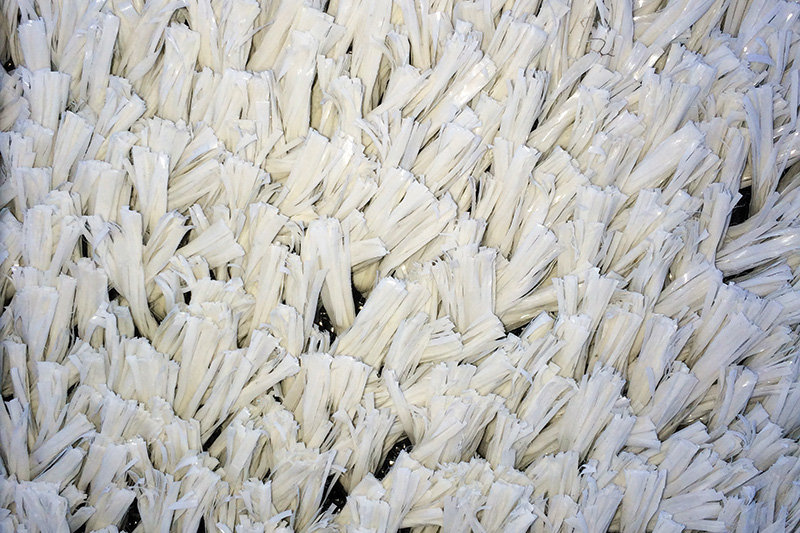
Close-up of mat surface texture showing the fiber grain that helps hold dry or wet sand on bunker faces reducing daily maintenance that meet USGA bunker sand recommendations.
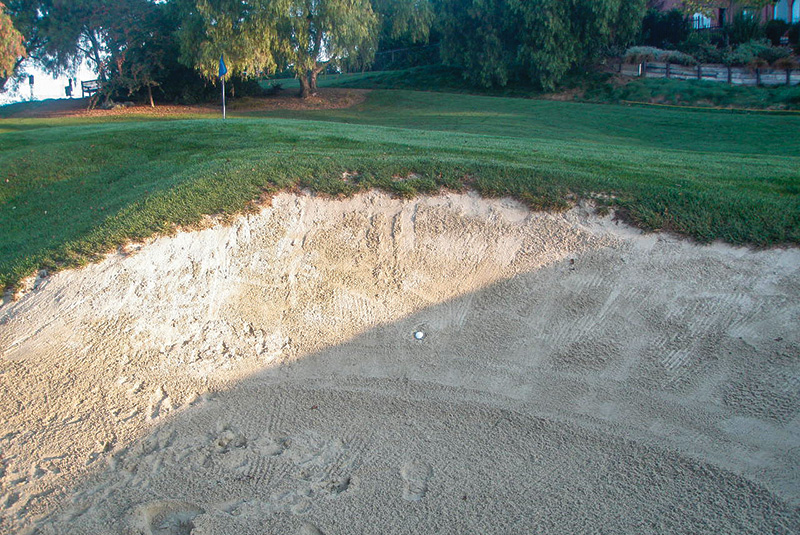
Plugged sand-face lies were common prior to LAHS reconstruction.
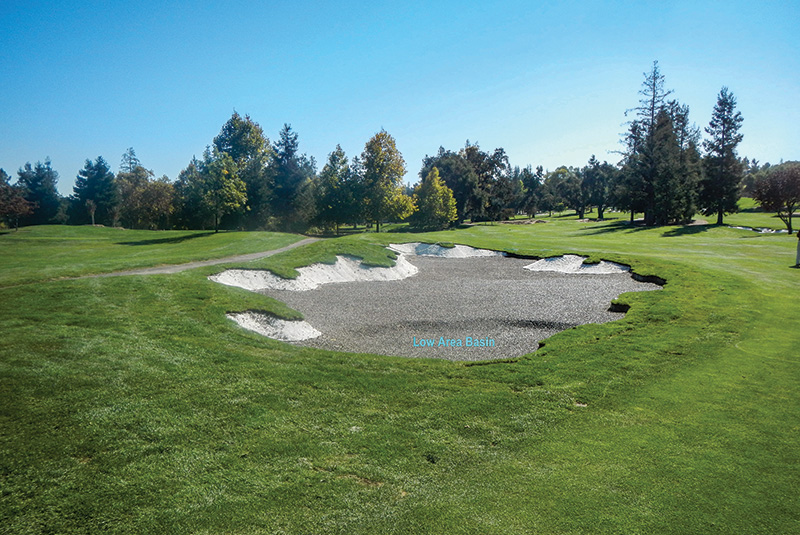
No. 17 fairway bunker showing engineered sand basin at low area of bunker prior to sand installation.
Design vision
LAGCC engaged architects Tim Jackson and David Kahn of Jackson/Kahn Design to refine bunker aesthetics that balanced strategic cohesion with natural artistry. The renovation retained the sand-faced character while strengthening capes and bays and selectively adding turf fingers. While visually impactful, the resulting bunker features required a thoughtful maintenance approach to preserve their aesthetic integrity and provide consistent playing conditions.
To meet these performance objectives, an integrated set of structural and management improvements was implemented to:
- Establish and maintain uniform bunker sand moisture across a wide range of environmental conditions.
- Reduce fried-egg lies by maintaining consistent sand firmness and limiting vertical sand displacement.
- Maintain stable, playable bunker faces while minimizing plugged lies.
- Provide sufficient moisture to bunker surrounds and turf fingers without increasing moisture within the bunker sand profile.
- Limit native soil contamination while preserving bunker shape and edge integrity.
- Reduce labor requirements associated with daily maintenance and post-storm bunker repair.
Why one liner system was not enough
Early testing demonstrated that no single liner system met all functional and performance requirements. Product names are referenced for technical clarity only, not commercial endorsement.
As a result, LAGCC developed a hybrid construction approach — the Los Altos Hybrid System — integrating two complementary liner technologies.
Better Billy Bunker was selected as the structural base liner, providing a durable, highly porous shell. In-house testing exposed the liner to continuous micro-irrigation for 24 hours, during which it drained freely without surface pooling. The BBB liner preserved the bunker shape and prevented native soil from contaminating the sand profile. Although the sand met USGA bunker sand recommendations and the BBB system provided excellent structural stability and drainage, it did not consistently achieve the level of sand-face stability required to meet player expectations at LAGCC.
To address this limitation, Bunker Solutions geotextile matting was selectively installed on the bunker faces. This material helps resist the gravitational movement of sand, improving the bunker playability and visual character.
With the BS mat in place, the maintenance team was able to standardize a uniform 1-inch sand layer over the faces. As a result, plugged lies became infrequent, and the labor previously required to roll bunker faces to reduce the plugged bunker face lie was eliminated.
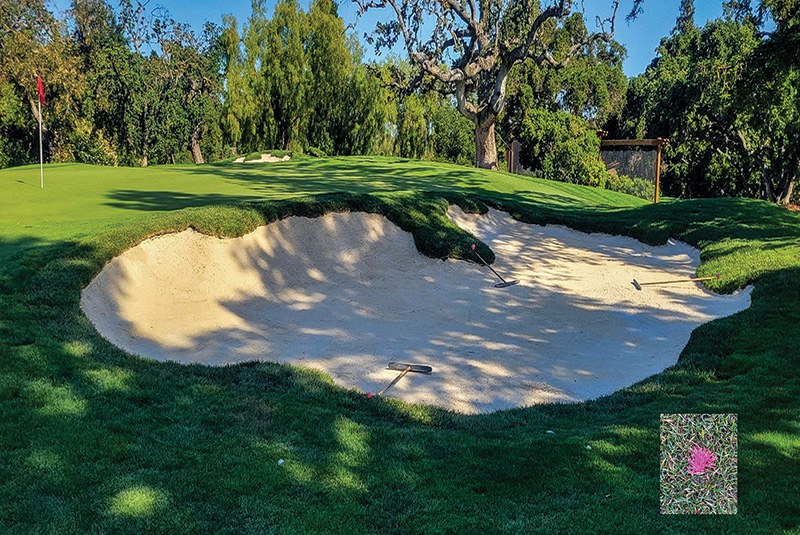
No. 2 greenside bunker showing pink survey whiskers used to guide staff and after-use player rake placement.
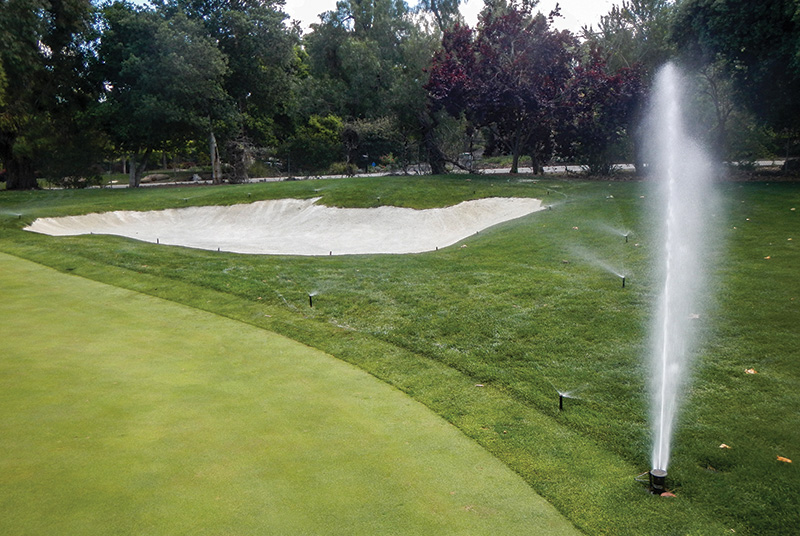
Small pop-up irrigation heads used to eliminate large golf course sprinkler overspray.
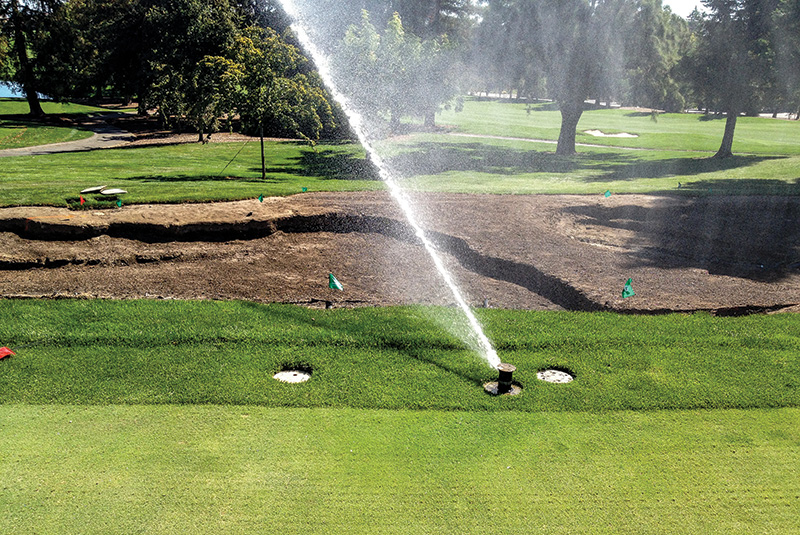
Large sprinklers individually controlled and used to add moisture when targeted sand density range was unachievable.
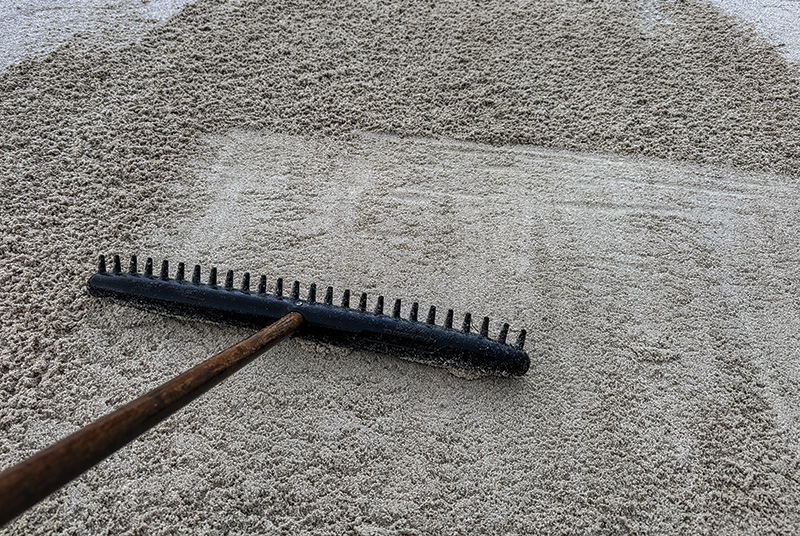
Bunker sand rake-tooth depth variances.
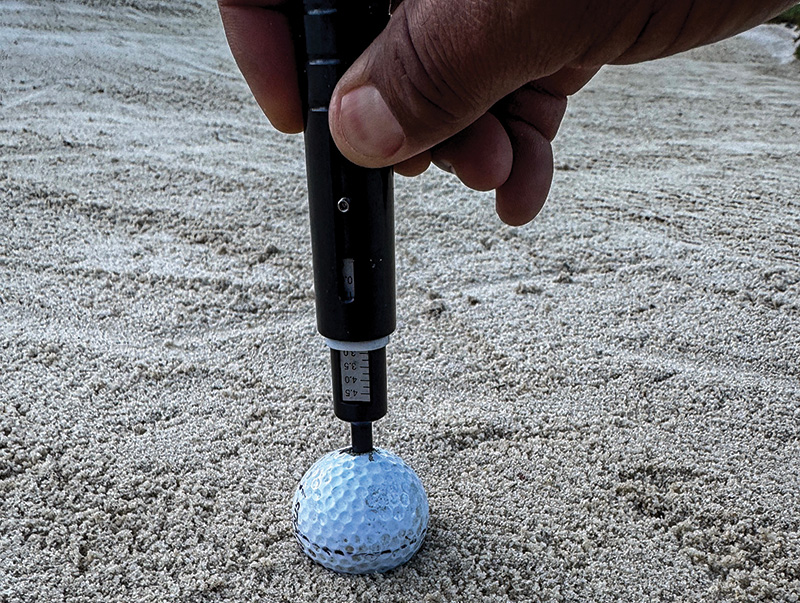
In-house ideal bunker sand density range based on player feedback between 20%–50% at 2.5 d kg/sq. cm.
Engineered sand depths
A defining feature of the LAHS is variable sand depth:
- 0–1 inch on bunker faces.
- 4 inches on bunker floors.
- 6–8 inches in the lowest bunker areas.
The increased sand depth in low areas functioned as a moisture reservoir, reducing the incidence of chronically wet bunker low areas compared with pre-renovation conditions.
Sand moisture and compaction: Critical variables for playability
In-house observations and player feedback indicated that bunker satisfaction was driven primarily by sand moisture and surface firmness, rather than by the visible soil or organic matter contamination typically associated with older sand.
Key observations included:
- Excessively wet sand resulted in heavy, dense sand prone to flier lies.
- Overly dry sand resulted in fluffy conditions prone to fried-egg lies.
Three-tier irrigation strategy
To support moisture consistency, LAGCC installed:
- Subsurface drip irrigation around bunker surrounds and turf fingers.
- Small pop-up sprinklers around bunker surround and turf fingers to assist drip system but mainly to minimize irrigation from large golf course sprinklers. Individually controlled irrigation heads were used to add moisture to bunker sand when target sand density levels could not be achieved given the dryness of the sand.
Moisture meters were initially used daily on a select group of bunkers but were later replaced by a pocket sand penetrometer for simplicity. Target sand density values were established through player feedback, and once a stable favorability range was achieved, this measurement became the primary operational benchmark.
Adaptive management
Although moisture had the greatest influence on playability, sand density was fine-tuned through raking technique. Rake-tooth depth was adjusted from approximately 2 inches to 0 (smooth troweling), depending on the targeted sand density.
In-house observation suggested that raking depth alone could alter pocket sand penetrometer measurements by up to 15%.
When sand displacement occurred from either gravity or storm events, the exposed BS matting remained uncontaminated and playable, while significantly reducing post-storm rebuild labor compared with pre-renovation conditions.
Once playability complaints became infrequent, attention shifted to presentation consistency. A course-wide rake placement map was developed and reinforced using pink survey whiskers, guiding both staff and players toward uniform rake placement.
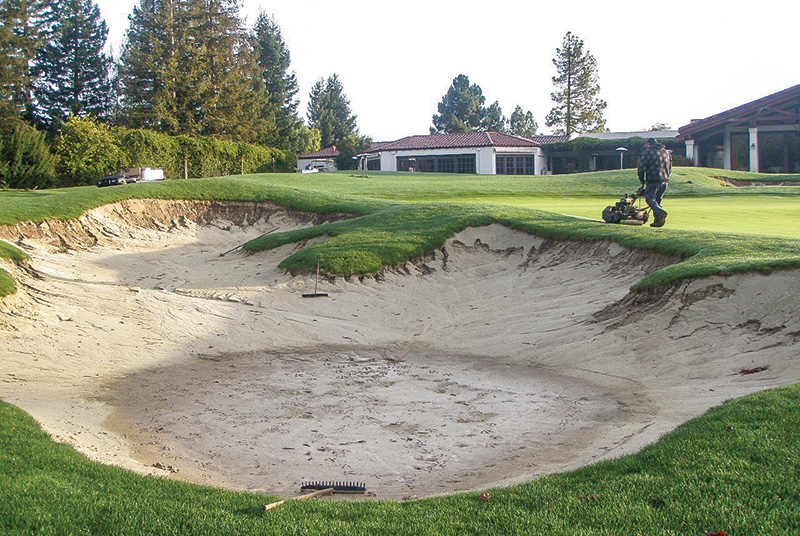
No. 9 greenside bunker showing storm damage prior to LAHS reconstruction.
That same bunker showing minimal storm damage after reconstruction.
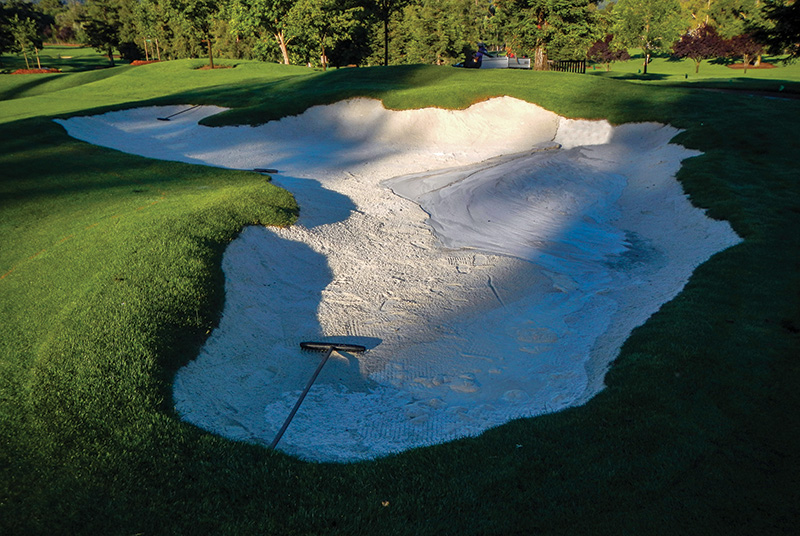
No. 10 bunker showing exposed BS mat after irrigation leak.
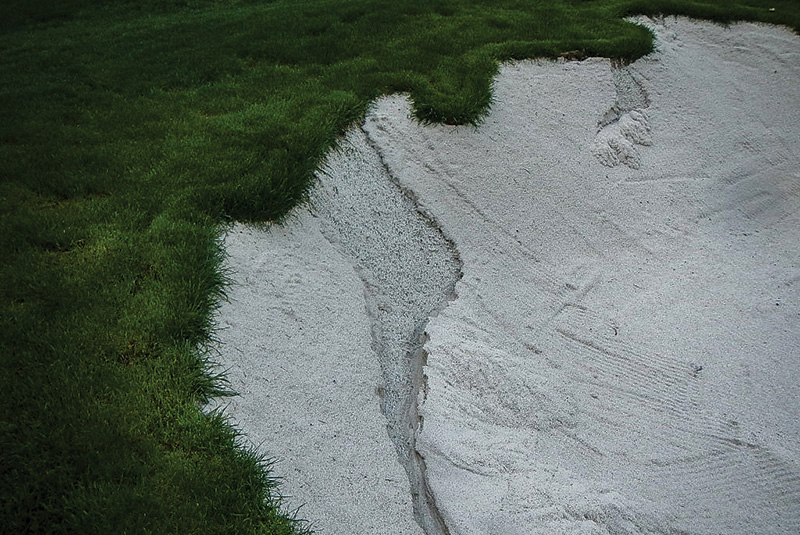
No. 5 greenside bunker showing typical post-storm face condition with BS exposed as well as the maintained 1-inch sand depth on bunker face.
Long-term in-house observations
- Improved the uniform sand moisture across variable weather conditions.
- Reduced the frequency of fried-egg lies.
- Maintained a playable bunker face while limiting plugged lies.
- Maintained sufficient turf moisture on the bunker surrounds and fingers without adding unnecessary moisture to the bunker sand.
- Minimized sand contamination and preserved bunker shape.
- Reduced daily and storm-related repair labor requirements.
The combination of structural and management improvement — targeted moisture management, hybrid liner integration, engineered sand profiles, adaptive maintenance practices and standardized presentation — has supported more consistent bunker performance while contributing to reduced negative player feedback and moderated labor demands.
Although not every facility will have the resources to implement every component at once, even selective adoption of these principles can deliver meaningful improvements. By aligning these strategies with operational goals and available budgets, golf facilities can achieve greater consistency, improved playability and more positive player experiences.
Michael Simpson, CGCS Retired, is a former superintendent at Los Altos (Calif.) Golf and Country Club and a 36-year GCSAA member.