Problem A: Six concentric circles on course devoid of grass
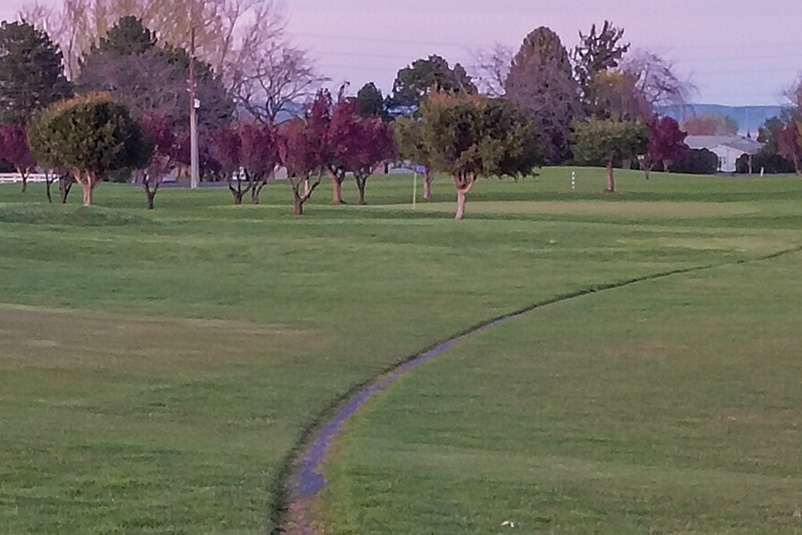
Location: Quincy, Wash.
Turfgrass area: Many areas on course except greens
Turfgrass variety: Bentgrass, ryegrass and bluegrass
Problem B: Multiple dents in grass
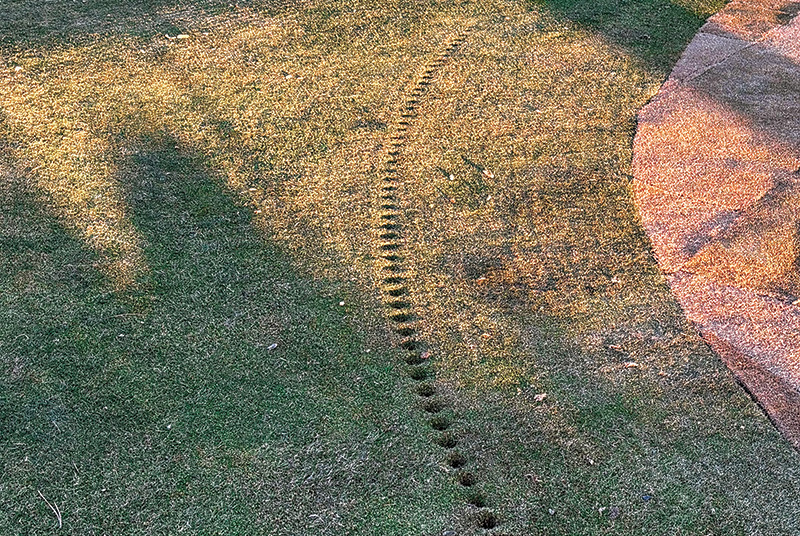
Location: Golden, Colo.
Turfgrass area: Chipping greens surrounds
Turfgrass variety: Ryegrass and bluegrass mix
Scroll down for answers.
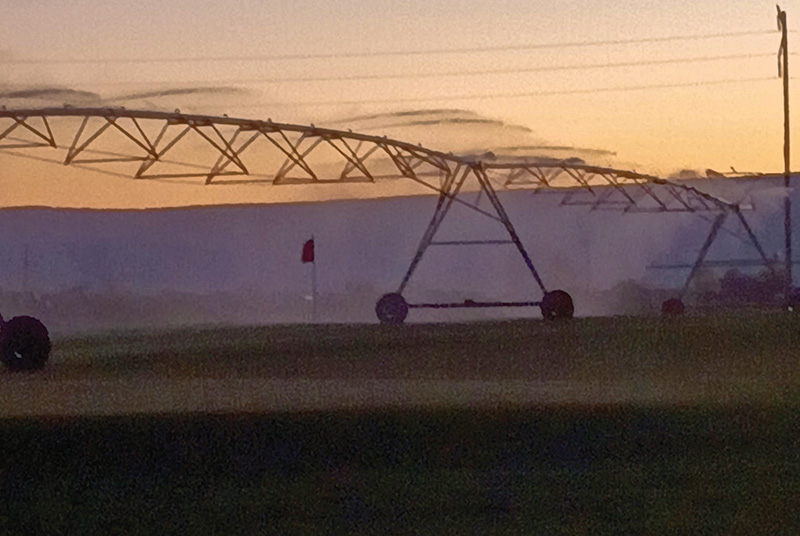
Problem A: Six concentric circles on course devoid of grass
The circles are not really a problem — they are more of a challenge for the superintendent. This golf course is located in central Washington in an agricultural area known as the Columbia Basin. The area has over 10,000 farms, and most use center pivot irrigation systems. In the late 1980s, the local municipality and a golf course architect decided to construct nine holes around the 20-foot high, center-pivot system. The course was eventually expanded to 18 holes. The six concentric circles are caused by the tires when the system traverses the course. For some of the area in play (like approaches), the superintendent installed rubber horse stall mats to facilitate being able to play through those depressions. Every tree on the course is maintained at the proper height to allow for the center pivot to travel across the property to irrigate.
Photo submitted by David Phipps, GCSAA northwest regional representative. Gabe Porter is superintendent at Colockum Ridge Golf Course in Quincy, Wash., and a two-year GCSAA member.
Problem B: Multiple dents in grass
These multiple dents in the surrounds of this chipping green are the result of a renovation that occurred about 3½ years ago. During that renovation, a range ball must have found its way into this area that was sodded over. After removing sod on part of the chipping green and using that turf for an expansion on a green on the course, the second assistant was training a new staff member on operating aerifiers and monitoring his progress. The 48-inch walk-behind aerator was set up with ¼-inch needle tines penetrating about 3 inches deep. The tines found a long-lost golf ball, impaled it and made these marks. This was a good lesson for the new employee. The area was repaired by applying sand and seed, leveling it and watering the area.
Photograph submitted by Landon King, second assistant superintendent at The Club at Rolling Hills in Golden, Colo., and two-year GCSAA member. Aaron Fankhauser, CGCS, is the director of agronomy at The Club at Rolling Hills and a 12-year GCSAA member.
Editor’s note: Have a photo of an on-course anomaly? GCM would love to have a look! Email it to Photo Quiz author John Mascaro.
John Mascaro is the president of Turf-Tec International.