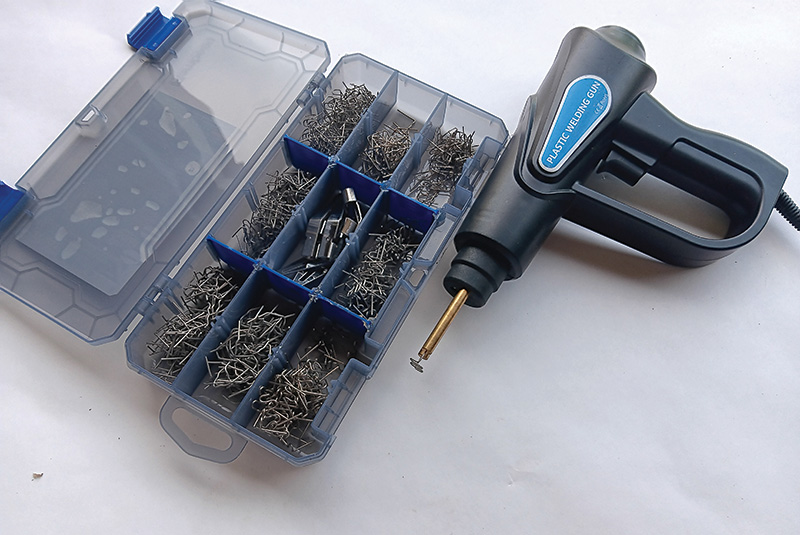
Thin wires in different shapes are the heart of the plastic repair system that uses an electric gun to heat the wires so they melt and fix cracks. Photos by Scott R. Nesbitt
Given the amount of polymers in the modern world, at some point, you’re going to deal with failing plastic. I’ve found two repair systems that work well.
The repairs involved two items made of high-density polyethylene (HDPE): the lid of a grass-catcher attachment and a fuel tank.
The grass-catcher lid had developed several cracks that were radiating from one of two hinges that let the lid swing back to allow emptying the catch baskets. The lid’s material was nearly the same thickness found in equipment fenders, hoods, control panels and the like — things that break from flexing and vibrating during normal use.
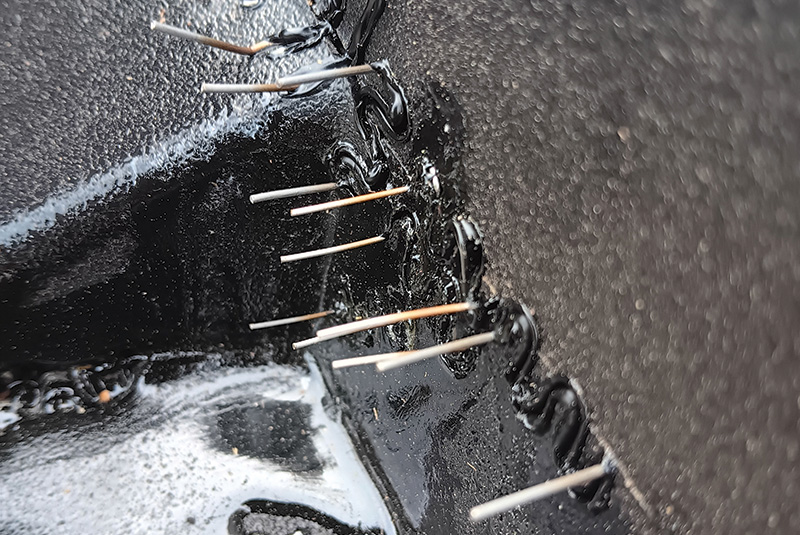
Wire stubs left by the repair system must be cut flush with the surface to avoid injury. They were cut using a Dremel-type rotary tool.
The lid repair involved inserting hot metal staples to bridge the tear that had been spreading for months. The staples are in a kit (about $25) sold online and in big-box stores as a “plastic welder.” Despite the name, the tool does not soften the workpiece and add filler. Instead, the kit includes an electric 110-volt gun with two tubes that accept thin steel wires that heat when the trigger is pulled.
Lightly pressing the hot wire against the plastic, you’ll see it sink in just below the surface; release the trigger and let it cool. Little practice is needed, but avoid breaking completely through the plastic. The kit includes a multitude of wire staples in different configurations.
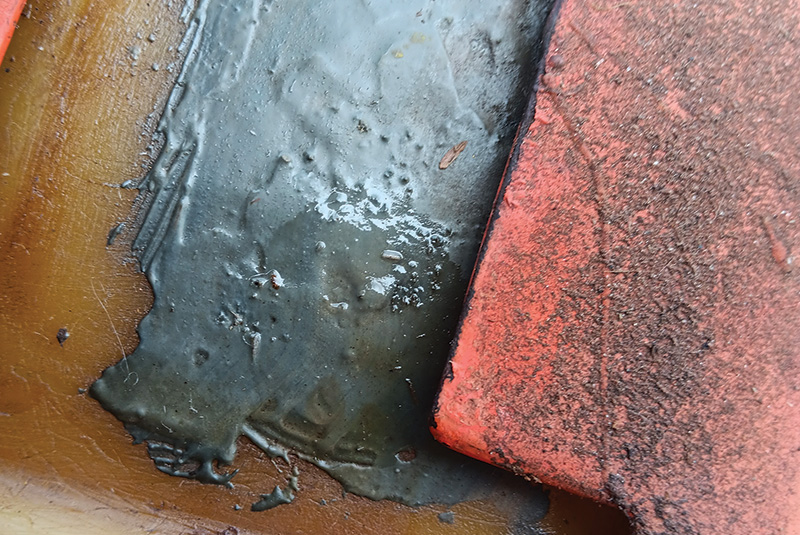
Pinholes in a fuel tank were successfully patched with two-part epoxy applied to the cleaned and roughened surface of the plastic tank.
The repaired area is tougher than the original because metal is much stronger than plastic. It’s far better than repairs I’ve done with actual plastic welders that use hot air or hot metal. There is a bit of post-repair clean-up to remove the wire legs left poking up. The wires are easily cut down flush with the surface using an angle grinder or Dremel-type motor tool with a cutoff wheel mounted.
I found the hot wires will embed in most, but not all, kinds of plastics I found around the shop. I almost look forward to finding uses for the hot-wire stapler, but it didn’t seem like the right system to take care of several fuel-tank pinholes that had developed after being exposed to sunlight for 20-plus years. Unlike the broken lid, the tank presented a solid, non-flexible surface, but hot wires seemed wrong, given there was fuel in the tank.
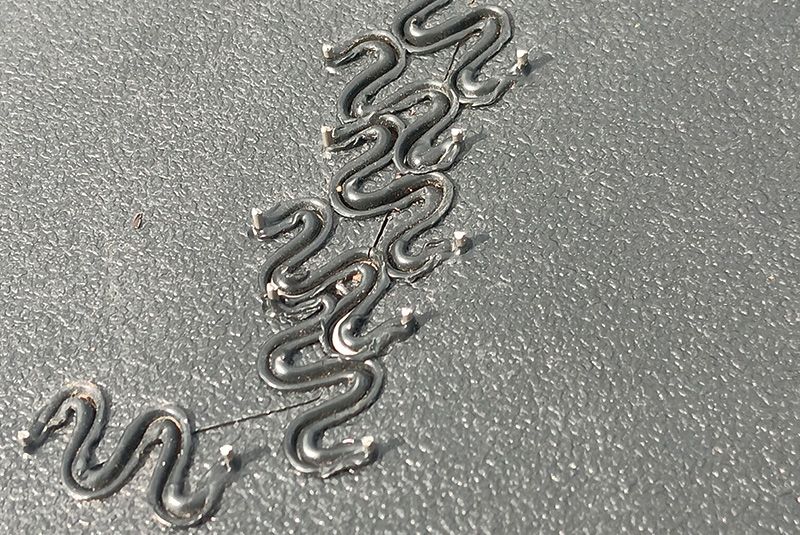
A long crack in the lid of a grass-catcher attachment was repaired with hot wires that melted into the plastic, bridging the cracks.
I looked into gluing an HDPE material over the area, but found the one available adhesive, Permabond TA4611, costs about $70 per fluid ounce. I turned to J-B Weld two-part steel-reinforced epoxy, less than $10 for two 1-ounce tubes. After it was degreased with acetone, the tank surface was roughed up with a coarse wire wheel to provide “tooth” for the epoxy to grip the surface. The mixed epoxy was pressed firmly over the holes and nearby areas, with a 48-hour cure time.
Six months later, the tank remains leak-free, holding up against the light pressure of fuel sloshing inside.
Scott R. Nesbitt is a freelance writer and former GCSAA staff member. He lives in Cleveland, Ga.