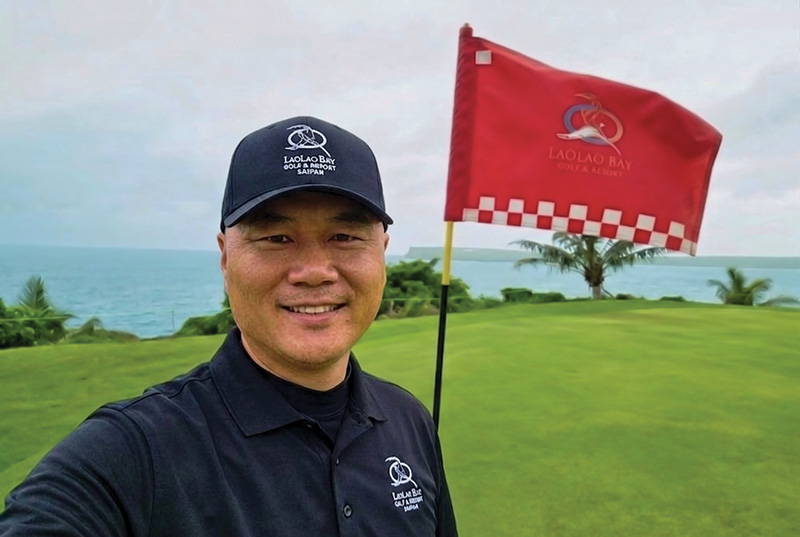
Jecheol Namkung is the golf course manager/director of LaoLao Bay Golf Resort in Saipan. Photos courtesy of Jecheol Namkung
Superintendents famously cope with just about every curveball under the sun just to keep their courses in good shape and playable.
But there’s perhaps only a handful who can count super typhoons among the variables with which they must contend.
One of them is Jecheol Namkung, superintendent at LaoLao Bay Golf Resort in Saipan, 36 holes located in the Northern Mariana Islands, a U.S. commonwealth located twice as far west from the U.S. mainland as Hawaii.
In April, Super Typhoon Sinlaku pounded the tiny islands along with Namkung’s course, causing more than $400 million in damage to the islands.
Hurricanes and typhoons are both warm-core tropical cyclones with a minimum sustained surface wind of 74 mph or more. Hurricanes form east of the international date line, while typhoons form west of the line. A super typhoon, like Sinlaku, has wind speeds of at least 150 mph.
Sinlaku recorded 10-minute estimated sustained winds of 130 mph and one-minute sustained peak winds of 185 mph, qualifying it as a Category 5 super typhoon.
“To be honest, the scale of the damage across all 36 holes is so extensive that it is difficult to put into words,” says Namkung, a two-year GCSAA member. “Our coastal holes have been severely impacted by saltwater intrusion, causing critical growth issues for the turf. Additionally, many of our bunkers require complete reconstruction due to severe erosion and structural damage. We are also facing a major technical crisis — the sprinkler control systems have been paralyzed and heavily damaged, cutting off our ability to manage irrigation effectively.
“Given the damage to our landscaping, building exteriors and power infrastructure, we anticipate the recovery costs will be substantial. Prioritizing the restoration of 18 holes to our premium standards will require significant investment in materials and labor.”
Although typhoons are a perennial threat to the Pacific islands, this is the first one Namkung has endured after moving to Saipan from the Philippines in February 2023 to take the superintendent job at Coral Ocean Golf Resort, another course in Saipan.
The 47-year-old is originally from South Korea, and his native language is Korean. Mark that as another substantial obstacle simply to communicate with GCSAA about his course’s troubles. Apart from the 16-hour time difference, every email communication is an exercise in significant translation.
“I would like to ask my colleagues at the GCSAA to please keep Saipan in your thoughts and prayers. We are determined to restore the peace and beauty of this island, and your support means the world to our team during this challenging time,” Namkung says.
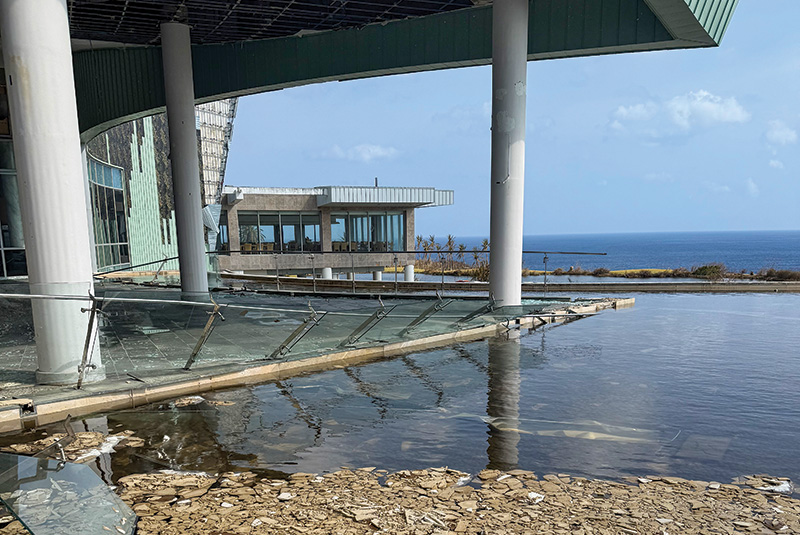
The clubhouse outdoor lobby at LaoLao after being damaged by the typhoon’s strong winds.
A long road back
How long it might take to restore at least one of his two courses back to playing shape is hard to say, says Namkung, the only GCSAA member on the islands.
“The exact reopening date remains undetermined at this time,” he says. “We are still in the process of clearing debris and ensuring the course meets our high safety and quality standards. We also need to see further stabilization of the island’s overall infrastructure before we can welcome guests back.”
Namkung said it is too early to venture a dollar estimate of the damage done to the course.
“At this moment, our priority is ensuring the safety of the site and conducting a thorough assessment of the grounds, rather than calculating a final dollar amount. It is still a bit early to provide a specific figure while the entire island is in the middle of emergency repairs,” he says.
Namkung said recovery efforts at LaoLao are focused on three areas:
- Debris clearance: “We are clearing fallen trees and metal fragments to ensure roads and pathways are safe for everyone.”
- Structural repairs: “We are prioritizing the repair of damaged roofs and windows to protect interiors from the elements.”
- Resource management: “We are carefully maintaining our generators to ensure a steady supply of power and water for as long as the public grid remains down.”
Although the work to be done can be overwhelming, Namkung said he remains hopeful in the Saipan community’s ability to bounce back soon.
“Even though we are eating dinner by lantern light and relying on temporary power, the spirit of sharing in LaoLao remains strong,” he says. “We are taking it one day at a time, and by supporting each other, I am confident we will restore this beautiful area to its full glory very soon.”
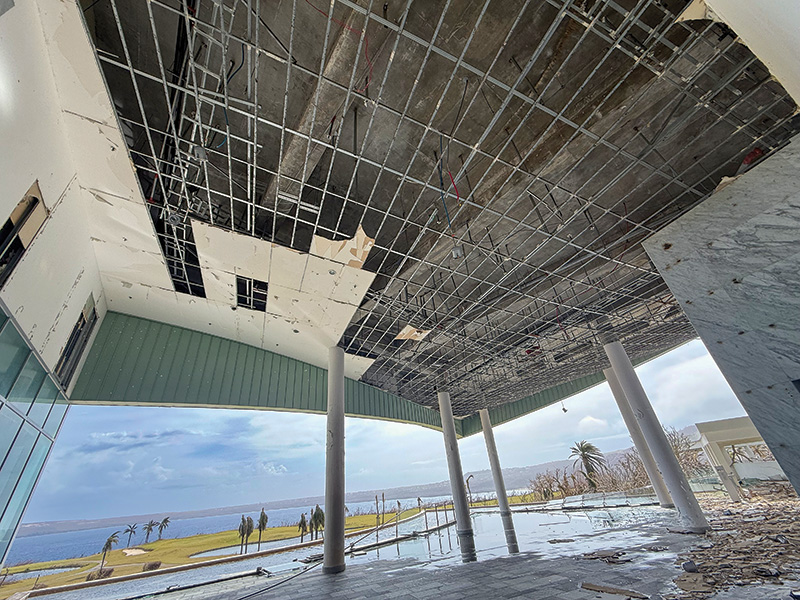
The ceiling of the resort’s clubhouse outdoor lobby after being damaged by the typhoon. Photos courtesy of LaoLao Bay Golf & Resort
Superintendent challenges apart from typhoons
Day to day, Saipan has a tropical rainforest climate with an average year-round temperature of 84 degrees Fahrenheit. The drier season runs from December to June, when LaoLao depends on irrigation.
“Our resort uses groundwater as its primary source for irrigation. Rather than using separate large-scale water tanks, we store the groundwater directly in our ponds, which is then used to irrigate the turf. Due to this setup, the water has a relatively high salinity content, making it less than ideal for optimal turf growth,” Namkung says.
More challenging still is topdressing greens. Namkung says he does so every three to four weeks, but maintaining a supply of sand takes constant planning months in advance due to the island’s remote location.
“Due to Saipan’s geographical location, topdressing sand is an incredibly scarce and vital resource in our maintenance operations,” he says. “To ensure the highest quality, we import premium silica sand via shipping containers at a significant cost. To prevent any logistics delays or inventory shortages, we typically place our orders three to four months in advance.”
“Since sand is such a precious resource here, its application requires meticulous planning and strategic thinking. It is not just about the task itself. Every grain is used with careful consideration to achieve the best possible results for the course.”
Similarly, fertilizers, pesticides and other additives require months of advance planning to secure via shipping containers.
“The long lead times inherent to island locations are a constant challenge for a course superintendent,” Namkung says.
More challenging still is obtaining parts in a timely fashion when a piece of equipment fails.
“The most memorable instance was when a critical component of our mowing equipment failed unexpectedly. Corroded by Saipan’s intense saline environment, a part snapped, and we were looking at over a month for a replacement to arrive by sea. With the grass growing rapidly every day, having our machinery sidelined was a true crisis,” Namkung says.
“To protect the course condition, I had to resort to cannibalization — sacrificing one functional unit to keep the rest of the fleet operational. Since we had fewer machines, I completely overhauled our work schedules, starting from the crack of dawn to ensure no area was neglected.”
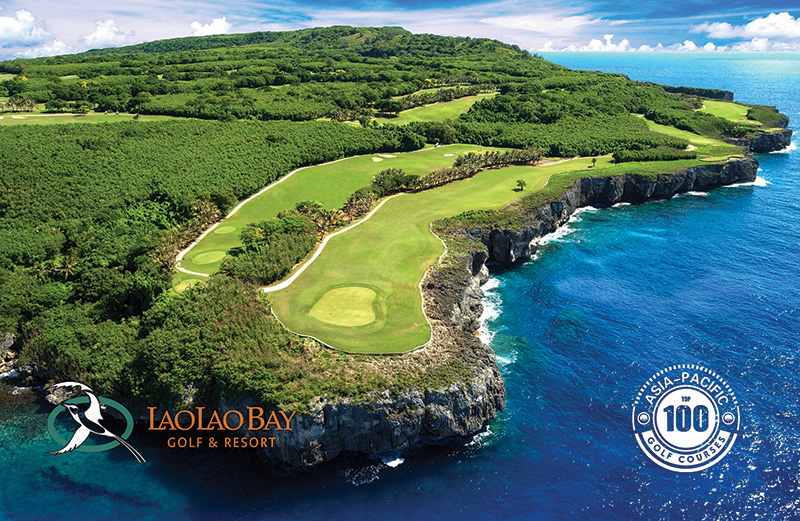
A view of the club’s coastal holes before the typhoon.
A spiritual relationship with golf
Asked to describe his relationship with golf, Namkung quickly goes to a more poetic than practical description.
“I describe it as a ‘delicate conversation with nature’ and a ‘record of patience’ built up day by day,” he says. “The grass is a living, breathing entity, yet it cannot speak. The intensity of the sunlight varies every morning, and the rhythms of wind and rain change ceaselessly. As a course manager, my duty is to read these capricious patterns before anyone else. Creating a perfect green amidst these variables is akin to a painter carefully sketching colors on a white canvas and applying them layer upon layer.”
Namkung’s wife, Eun-jung Lee, has a similarly spiritual take on golf in Saipan.
“My relationship with golf changed here in Saipan,” said Eun-jung Lee, a nurse by training. “I had started learning in the Philippines, but I couldn’t quite find the interest. But Saipan was different. How could anyone resist this? Looking at the emerald-green ocean and the stunning courses carved right into the coastline, I felt a spark. I started taking lessons, went out on the field and completely fell in love with the scenery. Now, walking along the beach and seeing that unique emerald glow of the water is my favorite way to enjoy life.”
Eun-jung Lee said Jecheol’s work ethic is understated but passionate.
“Even on his days off, his eyes instinctively turn to the sky to check the rain or sun. If an issue arises, he heads to the course immediately, regardless of the time. Some might call it an obsession, but to our family, his passion is a source of inspiration,” she says. “He nurtures the greens, and that energy nurtures our life together.”
Phil Cauthon (pcauthon@gcsaa.org) is GCM’s managing editor.