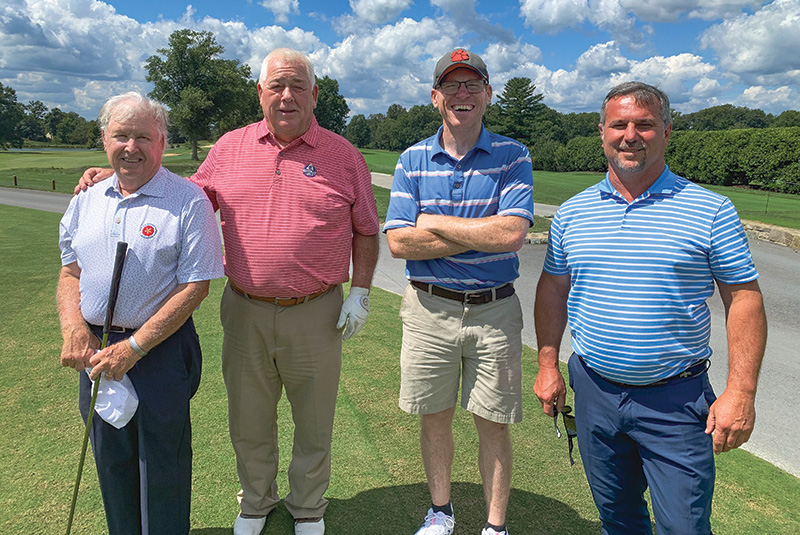
Supporters of Stewards of the Chesapeake include, from left, John Tanner, CGCS Retired; Kenny Ingram, CGCS, MG; Michael Brumbaugh; and Ferris Crilly. Photo courtesy of MAAGCS
Editor’s note: Chapter Spotlight is a bimonthly GCM feature designed to highlight notable achievements and impactful initiatives among GCSAA’s 94 affiliated chapters. To submit ideas for this feature, contact Howard Richman at hrichman@gcsaa.org.
The welcoming party was led by Ryan Severidt, CGCS. This year, the event celebrated a milestone.
Stewards of the Chesapeake — established by the Mid-Atlantic Association of Golf Course Superintendents— celebrates its 25th anniversary in 2025. From the outset, its goal was to develop a primary source of funding to support local research projects, environmental efforts and government relations as they pertain to the golf industry.
Part of the process features a golf tournament, which is the vehicle for MAAGCS members to invite their club or company officials to participate in the event for the presentation and improvement of both golf and the environment. The tournament this year took place Aug. 25 at Woodmont Country Club in Rockville, Md. Since its inception, Stewards of the Chesapeake has raised more than $250,000. Proceeds benefit multiple initiatives, such as the Maryland Association of Green Industries, turfgrass research at the University of Maryland, turfgrass education, scholarships, GCSAA, and other groups supporting environmental issues, such as the Chesapeake Bay Foundation.
“I’m happy to host, have other superintendents out here. It’s like having a bunch of your buddies come over,” says Severidt, a 23-year GCSAA member and director of golf course and grounds operations at Woodmont CC, which in July hosted the U.S. Adaptive Open and will host it again in July 2026. “This is important for our industry. Our association is working hard to advocate for us. Sometimes golf course superintendents get a bad rap from environmentalists, but we’re absolutely stewards for our industry.”
A continuance of Stewards of the Chesapeake pleases Dean Graves, CGCS Retired. The longtime superintendent at Chevy Chase Club in Chevy Chase, Md., was among the chapter leaders who launched Stewards of the Chesapeake. “We talked about it before we made a pitch to our board,” says Graves, a 45-year GCSAA member. “We wanted to get club officials, presidents, general managers and their superintendents to come out to a golf outing and try to get them to support the golf industry in the state of Maryland. My club fully supported me in being part of this.”
Brian Gietka, CGCS, a USGA East region agronomist, has been invited to speak at previous Stewards of the Chesapeake events. A former superintendent at Fountain Head Country Club in Hagerstown, Md., he has remained informed of activities that impact MAAGCS for numerous years. That includes the Fertilizer Use Act of 2011 — also known as Maryland’s Lawn Fertilizer Law — that was designed to reduce nutrients from washing into the bay from nonagricultural sources and give superintendents access to the resources that they need to manage golf courses. “Stewards of the Chesapeake is an excellent event that supports great policies and partnerships with places like the University of Maryland,” says Gietka, a Maryland graduate in 2003 and a 26-year GCSAA member. “The Stewards of the Chesapeake shows what we can do as superintendents.”
Delaware Valley University’s Doug Linde, Ph.D., spoke in August at the event. “For me it’s a chance to get out of the classroom to lend my expertise and take questions from superintendents and contribute to the profession,” says Linde, a 36-year GCSAA Educator member.
Tyler Eastham, MAAGCS chapter executive director, says the golf tourney drew a capacity crowd of 120. Landscape Supply is presenting sponsor for golf, which is played in a four-person shamble format. Vendors, golf courses and individuals help cover for money raised, which ranges anywhere from $10,000 to $25,000 annually. Among the potential beneficiaries this year is the Chesapeake Oyster Alliance. It is a coalition of nonprofits, community organizations and others, all of whom are committed to adding 10 billion oysters in Chesapeake Bay by the end of this year. MAAGCS will announce its entire list of beneficiaries in December at its annual meeting.
Eastham, who played college golf at Christopher Newport University in Newport News, Va., said the golf tourney was spectacular. Sunny skies and 75 degrees enhanced the setting. “We want our golfers to have the best experience they can. Golfers play for bragging rights, the food is great, and at the end of the day, players spent time on an immaculate golf course for a good cause,” he says.
All of this is music to Graves’ ears. “When we started this back around 2000, we did a lot of brainstorming. We discussed the pros and cons. There were very few cons,” Graves says. “We’re in one of the hardest places in the country to grow turf and be successful. We all have learned from each other, encourage others to try things. We spearheaded all of this, much in part so superintendents would be able to do their jobs better.”
Howard Richman is GCM’s associate editor.