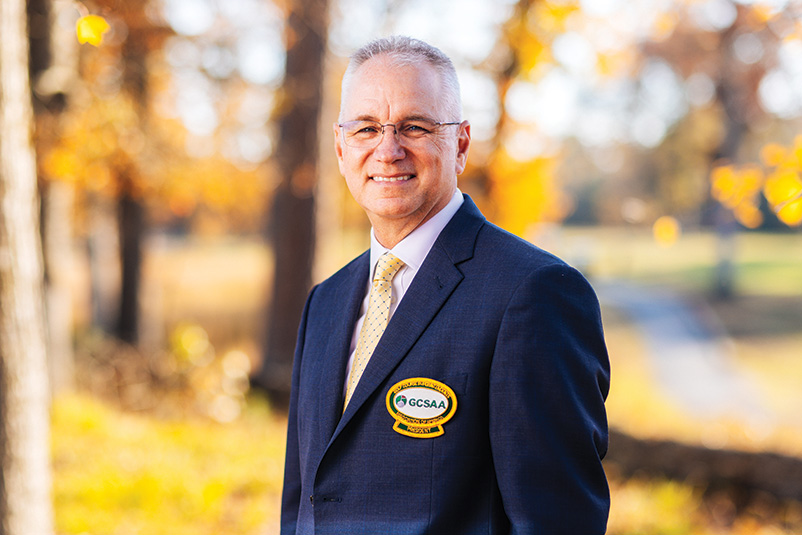
GCSAA President Paul L. Carter, CGCS, has been superintendent at The Bear Trace at Harrison Bay
in Harrison, Tenn., since 2001. Photos by Justin Wojtczak
GCSAA might be a professional association built by and for folks in the golf course management profession, but the way the 100-year-old association’s new president sees it, GCSAA’s reach goes much, much farther.
“We’re carrying the torch,” says Paul L. Carter, CGCS, “for everyone involved in golf.”
And now Carter is the lead torchbearer.
Carter, superintendent at The Bear Trace at Harrison Bay in Harrison, Tenn., director of agronomy for the nine-facility Tennessee Golf Trail and a 33-year association member, officially became GCSAA’s 89th president during the GCSAA Conference and Trade Show in early February in Orlando.
He’s stepping into the role as the association rolls into its Centennial year.
GCSAA members are seeing the benefits of several new or expanded programs, like a focus on career pathways, crew development, advocacy, continuing education, best management practices and diversity. That GCSAA Conference in Orlando saw a record number of seminar seats and nearly 13,000 attendees, a fourth straight year of growth. Membership, well over 21,000, is nearing an all-time high.
No wonder Carter enters his presidential year with both appreciation for the past and aspirations for the future.
“GCSAA is the golf course superintendents’ association, but it has to do with everyone who’s involved in golf,” he says. “It’s great to see where we are and where we’re heading, and I feel very blessed and very honored to be in this position.”
‘He had a knack’
Carter wasn’t always such a champion for the golf course superintendent.
In fact, the profession wasn’t even on his radar when he enrolled at Auburn University, intent on studying horticulture.
He recalls that, early in his Intro to Horticulture class, students went around the room, saying who they were, where they were from and what their professional aspirations were.
“As they introduced themselves and talked about their post-college plans, I thought, ‘This is a lot of competition,’” Carter recalls.
His introduction to golf course management was “pretty much an accident.”
One day, a guest speaker, Coleman Ward, Ph.D., visited the class. His son was a golf course superintendent, and Ward talked about turfgrass management.
That sparked something in Carter.
“I talked to one of my advisers, who said there’s horticulture work in golf courses,” Carter says. “He said, ‘You can be on a golf course and do horticulture work.’”
That’s exactly what Carter thought he’d be doing when he landed an internship at the Country Club of Birmingham in Birmingham, Ala., working under Lee McLemore, CGCS.
Carter reported for duty and was immediately put to work — on the golf course management team.
“I was green as anything,” Carter says. “The first five or six days, I’d done all golf course work. I thought maybe it was some sort of orientation. I went to Lee and said, ‘I thought I was going to be on the horticulture crew.’ He said, ‘No, there’s no room on the horticulture team.’ By that time, I’d already mowed greens and everything and thought, ‘This might be more fun than horticulture.’”
McLemore, a 40-year GCSAA member, is still the CC of Birmingham’s director of golf course operations. Like Carter, McLemore interned there while he was a student at Auburn. Hired there upon graduation as an assistant, McLemore immediately interviewed for the head superintendent job when it became open. “I was an assistant for about four-and-a-half, five weeks,” McLemore says.
That was 39 years ago. Over that span, the club’s robust internship program has brought in about 110 interns, McLemore says.
Carter was among those few who stood out.
“Obviously, he was smart,” McLemore says. “He was driven. Sometimes you get those young guys, and sometimes it’s hard getting them to focus on the right things. But you could see he had something special then. You always remember the good ones. Unfortunately, you remember the bad ones, too, but he was one of the good ones. He had a knack.”
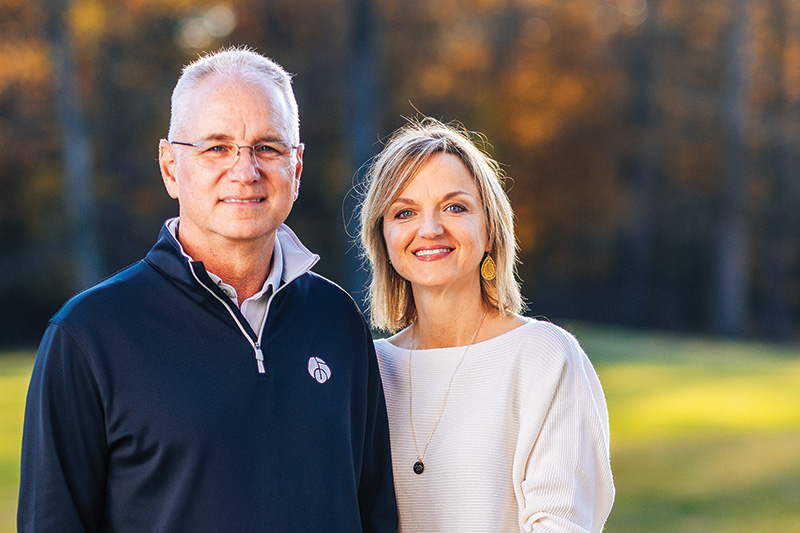
Carter met his wife, Melissa, when he was an assistant at Valley Hill Country Club in Huntsville, Ala.
Making his way
After graduating from Auburn, Carter became first assistant superintendent at Valley Hill Country Club in Huntsville, Ala., under Jeff Lee, CGCS. That’s where Carter met his wife, Melissa. Carter later became an assistant under former CC of Birmingham assistant Paul Hood at Willow Creek Golf Club in Knoxville, Tenn.
He landed his first head superintendent job at Medalist of Avalon in Lenoir City, Tenn., a move that quickly turned into a learning experience.
“That was one of those life lessons where it sounds good, it looks good on paper, they’re throwing a big chunk of money at you,” Carter says. “I thought, ‘I’m ready.’ Riding the golf course that day, I had my doubts. I took the job. I lasted about a year.”
Carter wasn’t let go, but sensing he might soon be, he submitted his resignation.
“That was one of those blessings that doesn’t seem like a blessing at the time,” he says. “But it taught me to listen to your instincts and listen to other people.”
Carter kicked around a bit, working on another ground crew and eventually being hired as landscape superintendent for Council Fire Golf Club in Chattanooga, Tenn. (Melissa’s twin sister lives there, “So it wasn’t a hard sell,” Paul Carter says.)
Carter ran a three-man crew tending to residences and townhomes at Council Fire GC before he was contacted about the superintendent job at The Bear Trace at Harrison Bay. The superintendent then was splitting time between there and The Bear Trace at Cumberland Mountain — a bit of a hike; it’s even in a different time zone — and Tim Brock, then equipment manager at Cumberland Mountain and now superintendent at Deer Creek Golf Club in Crossville, Tenn., remembered Carter from their time together at Willow Creek.
“He said, ‘Why don’t you give Paul a call and see if he’s interested,’” Carter says. “That’s how I came out here, how I got to this point.”
But it wasn’t without a bit of trepidation.
Carter visited The Bear Trace at Harrison Bay and played a round in early 2001 with Council Fire GC superintendent Gary Weller. They found the course … needed some work.
“We talked about me taking this job, and Gary said, ‘Are you sure you want to do this?” Carter says. “I was married and felt I needed to provide more than I was, and I saw this as an opportunity to get back in golf, so I accepted. Sometimes I need to learn the same lessons a few times.”
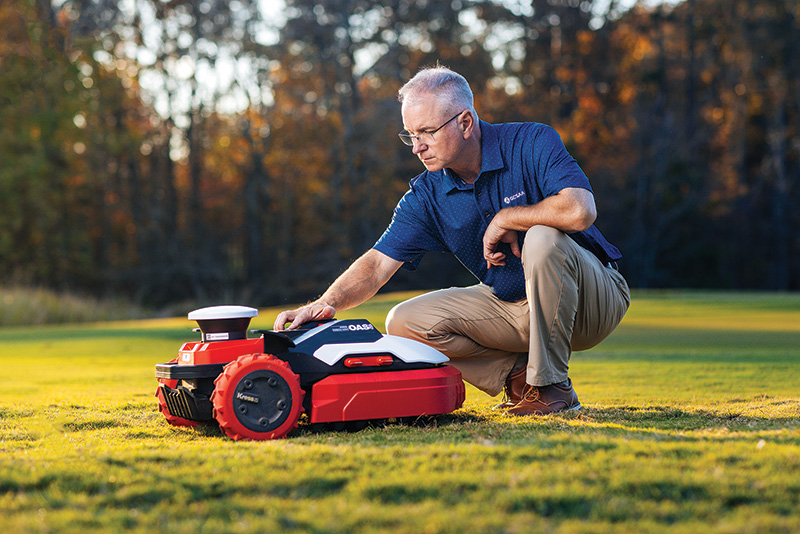
Carter oversees nine courses in the Tennessee Golf Trail. Carter's courses have been in the forefront of golf course management, from the use of robotic mowers to electric equipment.
Eating the elephant
Borrowing again from previous lessons, Carter set to work improving the course.
“There was a lot of work to be done,” Carter says. “But from my days at Avalon, I learned not to eat the whole elephant at one time.”
Carter and crew focused on bunkers first, then roughs and tees. They regrassed greens from bentgrass to Champion ultradwarf bermudagrass in 2003 — an event Carter, like many superintendents, can measure in meaningful life events. “It was two days after my daughter, Hannah, was born. She was born on the ninth; we regrassed greens on the 11th.”
Ultimately, Carter and his crew turned The Bear Trace at Harrison Bay around.
“We just started working and working. We got a fabulous crew in here. Most of them are still here,” Carter says. “We’ve gone from having people come in from the turn wanting their money back because the course was so bad to people coming in from the turn wanting to book another 18 holes that day because it’s so good. We’re well ahead of where we were.”
Another curveball came Carter’s way in 2005, when the management company that ran The Bear Trace at Harrison Bay, along with three other courses, failed to make lease payments, prompting the state to take over.
“So we became employees of the state,” Carter says. “All the processes and red tape you have to deal with at a municipal … if you want to do something three years from now, you’d better start planning today.”
Carter also has served as director of agronomy for the Tennessee Golf Trail, nine courses spread across the state from the northeast corner (Warriors’ Path) to the southwest (Pickwick Landing), since 2015. Over the last four or five years, Carter says, work has ramped up across the Trail to improve all the other courses.
“There’s always something to do,” he says. “As director of agronomy, I don’t do the day-to-day superintendent work. We have superintendents at those facilities. If they need me, I’ll answer questions or make suggestions. Sometimes they’re strong suggestions. But we’ve got great superintendents. It’s their golf course, their responsibility.”
Carter is especially proud of the “growth” he has seen in his assistant at Harrison Bay, Willie Hamby, a nine-year association member.
“We’ve got a fabulous crew,” Carter says. “I tell people, my assistant, Willie, has grown so much since I’ve been on the Board. It’s been nice to see him grow and flourish. When I’m here, I just try to stay out of his way. He could take over today. I’m very proud of him.”
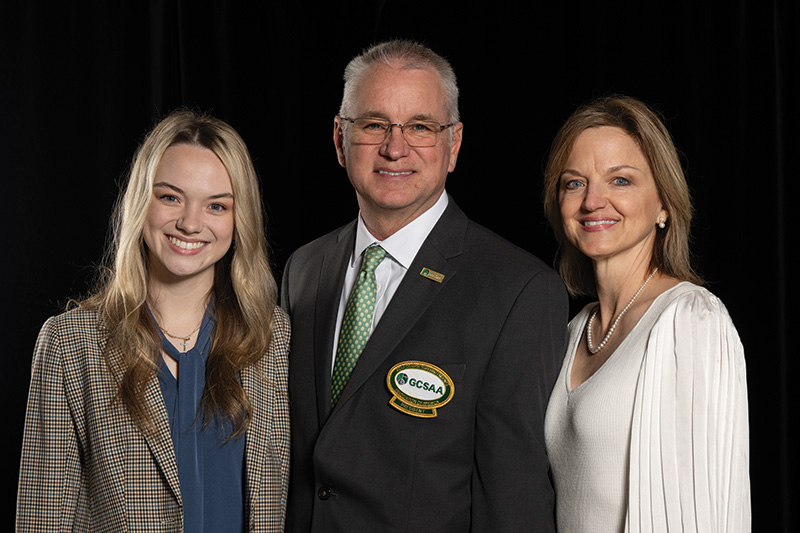
The Carter family, from left: daughter Hannah, Paul and Melissa.
Giving back
Given all he has on his plate overseeing nine courses, what prompted Carter to tackle the added responsibility that goes along with national Board service and the presidency?
“It goes back to my childhood,” he says. “My parents were both community servants. They were on committees at church. It was a small town. That’s what you do. You do what you have to do to help your community. Golf courses are now my community. My dad told me, ‘Never complain about something if you’re not willing to provide or work toward a solution.’ I’ve always tried to live by that.”
His first foray into service came during attesting for CGCS, when Bill Francis was president of the Tennessee Turfgrass Association.
“I had never been on any committees before,” Carter says. “He said to me, ‘You should run for the Tennessee Turfgrass Association board.’ He was doing my attesting, so I didn’t want to say no.”
Another can’t-say-no moment came a few years later. Carter made the TTA board and served as its president 2014-15. After becoming Certified, he was asked to serve on GCSAA’s Certification Committee.
“That was my first time at headquarters,” he says. “That got me kind of introduced, and I’ve been hooked on committees ever since.”
Another telling moment came after then-superintendent Shelia Finney joined GCSAA as its senior director of member services, vacating her position as Tennessee GCSA’s chapter delegate.
“(GCSAA CEO) Rhett (Evans) stole Shelia away from us,” Carter says. “She was our delegate forever. She called me up and said, ‘I need a favor. I need you to do something for me.’ When she says that, you just say, ‘Yes, ma’am, what do you need?’ She said, ‘I need you to be a chapter delegate this year. Just do it for a year. We’ll walk you through it. The next year comes and, ‘You know, we couldn’t find anybody. Why don’t you just do it again?’”
Another Finney request came after an Annual Meeting in Orlando.
“Shelia says, ‘Sit down. Let’s have a talk,’” Carter recalls. “She said, ‘You should be on that stage (with the national Board of Directors). I said, ‘I don’t know about that.’ But I thought about it and decided, why not throw my hat in the ring one time?”
Carter first consulted with his wife and daughter, then his assistant, Hamby, his golf pro, Robin Boyer, and his higher-ups with the state.
“Everybody approved, so I said I’d give it one year,” Carter says. “I was fortunate I got elected. For me, it’s about giving back, and I’m very grateful for the great support of my supervisors in Nashville to allow me to give back to GCSAA and serve our association at the national level.
“Being a municipal superintendent over multiple courses gives me a different perspective on the board than I’ve seen in the past. I wanted to give a voice to municipal superintendents. We’re going from T.A. (Barker), with his family-owned public golf course to a municipal superintendent. I think that’s very representative of all our membership. We’ve got good representation now of all our members. It makes for some interesting conversations, some interesting points of view. Hopefully we’re making the right decisions, and I think we are.”
McLemore, one of Carter’s mentors, was in Orlando in February for Carter’s ascension.
“It’s a commitment to serve in those roles,” McLemore says. “I think it shows you what kind of leadership ability he has. He was able to start at the state association and move on up. He paid his dues all the way up. Every time you go through any of those positions, you learn something. To see him go all the way to national … it’s a proud moment. To see someone make it all the way, it’s like it’s one of your children. We’re proud of him.”
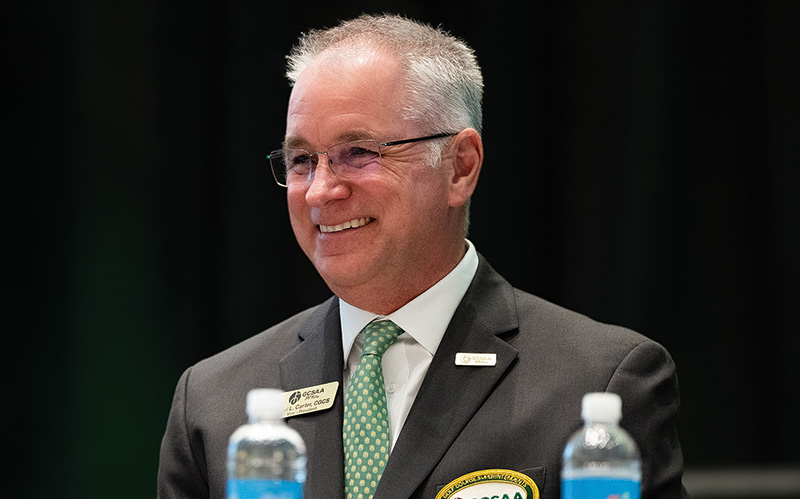
Carter was inducted as president at the 2026 GCSAA Conference and Trade Show in Orlando
Centennial Coincidence
Paul L. Carter, CGCS, didn’t aim to become president of GCSAA in time for the association’s 100-year anniversary.
In fact …
“I joke with everybody that I had four spreadsheets open (calculating when to make his move toward the presidency),” Carter says. “No, I had no earthly clue the Centennial was coming up when I first became involved. I was about two years in before somebody did the math and figured I’d be president during the Centennial year.”
Thus Carter will serve as GCSAA’s 89th president during its 100th year. The anniversary of GCSAA’s founding is Sept. 13.
“I’m blessed,” Carter says. “It’s a tremendous honor, but it’s also a tremendous amount of added pressure. It’s our 100th year. There’s always great pressure to have a great Conference and Show. But the events that are going to happen in 2026, they’re not going to happen again, and they never happened in the previous 100 years. It’s a special moment.
Carter hopes the association can use the Centennial to continue to lift up the superintendent’s standing in the golf world.
“Being our Centennial year, I want us to celebrate our association and our membership,” he says. “We’ve worked so hard for 100 years to get to this point. The reputation of GCSAA is on the rise. My challenge is to spend the year celebrating and also plastering GCSAA everywhere. I’d challenge all our members not to be afraid to plaster GCSAA everywhere — stickers, embroidery, signs, ad campaigns. Be proud of being a GCSAA member. It’s a perfect opportunity to get everybody who plays golf to realize without us, there’s no game or business of golf.
“It’s great to see where we are and where we’re heading. I never really thought about it before, but I feel very blessed and honored. I’ll be the 89th president. Only 89 people have held that office in our 100-year history. It’s a very unique and small group of people.”
Andrew Hartsock (ahartsock@gcsaa.org) is GCM’s editor-in-chief.