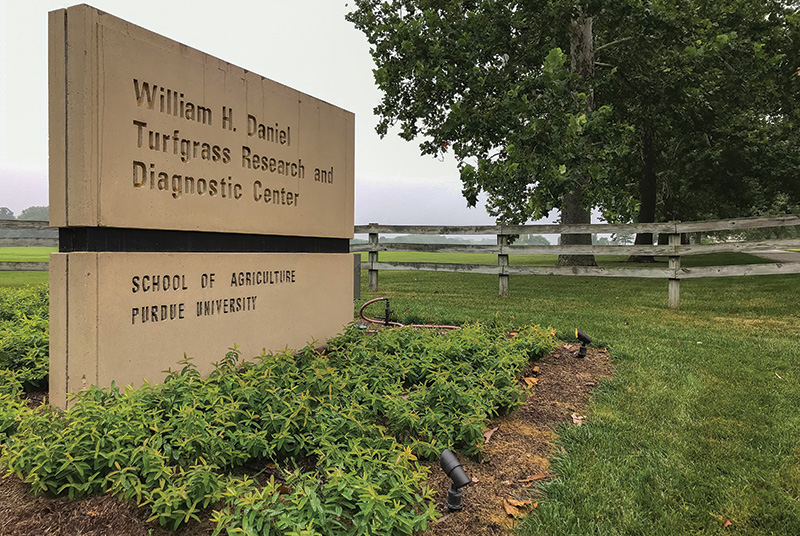
Purdue University’s turfgrass and research center is named for William H. Daniel, a 36-year member of the Purdue faculty. Photo by Darrell J. Pehr
Advances in turf breeding, pesticide and herbicide use, irrigation technology, maintenance practices and, of course more recently, the use of drones, electric vehicles and robotic mowers come to mind — but what about the people behind all these innovations?
The first turfgrass research field day I attended as part of my job as science editor was in July 2022 at the William H. Daniel Turfgrass Research and Diagnostic Center at Purdue University. The daylong event was packed with the latest updates on research being conducted by Purdue research faculty and graduate students, but when I stopped at the end of the day to shoot a photo of the sign at the entrance of the center, I wondered about Daniel.
So now, four years later and with all this Centennial activity on my mind, it seems like a good time to share a little about Daniel, a person who devoted his life to improving turfgrass.
A Purdue University faculty member for 36 years, Daniel, a professor of agronomy, was honored by GCSAA in 1975 with the Distinguished Service Award (now known as the Col. John Morley Award). In 1984, Daniel received the USGA Green Section Award in recognition of his distinguished service to golf through work with turfgrass. It was presented during the GCSAA Conference and Trade Show at the MGM Grand in Las Vegas.
Daniel, born in Sparkman, Ark., earned his bachelor’s degree in 1941, then took a break from his studies to serve in WWII as a U.S. Army Air Corps pilot. He and Gwen were married in 1944, and after the war, he returned to college, earning a second bachelor’s at the University of Arkansas, followed by a master’s in 1948 and doctorate in soil science in 1950 at Michigan State University.
He started a career in turf research and teaching as an assistant professor in 1950 at Purdue University, rising in rank to associate professor in 1954 and professor in 1957.
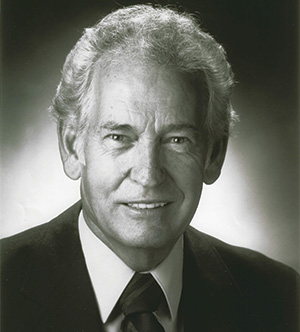
William H. Daniel. Photo courtesy of Purdue University
Among his research projects, Daniel developed improved varieties of turf, including Sodco bluegrass, Evansville bentgrass and Midwest zoysiagrass. He developed the use of calcium arsonate for the control of Poa annua; the use of vertical turf thinners, vertical turf seeders and vegetative turf planters; and the use of plastic covers to reduce heat buildup on covered turf, such as athletic fields. He invented the Prescription Athletic Turf System for use on football and baseball fields.
Daniel served on the executive committee of the International Turfgrass Society and on the USGA Green Section Committee for more than 30 years.
As an educator, Daniel taught agronomy courses and supervised graduate student programs at Purdue, assisting more than 200 students seeking employment in the turf management field.
He was the long-time executive secretary of the Midwest Regional Turf Foundation, coordinator of the annual Midwest Regional Turf Conference and editor of the conference proceedings.
Daniel was named a fellow in the American Society of Agronomy in 1964 and was the Agronomic Service Award recipient in 1973.
Upon receiving the USGA honor, Daniel said, “My career as a worker in turfgrass science has covered 34 exciting years, and I am honored to be the recipient of the Green Section’s 1984 award and to join the distinguished group of those who have received it before me.”
Daniel died in 1996, but even these 30 years later, his legacy carries on in the impactful work being done at Purdue and the untold progress that has been made from those he mentored and inspired.
Thanks, Dr. Daniel, for all you did for turfgrass research.
Darrell J. Pehr is GCM’s science editor.