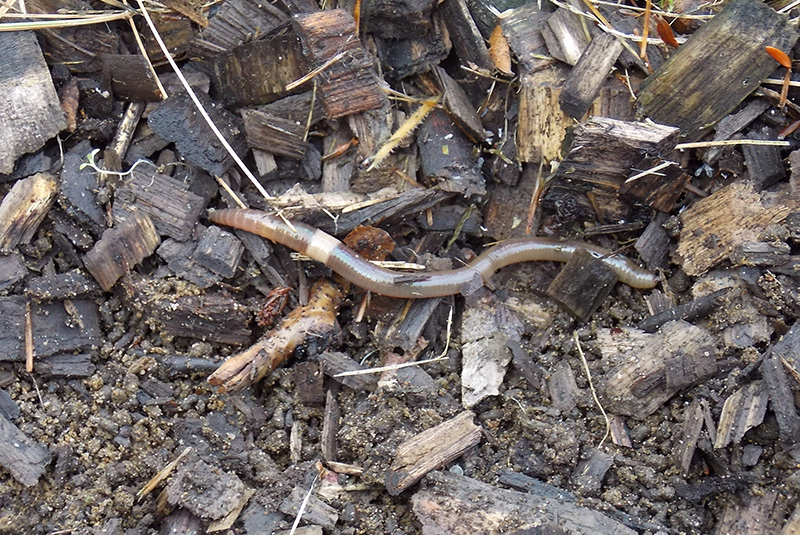
In the 1920s and 1930s, earthworm castings were a big problem on golf courses. An earthworm casting is the end-product of digestion. As earthworms move through the soil, they create tunnels, pathways and channels that create spaces for air, water and nutrients to reach plant roots, and they improve soil structure, too. Earthworms “consume” soil particles, which eventually get expelled as castings — little mud-like piles deposited at the surface next to holes where they burrow into the soil.
Earthworm castings are full of organic matter, nutrients and beneficial microorganisms. They’re great for gardens, but on turfgrass playing surfaces, castings smear and become slippery, and mower reels don’t like them.
Mowrah meal was used for earthworm control back in those early days. This substance is derived from the seeds of the mowrah tree (Madhuca longifolia), also called the Indian butter tree. The tree is native to India and valued for the cosmetic-grade oil extracted from seeds. Mowrah meal contains saponins, which irritate earthworms and thus cause them to relocate quickly to the surface, where they can be physically removed.
The famous naturalist Charles Darwin published his last book in 1881: “The Formation of Vegetable Mould through the Action of Worms, with Observations on their Habits.” This book was based on his 40 years of observing earthworms in gardens and farm fields. Darwin recommended the use of lime water to remove earthworms from lawns. Turf research in those early days showed that lowering pH with the use of acidifying fertilizers was associated with a reduction in earthworm castings.
With today’s golf course turf management practices, it is speculated that sand topdressing may increase soil abrasiveness, which may repel the earthworms. Researchers at the University of Arkansas, Fayetteville, wanted to determine earthworm density and species composition in native soil compared to a sand-based root zone. They also wanted to see if sand topdressing would affect the earthworm populations.
The randomized and replicated field study was conducted on Patriot hybrid bermudagrass (Cynodon dactylon × C. transvaalensis) maintained at 0.59-inch (1.5-centimeters) height-of-cut with clippings returned. The sites consisted of simulated golf tees with either a silt loam root zone with pH 6.2, or a sand-capped root zone containing 5 inches (12.5 centimeters) of sub-rounded, medium-sized sand over silt loam soil. Sand topdressing treatments consisted of 0.25 inch (0.64 centimeter) of medium sub-rounded sand applied one time or four times during the growing season of May through August. Therefore, the low sand topdressing amount was 0.25 inch of sand, and high sand topdressing amount totaled 1 inch (2.54 centimeters) of sand. There were also plots with no sand topdressing for comparison.
Earthworm samples were collected in December by the hand-sorting method. In each plot, a sub-section of soil measuring 12 × 12 × 8-inch depth (30 × 30 × 20-centimeter depth) was extracted and stored until processing. Next, all soil samples were thoroughly examined and earthworms manually collected and identified. Earthworms were separated by morphology based on pigmentation, length and that thick, saddle-shaped glandular band on their body. Their DNA was extracted for confirmation of species identification.
Overall, there were no differences in earthworm populations between the soil and sand root zones. The dominant earthworm species found was Diplocardia spp., native to North America and Central America, which can grow to over 18 inches (46 centimeters) in length. Other earthworm species identified were Microscolex phosphoreus (a bioluminescent earthworm found globally) and Amynthass spp. (“jumping worms” native to Eastern Asia).
Sand topdressing amount did influence earthworm populations. More earthworms were extracted from soil or sand root zones under low sand topdressing compared to high sand topdressing. The direct effects of sand topdressing on earthworm activity and density remain unclear. Do the angular sand particles influence abrasiveness, which deters the earthworms from inhabiting the root zone, or does sand topdressing alter the moisture or food source within the root zone, which influences feeding and casting behavior? More research is needed on these earthworms. After all, the oldest earthworm fossils go back 1.2 billion years.
Source: Boyle, P., M. Savin, M. Richardson and D.E. Karcher. 2022. Identification of earthworm species in sand-topdressed hybrid bermudagrass golf tees. International Turfgrass Society Research Journal 14:544-547.
Mike Fidanza, Ph.D., is a professor of plant and soil science in the Division of Science, Berks Campus, at Pennsylvania State University in Reading, Pa. He is a 24-year member of GCSAA.