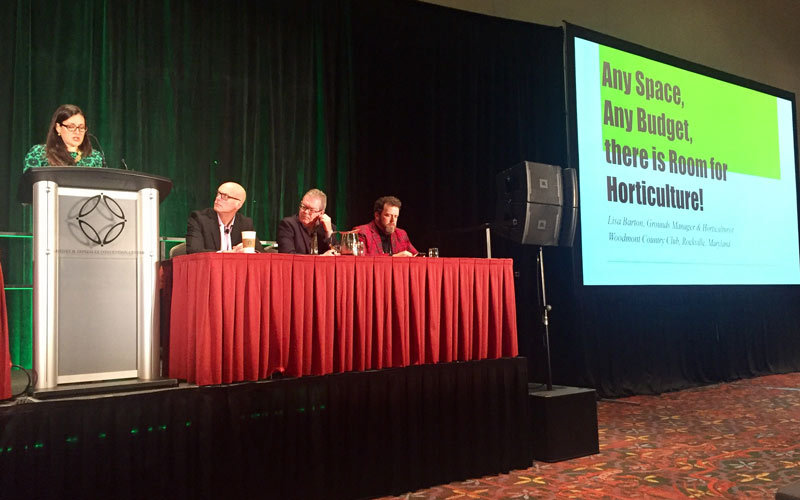
Lisa Barton of Woodmont Country Club in Rockville, Md., shares horticulture principles and tactics for establishing eye-catching, functional landscaping around any golf property in “Why Didn’t I Think of That? Ideas That Make an Impact at Your Facility.” Photo by Roger Billings
Stakes. Kale. The “golden hour.”
A wealth of ideas to help you put your facility’s best face forward were on parade during “Why Didn’t I Think of That? Ideas That Make an Impact at Your Facility” on Monday morning at the Golf Industry Show. Held in the Henry B. Gonzalez Convention Center’s Hemisfair Ballroom, the education session boasted a range of subject matter and a healthy morning-after-the-Super-Bowl head count.
First up was golf course architect Nathan Crace, who invited attendees to “Imagine if there were no tee markers — it’s easy if you try.” Crace offered a case study on swapping tee markers for tee stakes at The Refuge in Flowood, Miss., and explained how the strategy spreads out wear and tear, saves money on labor, speeds up pace of play (stakes are quite easy for golfers to spot), and can create a unique talking point for your golf course. Superintendents can consider crafting their own customized stakes to fit their property’s aesthetic.
Next to speak was Lisa Barton, grounds manager and horticulturist at Woodmont Country Club in Rockville, Md., on applying horticulture practices for style and utility. Barton advised attendees to “plant with a purpose,” and touched on choosing plants for color, for their artistic qualities, as distraction from unsightly elements, and for other practical reasons. For instance, Barton is a fan of planting kale in winter, as the leafy, cold-hardy veggie displays attractive color during an otherwise drab time of year. The presentation was peppered with interesting facts, among them that bees have trouble distinguishing the color red, and that geraniums and marigolds possess a mosquito-repelling compound.
John Kaminski, Ph.D., associate professor of turfgrass science at Penn State University, took the mic next, and introduced concepts and tips to help superintendents capture better photos out on the golf course. In addition to the details of exposure and composition, Kaminski discussed various uses for photography — employing a GoPro to shoot photos to turn into a time-lapse video chronicling a project’s progress, for example — and mentioned that superintendents already have a leg up in taking spectacular photos, as they’re frequently at work during the “golden hour,” which is that magical time shortly after sunrise and before sunset when daylight is redder and softer, lending itself to beautiful images.
Wrapping up the two-hour session were Ted Blahnik and John O’Neal, who gave an overview of what began as a creek bank stabilization initiative at Old Oakland Golf Club in Indianapolis. Blahnik is a principal at the engineering firm Williams Creek Consulting, and O’Neal is the chief operating officer at Cohoat and O’Neal Management Corp., which operates Old Oakland GC. With the creek project as catalyst, the club seized the opportunity to renovate the entire facility to increase playable space. Blahnik and O’Neal’s presentation took attendees through the ins and outs of the multipurpose project, which will culminate with the opening of the fully renovated 27-hole facility later this year.
Megan Hirt is GCM’s managing editor.