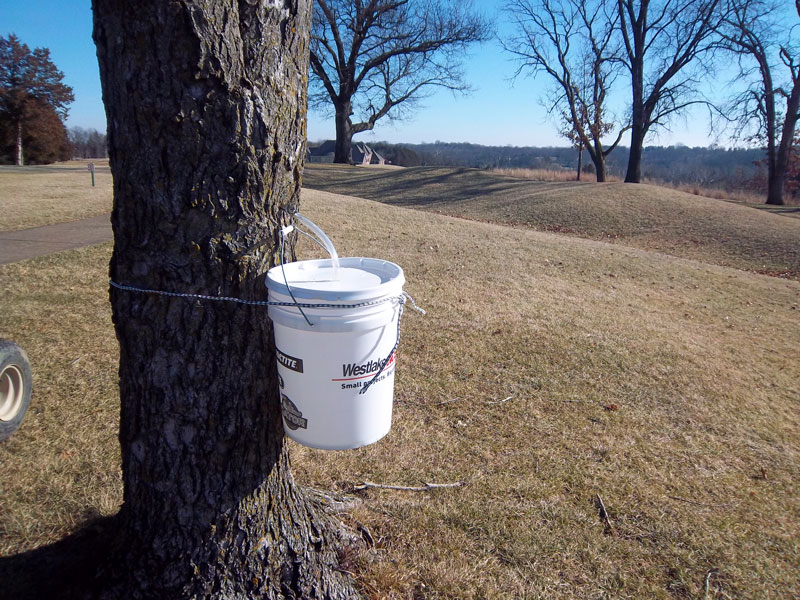
A collection bucket hangs on one of the 20 or so maple trees Ed Wachter, CGCS, taps on and around the grounds at Franklin County Country Club in Washington, Mo. Photos by Ed Wachter
Maple syrup is a distinctly North American phenomenon, and its production is overwhelmingly concentrated in Canada and in the northeastern/north-central United States.
That’s not to say it can’t be made elsewhere — as a pair of brothers, both Certified Golf Course Superintendents located in the middle of the map, prove every winter.
“It’s enjoyable,” says Joe Wachter, CGCS, at Glen Echo Country Club in St. Louis. “It’s not hard to do, and it’s something to do in the winter. It’s just a little something extra for the membership, one of the finer things in life. Some properties have everything. They can produce fish and all sorts of things for their membership. We’re pretty simple. But we do have some trees, and we can produce a simple product. It’s natural, and the members like natural things. It’s a farm-to-table type of thing.”
At Glen Echo — the oldest 18-hole course (est. 1901) west of the Mississippi and site of the 1904 Olympic gold medal matches — it’s more of a trunk-to-table type of thing.
Every winter for the past 10 or so years, Wachter, a 29-year GCSAA member, has tapped 12 to 15 maple trees, most of them on the course; collected their sap; and boiled it down into maple syrup. In middle America, the weather-dependent syrup season runs only a handful of weeks from, roughly, late January to early March.
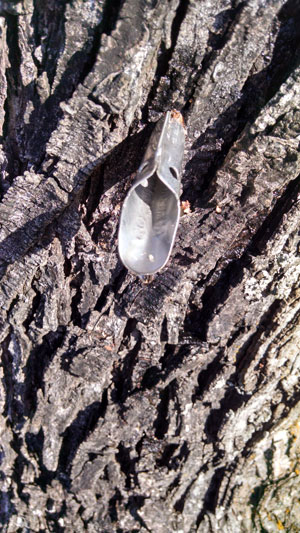
Right: An up-close look at a spile that delivers the sap from a maple tree.
Younger brother Ed Wachter, CGCS, taps more trees on and around his course, Franklin County Country Club, but his yield isn’t as great as his brother’s. Joe’s best year produced 8 gallons of the sticky liquid gold; Ed’s bumper year at FCCC — located in Washington, Mo., the “corncob pipe capital of the world,” about 50 or so miles west of St. Louis — produced just a gallon from 20 or so maple trees.
“It’s a nice hobby,” says Ed Wachter, a 33-year GCSAA member. “It’s something to do in the winter when it’s cold and snowy. The members love it. The problem is, I can’t get enough.”
Sugar maples are the superior sap source, though black, red, silver and ash-leafed maples also produce sweet sap. Sugar maple sap has a sugar content of around 2% — twice the content of the lesser saps. It takes the Wachters, who tap various types of maples, roughly 40 to 45 gallons of sap to make 1 gallon of syrup.
Ed keeps some of the final product and delivers the rest to the clubhouse. If the yield is good enough, FCCC members benefit with a breakfast/pancake feed.
“My members love it. They eat it up,” Ed says. “When I have parties at the clubhouse, the maple syrup is gone. It does taste really good. It’s even better than the stuff in stores.”
Joe also shares the love. He delivers the bulk of his syrup to the course’s kitchen, where the staff uses it in special dishes and desserts and for special occasions.
“We might have an Easter brunch, or they’ll put it out on opening day for the men, or the chefs will save it for a dessert treat,” Joe says. “We try to advertise when we’re going to use it, put it on the blog and social media, and tell everybody it’s something made on the property. Eight gallons isn’t a huge amount. I’ve seen some guys have honey production on their courses. There are guys making hundreds of gallons of honey. It’d be nice to be able to do that, but we don’t have that many maple trees. This is just something a little different that we do.”
The Wachters learned syruping from their father, who made the maple goodness on a friend’s rural Missouri acreage. A third brother, Delmar, isn’t in the golf maintenance industry, but he still makes syrup, too.
According to the United States Department of Agriculture, Vermont is by far the biggest producer in the U.S., with nearly 2 million of the country’s 4.3 million gallons produced in 2017. New York and Maine ranked 2-3, with more than 760,000 and 709,000 gallons produced, respectively.
It’s all a drop in the sticky, pancake-enhancing bucket compared to The Great White North. Canada produces more than 80% of the world’s maple syrup. Quebec alone accounts for about 70% of global production; that province churned out a record 11.2 million gallons in 2016.
The Wachters’ small-scale operation isn’t going to worry North America’s maple heavyweights — but that doesn’t make their contributions any less sweet.
“It’s a simple task,” Joe Wachter says. “It’s not that complicated, and it’s something neat that the members seem to appreciate. It’s a great-tasting product. Once you taste it … it’s not like that artificial corn syrup. My lord, it comes out of the ground. It’s natural, and it’s easy to do.”
Andrew Hartsock is GCM's managing editor.