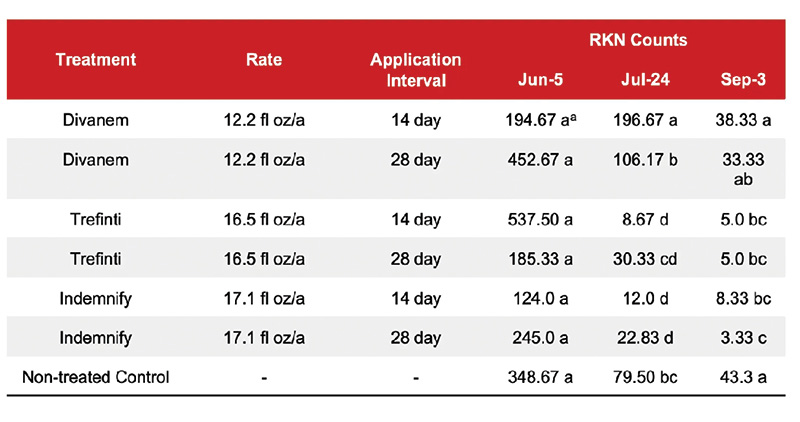
Effects of nematicide and application interval on RKN Counts from an ultradwarf bermudagrass putting green.
Biology and management of turf diseases in North Carolina: focusing on root-knot nematode and the turfgrass microbiome
(Author’s note: This project highlights one component of a broader portfolio of center-funded research initiatives focused on developing novel approaches to complex scientific challenges.)
Numerous fungi and nematodes are problematic for turfgrasses, especially on golf course putting greens. Recently, we have observed an increase in the incidence of root-knot nematode (RKN) in samples submitted to the NCSU Turfgrass Diagnostic Lab. Consequently, we found it vital to further explore the biology and management of this important pathogen. The objectives of this study include:
- Identifying the species associated with RKN damage on golf course putting greens in N.C.;
- Assessing nematicide sensitivity among various RKN species present in N.C.;
- Evaluating the effect of temperature on RKN life stages in vitro; and
- Evaluating nematicide programs and timings for RKN suppression.
To date, we have collected RKN samples from over 35 golf courses in N.C. and throughout the U.S. We are currently working to identify the species in these samples. Objectives 2 and 3 are in the early planning stages and should commence in the summer of 2026. We have completed a year of nematicide testing and have found that Indemnify and Trefinti provide excellent reductions in RKN populations regardless of reapplication interval. Applications were conducted in late April, and four applications were made in this study. We plan to evaluate different timings and rates in the future.
— Jim Kerns, Ph.D., (jpkerns@ncsu.edu) professor and Extension specialist, Department of Entomology and Plant Pathology, North Carolina State University, Raleigh
More than half of the games in FIFA soccer tournament were played on turfgrass bred by Rutgers experts
While soccer fans watched their favorite teams compete at this summer’s World Cup, Rutgers University’s plant biologists were looking under the players’ cleats — eyeing the lush, green natural turfgrass they created. Ten of the tournament’s 16 soccer stadiums in the U.S., Canada and Mexico hosting the World Cup featured cultivated varieties (cultivars) of cool-season natural turfgrasses bred by the university’s team of experts.
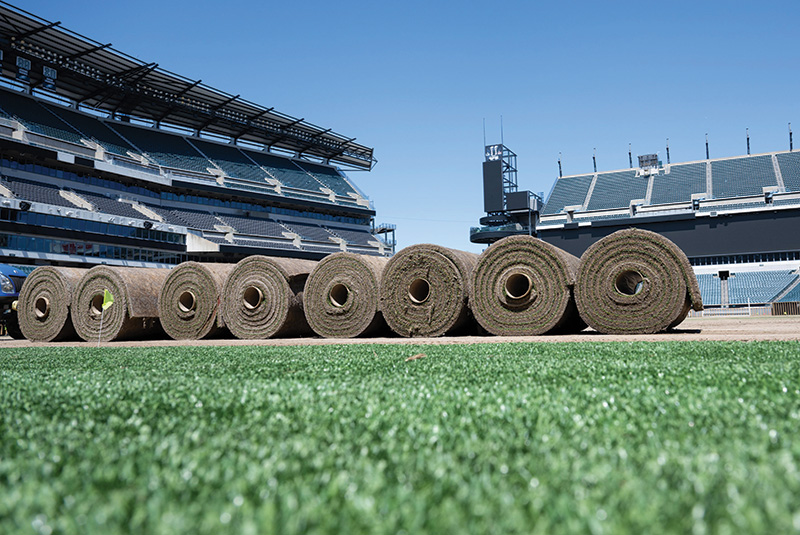
Rutgers turfgrass was used in locations from nearby Philadelphia’s Lincoln Financial Field to Mexico City’s Estadio Azteca at an altitude of more than 7,000 feet, to Vancouver’s BC Place domed stadium. “This is one of our flagship programs that’s world-renowned,’’ said Stacy Bonos, a professor of turfgrass breeding in the university’s plant biology department. “Rutgers grasses are recognized for having good turf quality and being the best overall in multiple different trials all over the country."
While Rutgers’ turfgrasses were also in play at this year’s Masters golf tournament — and have been used at Yankee Stadium and the White House, not to mention for countless lawns, parks and non-professional athletic fields — the spotlight is now on soccer. Michigan State University and the University of Tennessee led FIFA’s research into which turfgrasses would perform best at each of the World Cup stadiums. Their experts settled on Rutgers-bred cultivars as their top choice in most cases in consultation with each venue’s groundskeepers and the seed companies, according to Bonos.
In addition to Philadelphia, Mexico City and Vancouver, Rutgers cool-season turfgrasses were used in Toronto, Boston, Atlanta, Dallas, Houston, Los Angeles and Seattle. James Murphy, an extension specialist in Rutgers’ plant biology department, oversaw the tolerance tests on the university’s turfgrasses that helped confirm their durability for World Cup games. “Seeing Rutgers turfgrasses on the world stage is very rewarding because it validates the mission of the program that was initiated over 60 years ago and the research that we do each day, which is to develop the best quality turfgrasses that perform well under many stresses," Bonos said.
Darrell J. Pehr (dpehr@gcsaa.org) is GCM’s science editor.