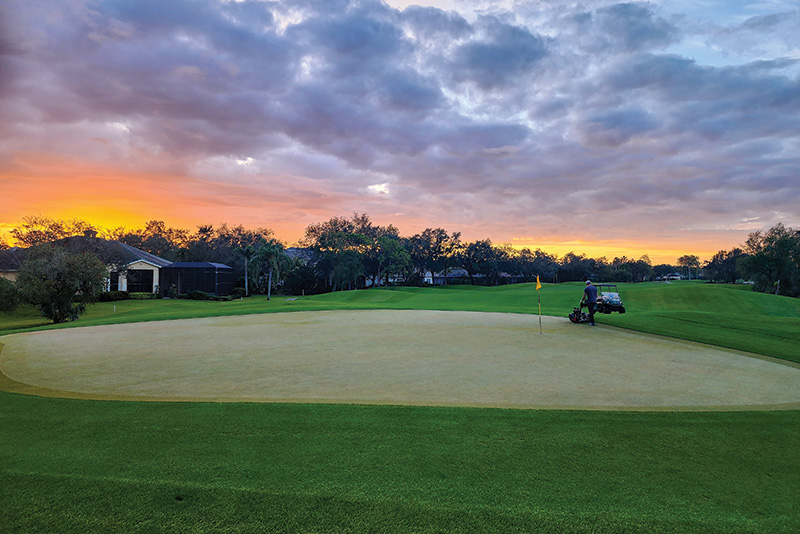
Perennial ryegrass growing after first spray to shade out underlying plants.
Editor’s note: All pesticide applications referenced in this article describe the author’s program at the time of these renovations. Always follow current product labels and applicable federal, state, and local regulations.
After more than 33 years in the golf course industry, I have had the opportunity to be involved in eight major golf course renovations and numerous turf conversions. Throughout my career, I have worked with many different turfgrasses and have been directly involved in converting existing turf, including bermudagrass and seashore paspalum, to newer and improved varieties.
One lesson has become very clear to me: when converting a golf course from one turf variety to another, treating what you can see is not enough.
The goal should be complete elimination of the existing turf before the new turf is planted.
Over the years, I watched traditional turf-conversion methods produce inconsistent results. Even after multiple herbicide applications and construction activities, unwanted turf could eventually reappear in the newly established surface.
Billy Huskins, CGCS, is the Director of Agronomy at Vineyards Country Club in Naples, Fla.

That led me to develop and refine a different approach to turf conversion — one focused not simply on treating the visible plant, but on eliminating the entire existing turf system before construction and regrassing begin.
The problem with traditional turf conversion
The traditional approach to golf course turf conversion is relatively straightforward. The existing turf is treated with a non-selective herbicide, allowed to decline, and then the golf course moves into construction.
At first glance, this process appears successful. The turf turns brown and looks dead. But dead-looking turf does not always mean dead turf.
Aggressive warm-season grasses such as common bermudagrass and seashore paspalum can survive through stolons, rhizomes, crowns, and other viable plant material. Even when the surface appears completely dead, living material can remain below the surface.
Once construction begins, surviving material can be moved throughout the site. Grading, excavation, drainage installation, irrigation work, and other construction activities can redistribute viable turf material into areas where it did not previously exist.
The contamination may not become apparent immediately. The new turf can establish successfully and look excellent, only for patches of the previous turf to begin emerging months later.
The key realization for me was simple: Complete turf elimination should be completed before construction — not during construction and certainly not after the new turf has been established.
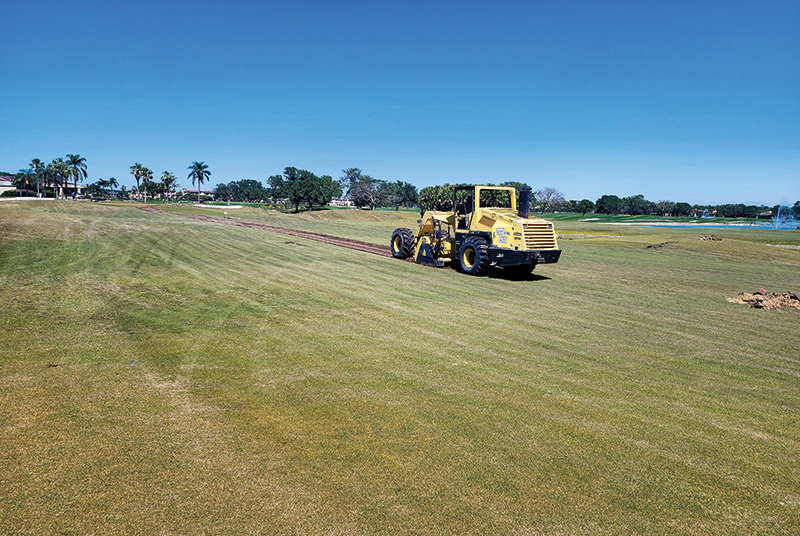
Bo mag roto cultivation.
Developing a different approach
During the South Course renovation at Vineyards Country Club in Naples, Fla., we had an opportunity to put this philosophy into practice.
The existing golf course contained a combination of seashore paspalum, Celebration bermudagrass, and common bermudagrass. Our objective was to completely eliminate the existing turf before establishing Bimini bermudagrass.
Rather than treating elimination as one step immediately before construction, we developed a program that began months in advance.
September 2022: Preparing the existing turf
On Sept. 4, 2022, we scalped the entire golf course to approximately 0.500 inch.
The purpose was to remove excessive plant material and prepare the existing turf for the first herbicide treatment while the warm-season grasses were still actively growing.
On Sept. 18, 2022, we treated the existing turf with:
- Glyphosate — 6 quarts per acre
- Triclopyr — 32 ounces per acre
The timing was intentional. We wanted the existing paspalum, Celebration bermudagrass, and common bermudagrass actively growing so the herbicides could be absorbed and translocated throughout the plants.
The objective was not simply to make the golf course brown. We wanted to begin attacking the entire plant system, including material capable of surviving below the surface.
Using ryegrass as part of the process
On Oct. 2, 2022, we overseeded the golf course with perennial ryegrass at 600 pounds per acre.
The ryegrass served two important purposes. First, it allowed us to maintain a playable golf course throughout the winter while the conversion process continued. Second, the dense ryegrass canopy was intentionally used to shade the underlying paspalum, Celebration bermudagrass, and common bermuda-grass, further weakening any plants that survived the initial herbicide application.
We maintained the ryegrass at approximately 0.600 inch on tees and fairways and 1.5 inches in the rough. Maintaining a dense, competitive ryegrass canopy reduced sunlight reaching the underlying warm-season turf and placed additional pressure on already weakened plants during the winter months.
This allowed us to continue the elimination process for several months while keeping the golf course playable prior to construction.
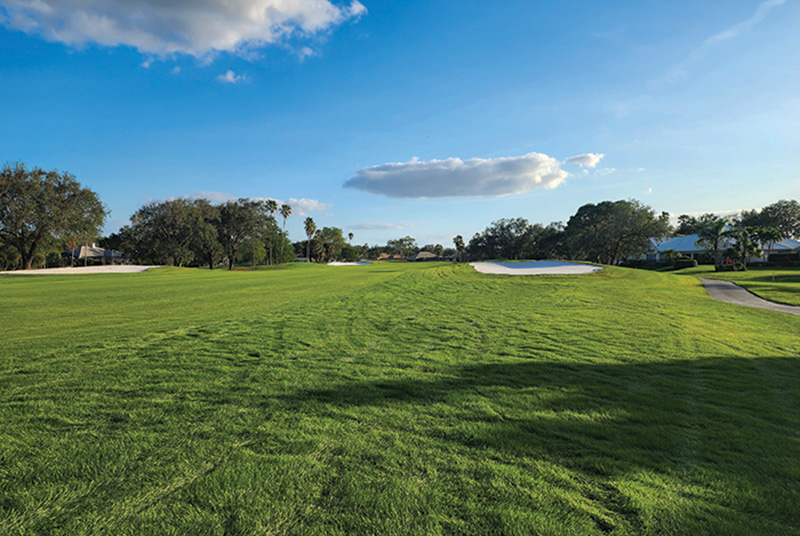
Perennial ryegrass growing 1.5 inches (very thick) to compete and stress underlying plants.
March 2023: Second and final herbicide application
As we approached construction, we began the final chemical phase of the program.
On March 11, 2023, we scalped the ryegrass rough to approximately 0.600 inch. Four days later, on March 15, 2023, we made the second and final herbicide application:
- Glyphosate — 6 quarts per acre
- Triclopyr — 32 ounces per acre
- Fusilade — 24 ounces per acre
The objective was to eliminate the remaining ryegrass while targeting any surviving paspalum, Celebration bermudagrass, or common bermudagrass before construction.
Rather than assuming the September treatment and winter shading had eliminated everything, we treated the site one final time immediately before construction.
Construction begins
On March 20, 2023, construction began.
This is where our approach differed significantly from many traditional turf conversions. Rather than stripping the existing turf and hauling or burying the material, we used a BOMAG rotary tiller to aggressively disintegrate the existing root mass.
My philosophy was very specific: Do not strip and bury.
Stripping the surface may make a construction site appear clean, but it does not necessarily eliminate viable turf material. Stolons, rhizomes, crowns, and other living plant material can remain in the soil or become buried during construction. Instead, our objective was to disintegrate the root mass, breaking apart the interconnected stolons, rhizomes, crowns, and other plant material that could potentially survive and regenerate.
Establishing Bimini bermudagrass
On July 4, 2023, we began regrassing the South Course with Bimini bermudagrass. Approximately 18 acres were sodded, while another 92 acres were sprigged at approximately 800 bushels per acre. Immediately before establishment — either the day before or the day of regrassing —we applied:
- Ronstar FLO — 122 ounces per acre
The Ronstar FLO application was part of our preemergence strategy to provide the cleanest possible environment for establishment of the new Bimini bermudagrass.
At this point, we had spent approximately 10 months preparing for the conversion—from the initial scalp in September 2022 through regrassing in July 2023. That time was intentional. Instead of asking, How quickly can we eliminate the old turf? I approached the process with a different question: How do we make sure it never comes back?
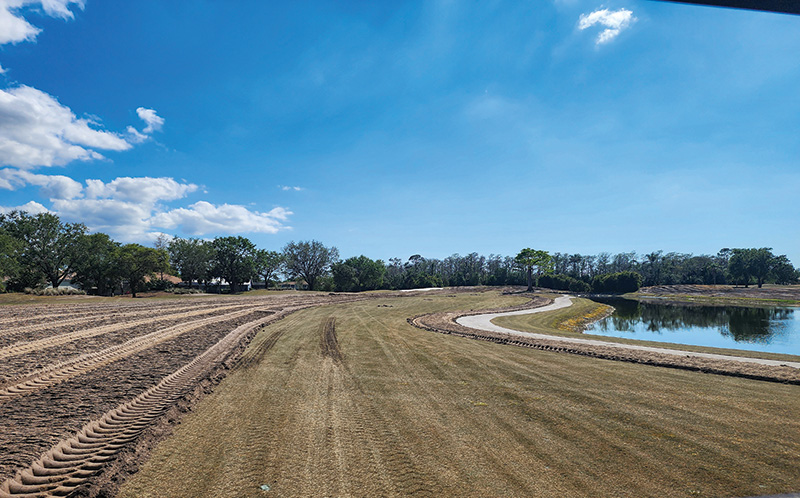
Conditions after second spray and after Bo mag roto cultivation.
More than three years later
The real measure of a turf-conversion program is not how the golf course looks immediately after grow-in. It is what happens years later. Today, after more than three years of growth, we have not seen any new growth or reemergence of the old seashore paspalum, Celebration bermudagrass or common bermudagrass within the converted turf areas.
To my knowledge, achieving true complete elimination of existing warm-season turf during a golf course conversion has rarely, if ever, been documented. Industry guidance has traditionally suggested that complete elimination is an unrealistic expectation.
Our objective, however, was never 90% control. It was not 95%. It was not even 99%. The objective was complete elimination before regrassing. More than three years later, we have achieved what we set out to accomplish: a clean monostand of Bimini bermudagrass.
When a club is investing millions of dollars into a golf course renovation, accepting even a small percentage of contamination from the previous turf can create problems for years. Trying to selectively remove old turf from a newly established golf course is difficult, disruptive, expensive and, depending on the grasses involved, sometimes nearly impossible.The better opportunity is before the new turf ever goes down.
Repeating the process on the North Course
The South Course was not our only opportunity to put this approach to the test. During 2024 and 2025, we implemented the same fundamental turf-conversion process during the renovation and establishment of the North Course at Vineyards Country Club.
Again, the philosophy was straightforward: chemically treat the existing turf, use ryegrass to shade and further weaken the underlying plants, disintegrate the existing root mass during construction, and establish a clean monostand of the desired turf. The results were again outstanding, with no reemergence of the unwanted existing turf within the converted areas. Successfully repeating the process on a second golf course was important.
The South Course demonstrated that the approach could work. The North Course demonstrated that the results could be repeated. The overall transformation of Vineyards Country Club also received national recognition, including recognition by Golf Digest in 2025 as one of the year’s notable golf course transformations.
While that recognition encompassed much more than turf conversion alone, establishing clean, uniform stands of the desired turf was an important component of the finished product.Having the same elimination strategy produce outstanding results on two consecutive golf course renovations reinforces the central premise of this approach: investing the time and effort to eliminate the existing turf before regrassing can provide a cleaner and more sustainable result for the club.
Cost of doing it right
Some may look at the additional cost of overseeding with ryegrass and rotary tilling the golf course and question whether those expenses are necessary. Compared with an industry-standard approach of relying primarily on multiple herbicide applications, these additional steps can appear more expensive upfront. My response would be the opposite. The greater expense is failing to give the club a true monostand of the desired turf from the beginning.
When paspalum, common bermudagrass, or another unwanted turf survives a conversion, the club inherits a problem that can last for years. The agronomy team then spends additional labor, chemicals, time, and money attempting to suppress or selectively remove unwanted turf from the new variety. Even with those efforts, achieving complete separation after establishment can be extremely difficult. The problem can become so widespread that some in the industry jokingly refer to contaminated turf as “pasmudagrass”—paspalum and bermudagrass so intermingled that neither exists as the clean, defined stand originally intended.
When a club has invested millions of dollars in a renovation and selected a specific turf variety for its playing characteristics, appearance, and agronomic benefits, the goal should be to deliver exactly that turf. The additional investment in ryegrass and rotary tilling should therefore be viewed as protecting the club’s long-term investment, not simply as an additional renovation expense. Spending more during the elimination phase to establish a clean monostand can ultimately cost far less than spending years attempting to manage contamination after the golf course has reopened.
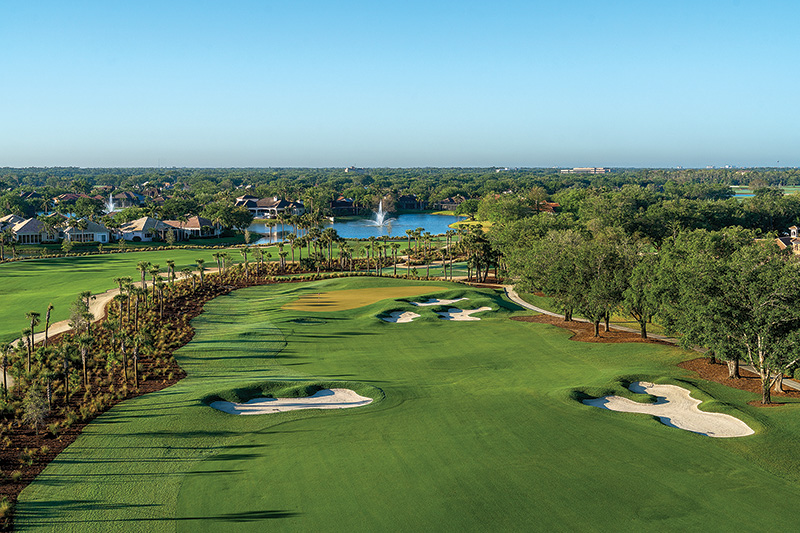
Hole No. 17 on North Course (after) with new mono stand of Bimini bermuda grass.
A different way to think about turf conversion
My experience at Vineyards reinforced my belief that turf conversion should not be viewed as simply spraying the golf course with herbicide and then beginning construction. It should be treated as a separate agronomic phase of the renovation.
- Sept. 4, 2022: Scalp existing turf to 0.500 inch.
- Sept. 18, 2022: Apply glyphosate at 6 qt/acre plus triclopyr at 32 oz/acre.
- Oct. 2, 2022: Overseed perennial ryegrass at 600 lb/acre to provide winter playability while creating a dense canopy to shade and further weaken the underlying warm-season turf.
- Maintain ryegrass through the winter at approximately 0.600 inch on tees and fairways and 1.5 inches in the rough.
- March 11, 2023: Scalp ryegrass rough to 0.600 inch.
- March 15, 2023: Make the second and final herbicide application of glyphosate at 6 qt/acre, triclopyr at 32 oz/acre, and Fusilade at 24 oz/acre.
- March 20, 2023: Begin construction using a BOMAG rotary tiller to disintegrate the existing root mass rather than stripping and burying the turf.
- Immediately before regrassing, apply Ronstar FLO at 122 oz/acre.
- July 4, 2023: Begin establishment of Bimini bermudagrass—18 acres of sod and 92 acres sprigged at approximately 800 bushels per acre.
The concept behind the program is straightforward: Chemically treat it. Shade and weaken it. Disintegrate the root mass. Eliminate the old turf. Then regrass.
Every golf course renovation is different, and any pesticide program must follow the current product label and applicable regulations. Turf species, climate, soil conditions, construction schedules, and available products all influence the final program. But the principle remains the same: Do not let construction hide the problem. Eliminate the existing turf before establishing the new variety.
After more than three decades in this business and eight major golf course renovations, I believe the preparation that occurs before the first piece of new turf is installed can be just as important as the grow-in that follows. We have now used this approach on two golf course renovations at Vineyards Country Club with the same outstanding result: clean stands of the desired turf without reemergence of the varieties we set out to eliminate. For me, that is the proof. Make elimination its own phase of the renovation — and do not regrass until you are confident the old turf is truly gone.
Billy Huskins, CGCS, is the Director of Agronomy at Vineyards Country Club in Naples, Fla., and a 1992 graduate of North Carolina State University with a background in agronomy and business.