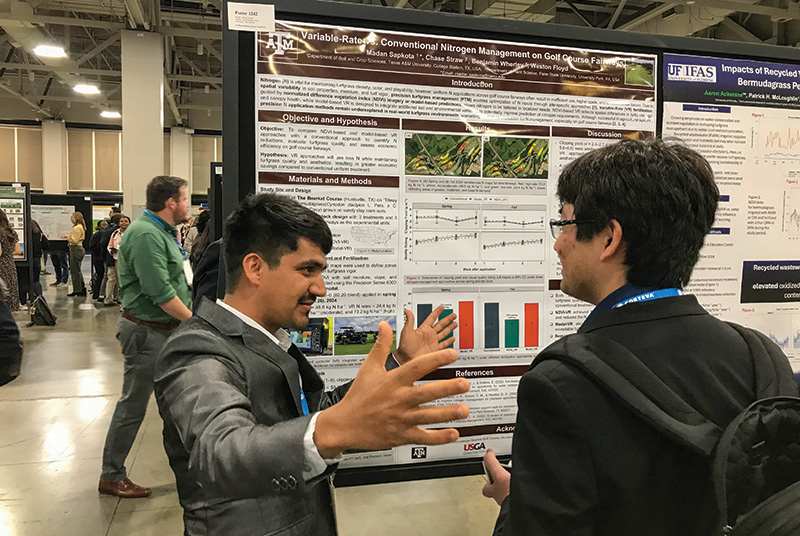
Madan Sapkota, Ph.D., explains a research project on nitrogen fertilization managment Photos by Darrell J. Pehr
Variable-rate versus conventional nitrogen management on golf course fairways
Nitrogen (N) is essential for turfgrass growth and quality, yet increasing pressure to reduce inputs has accelerated the adoption of precision N management strategies in turfgrass systems. This study aimed to develop variable-rate (VR) N prescription maps and evaluate their effectiveness, comparing them with a conventional uniform approach on nine hybrid bermudagrass fairways (three replicated blocks). Treatments were: conventional; normalized difference vegetation index guided VR (NDVI-VR) from UAV imagery; and a model-VR integrating NDVI, slope, volumetric water content and penetration resistance via K-means clustering to fixed site-specific management units. VR used three N classes at 21.8, 43.5 and 65.3 pounds nitrogen per acre (24.4, 48.8 and 73.2 kilograms per hectare) for low, moderate and high N classes. Polymer-coated urea (slow-release) was applied once in spring 2024 and again in fall 2024, using NDVI- and model-based prescription maps generated for spring and updated for fall and deployed using a Ninja GNSS-guided spreader. NDVI, visual turfgrass quality and clipping yield were measured at one, two, four and eight weeks post-application and analyzed using a linear mixed-effects model, with replication as a random effect, and treatment, season and week as fixed effects, with week treated as a repeated measure.
Across most of the variables, season and week were dominated factors for full variation; treatment effects on turfgrass quality were not significant, indicating no quality reduction for VR. NDVI-VR reduced N by about 13% in spring and 36% in fall (≈$138/acre and $385/acre or $56/hectare and $156/hectare at $19.44 per pound N or $8.82 per kilogram), with the largest reductions after the fall map update. Model-VR maintained quality but remained within ~±3% of conventional approach in total N. The model-based approach is promising but requires goal-aligned calibration (e.g., minimizing N subject to a quality margin) and seasonal retuning. These results suggest that VR fertilization on golf fairways could reduce N inputs while maintaining turfgrass quality, especially when prescriptions are updated each season.
— Madan Sapkota, Ph.D. (madan.sapkota@tamu.edu); Benjamin Wherley, Ph.D.; and Weston Floyd, Texas A&M University, College Station; and Chase Straw, Ph.D., Pennsylvania State University, University Park
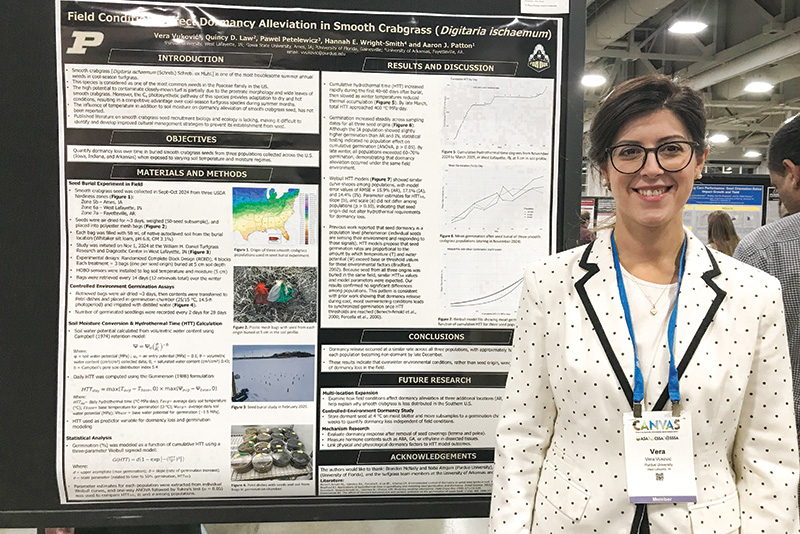
Vera Vukovic
Field conditions affect dormancy alleviation in smooth crabgrass (Digitaria ischaemum)
Smooth crabgrass [Digitaria ischaemum (Schreb.) Schreb. ex Muhl.] is a widespread annual weed in turfgrass systems, yet the environmental effects on dormancy release remain poorly understood. To evaluate how field conditions influence dormancy release, a seed burial experiment was initiated in November 2024 using three populations originating from Arkansas, Indiana and Iowa. Mesh bags containing 50 seeds per population were buried at a 2-inch (5-centimeter) depth in native soil at the William H. Daniel Turfgrass Research and Diagnostic Center in West Lafayette, Ind. Experimental design was a randomized complete block with four replications. Bags were retrieved every 14 days through March 2025, and germination was quantified under controlled conditions (77/59 F, 25/15 C; 14.5-hour photoperiod) for 28 days. Soil temperature and volumetric water content were logged continuously, and cumulative hydrothermal time (HTT) was calculated from daily soil temperature and water potential.
Cumulative HTT increased rapidly through early winter before slowing during freeze periods, reaching ~752 F/400 C MP a day by late March. Germination increased steadily across retrieval dates, with all three populations reaching 60%-70% germination by the end of winter. Weibull HTT models showed no significant population differences in HTT₅₀ and curve slope (b) (p > 0.10), indicating that seed origin did not affect hydrothermal requirements for dormancy alleviation under the same field environment. These findings suggest that overwinter soil conditions, rather than population origin, are the primary driver of dormancy loss in smooth crabgrass. Data from additional burial sites in Arkansas, Florida and Iowa are being analyzed to assess whether this pattern is consistent across climates.
— Vera Vukovic (vvukovic@purdue.edu) and Aaron J. Patton, Ph.D., Purdue University, West Lafayette, Ind.; Quincy Law, Ph.D., Iowa State University, Ames; Pawel Petelewicz, University of Florida, Gainesville; and Hannah Wright-Smith, Ph.D., University of Arkansas, Fayetteville
Darrell J. Pehr (dpehr@gcsaa.org) is GCM’s science editor.